

ENOLS AND ENOLIZATION
355
HO
H
O
H
O
O
H
H
H
H
pregnenolone
progesterone
corticosteroids
NAD
+
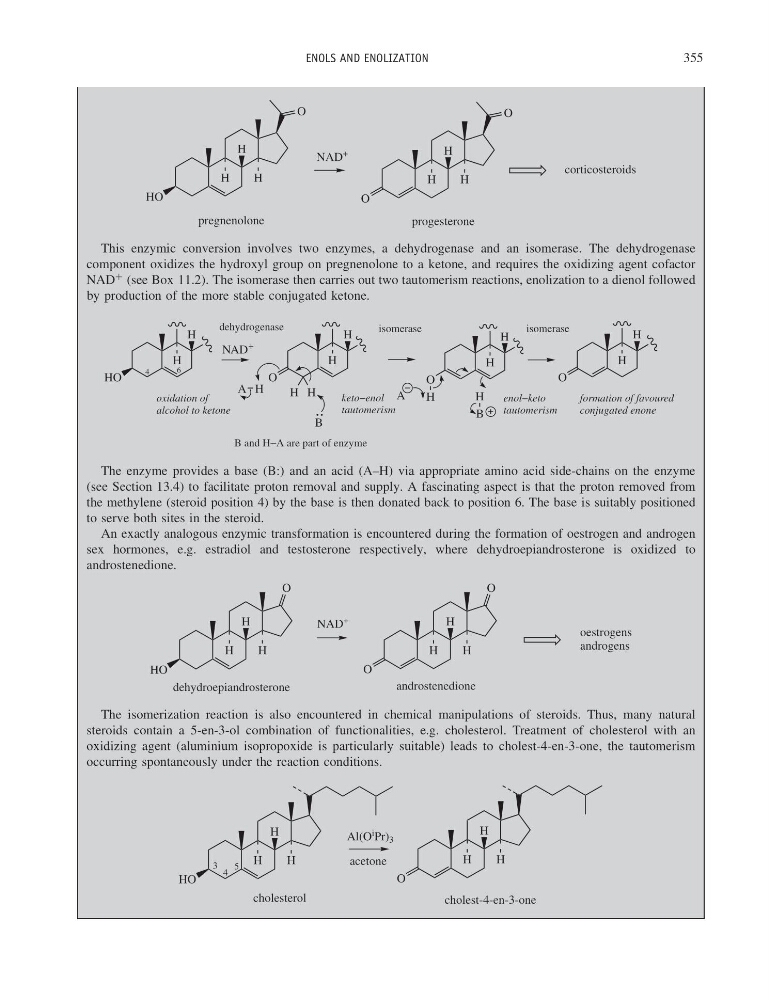
This enzymic conversion involves two enzymes, a dehydrogenase and an isomerase. The dehydrogenase
component oxidizes the hydroxyl group on pregnenolone to a ketone, and requires the oxidizing agent cofactor
NAD
+ (see Box 11.2). The isomerase then carries out two tautomerism reactions, enolization to a dienol followed
by production of the more stable conjugated ketone.
O
H
H
O
H
H
keto−enol
tautomerism
enol−keto
tautomerism
HO
H
H
H H
B
A H
A
H
H
B
O
H
H
oxidation of
alcohol to ketone
dehydrogenase
isomerase
4
6
isomerase
formation of favoured
conjugated enone
B and H−A are part of enzyme
NAD
+
The enzyme provides a base (B:) and an acid (A–H) via appropriate amino acid side-chains on the enzyme
(see Section 13.4) to facilitate proton removal and supply. A fascinating aspect is that the proton removed from
the methylene (steroid position 4) by the base is then donated back to position 6. The base is suitably positioned
to serve both sites in the steroid.
An exactly analogous enzymic transformation is encountered during the formation of oestrogen and androgen
sex hormones, e.g. estradiol and testosterone respectively, where dehydroepiandrosterone is oxidized to
androstenedione.
O
H
H
H
O
androstenedione
HO
H
H
H
O
dehydroepiandrosterone
oestrogens
androgens
NAD
+
The isomerization reaction is also encountered in chemical manipulations of steroids. Thus, many natural
steroids contain a 5-en-3-ol combination of functionalities, e.g. cholesterol. Treatment of cholesterol with an
oxidizing agent (aluminium isopropoxide is particularly suitable) leads to cholest-4-en-3-one, the tautomerism
occurring spontaneously under the reaction conditions.
HO
H
H
H
cholesterol
O
H
H
H
cholest-4-en-3-one
3
4
5
acetone
Al(O i Pr) 3
355
HO
H
O
H
O
O
H
H
H
H
pregnenolone
progesterone
corticosteroids
NAD
+
This enzymic conversion involves two enzymes, a dehydrogenase and an isomerase. The dehydrogenase
component oxidizes the hydroxyl group on pregnenolone to a ketone, and requires the oxidizing agent cofactor
NAD
+ (see Box 11.2). The isomerase then carries out two tautomerism reactions, enolization to a dienol followed
by production of the more stable conjugated ketone.
O
H
H
O
H
H
keto−enol
tautomerism
enol−keto
tautomerism
HO
H
H
H H
B
A H
A
H
H
B
O
H
H
oxidation of
alcohol to ketone
dehydrogenase
isomerase
4
6
isomerase
formation of favoured
conjugated enone
B and H−A are part of enzyme
NAD
+
The enzyme provides a base (B:) and an acid (A–H) via appropriate amino acid side-chains on the enzyme
(see Section 13.4) to facilitate proton removal and supply. A fascinating aspect is that the proton removed from
the methylene (steroid position 4) by the base is then donated back to position 6. The base is suitably positioned
to serve both sites in the steroid.
An exactly analogous enzymic transformation is encountered during the formation of oestrogen and androgen
sex hormones, e.g. estradiol and testosterone respectively, where dehydroepiandrosterone is oxidized to
androstenedione.
O
H
H
H
O
androstenedione
HO
H
H
H
O
dehydroepiandrosterone
oestrogens
androgens
NAD
+
The isomerization reaction is also encountered in chemical manipulations of steroids. Thus, many natural
steroids contain a 5-en-3-ol combination of functionalities, e.g. cholesterol. Treatment of cholesterol with an
oxidizing agent (aluminium isopropoxide is particularly suitable) leads to cholest-4-en-3-one, the tautomerism
occurring spontaneously under the reaction conditions.
HO
H
H
H
cholesterol
O
H
H
H
cholest-4-en-3-one
3
4
5
acetone
Al(O i Pr) 3