

354
NUCLEOPHILIC REACTIONS INVOLVING ENOLATE ANIONS
Box 10.2 (continued)
favoured conformer; large
substituent equatorial
O
H
OH
H
OH 2
OH
enol function planar
H
O
favoured conformer;
both substituents
equatorial
H
acid-catalysed
enol formation
isodihydrocarvone
dihydrocarvone
10.1.3 Conjugation
When an enol tautomer reverts back to a keto tautomer, it must acquire a proton, and we have already
seen that it may be acquired from different faces of
the double bond, giving two types of stereochemistry.
In the example described in Box 10.2, the stereochemistry of the product was effectively dictated by
the existing chirality at a second centre. Now we
can see a further variant, in that the stability of the
product dictates that an alternative carbon in the enol
tautomer actually receives the proton. This relates to
conjugation in the product.
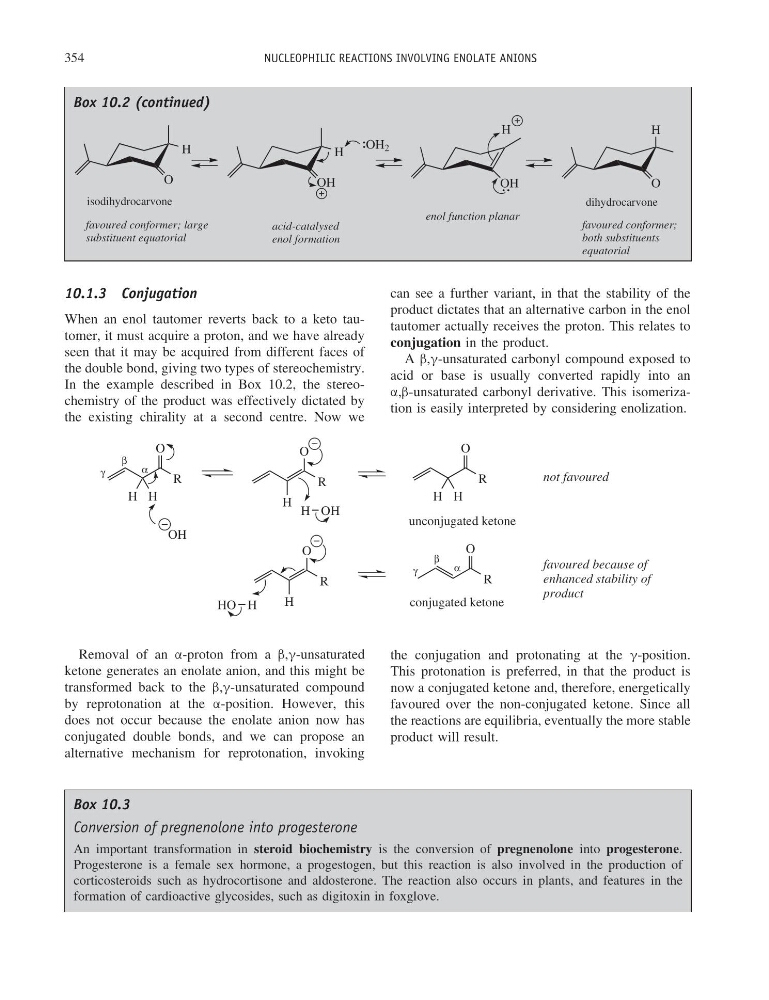
A β,γ-unsaturated carbonyl compound exposed to
acid or base is usually converted rapidly into an
α,β-unsaturated carbonyl derivative. This isomerization is easily interpreted by considering enolization.
R
O
H
H
α
β
γ
OH
R
O
H H OH
R
O
H
H
R
O
H
H
HO
R
O
unconjugated ketone
conjugated ketone
α
β
γ
not favoured
favoured because of
enhanced stability of
product
Removal of an α-proton from a β,γ-unsaturated
ketone generates an enolate anion, and this might be
transformed back to the β,γ-unsaturated compound
by reprotonation at the α-position. However, this
does not occur because the enolate anion now has
conjugated double bonds, and we can propose an
alternative mechanism for reprotonation, invoking
the conjugation and protonating at the γ-position.
This protonation is preferred, in that the product is
now a conjugated ketone and, therefore, energetically
favoured over the non-conjugated ketone. Since all
the reactions are equilibria, eventually the more stable
product will result.
Box 10.3
Conversion of pregnenolone into progesterone
An important transformation in steroid biochemistry is the conversion of pregnenolone into progesterone.
Progesterone is a female sex hormone, a progestogen, but this reaction is also involved in the production of
corticosteroids such as hydrocortisone and aldosterone. The reaction also occurs in plants, and features in the
formation of cardioactive glycosides, such as digitoxin in foxglove.
NUCLEOPHILIC REACTIONS INVOLVING ENOLATE ANIONS
Box 10.2 (continued)
favoured conformer; large
substituent equatorial
O
H
OH
H
OH 2
OH
enol function planar
H
O
favoured conformer;
both substituents
equatorial
H
acid-catalysed
enol formation
isodihydrocarvone
dihydrocarvone
10.1.3 Conjugation
When an enol tautomer reverts back to a keto tautomer, it must acquire a proton, and we have already
seen that it may be acquired from different faces of
the double bond, giving two types of stereochemistry.
In the example described in Box 10.2, the stereochemistry of the product was effectively dictated by
the existing chirality at a second centre. Now we
can see a further variant, in that the stability of the
product dictates that an alternative carbon in the enol
tautomer actually receives the proton. This relates to
conjugation in the product.
A β,γ-unsaturated carbonyl compound exposed to
acid or base is usually converted rapidly into an
α,β-unsaturated carbonyl derivative. This isomerization is easily interpreted by considering enolization.
R
O
H
H
α
β
γ
OH
R
O
H H OH
R
O
H
H
R
O
H
H
HO
R
O
unconjugated ketone
conjugated ketone
α
β
γ
not favoured
favoured because of
enhanced stability of
product
Removal of an α-proton from a β,γ-unsaturated
ketone generates an enolate anion, and this might be
transformed back to the β,γ-unsaturated compound
by reprotonation at the α-position. However, this
does not occur because the enolate anion now has
conjugated double bonds, and we can propose an
alternative mechanism for reprotonation, invoking
the conjugation and protonating at the γ-position.
This protonation is preferred, in that the product is
now a conjugated ketone and, therefore, energetically
favoured over the non-conjugated ketone. Since all
the reactions are equilibria, eventually the more stable
product will result.
Box 10.3
Conversion of pregnenolone into progesterone
An important transformation in steroid biochemistry is the conversion of pregnenolone into progesterone.
Progesterone is a female sex hormone, a progestogen, but this reaction is also involved in the production of
corticosteroids such as hydrocortisone and aldosterone. The reaction also occurs in plants, and features in the
formation of cardioactive glycosides, such as digitoxin in foxglove.