

ENOLS AND ENOLIZATION
353
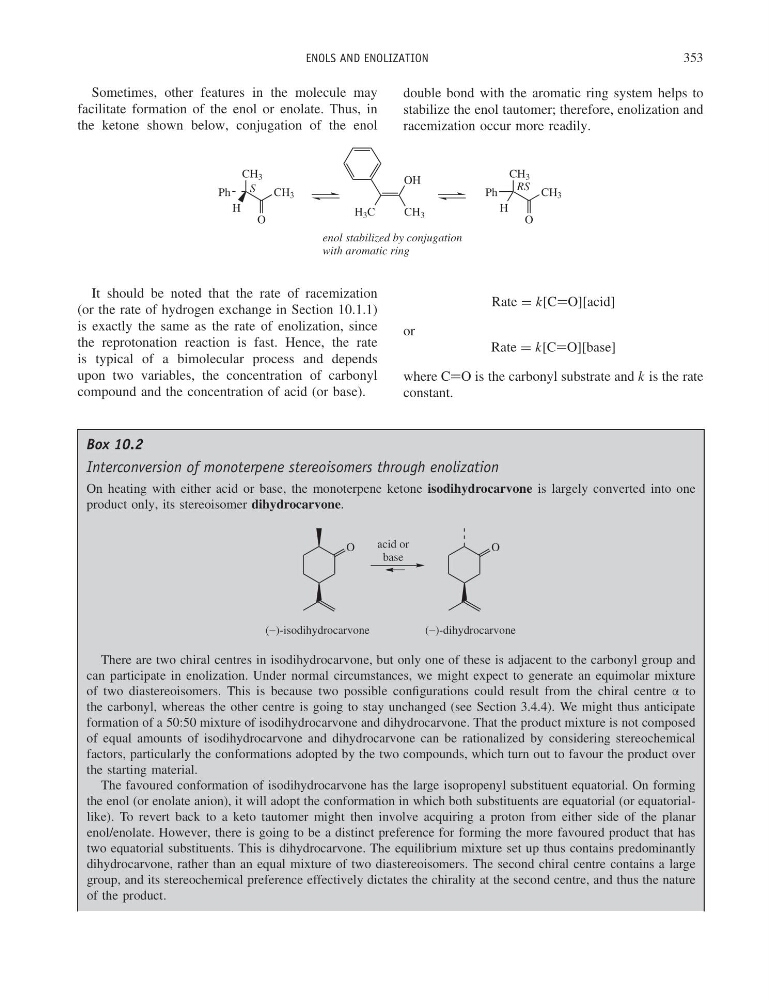
Sometimes, other features in the molecule may
facilitate formation of the enol or enolate. Thus, in
the ketone shown below, conjugation of the enol
double bond with the aromatic ring system helps to
stabilize the enol tautomer; therefore, enolization and
racemization occur more readily.
OH
CH 3
H 3 C
CH 3
H
Ph
CH 3
O
CH 3
H
Ph
CH 3
O
RS
S
enol stabilized by conjugation
with aromatic ring
It should be noted that the rate of racemization
(or the rate of hydrogen exchange in Section 10.1.1)
is exactly the same as the rate of enolization, since
the reprotonation reaction is fast. Hence, the rate
is typical of a bimolecular process and depends
upon two variables, the concentration of carbonyl
compound and the concentration of acid (or base).
Rate = k[C=O][acid]
or
Rate = k[C=O][base]
where C=O is the carbonyl substrate and k is the rate
constant.
Box 10.2
Interconversion of monoterpene stereoisomers through enolization
On heating with either acid or base, the monoterpene ketone isodihydrocarvone is largely converted into one
product only, its stereoisomer dihydrocarvone.
(−)-isodihydrocarvone
(−)-dihydrocarvone
O
O
acid or
base
There are two chiral centres in isodihydrocarvone, but only one of these is adjacent to the carbonyl group and
can participate in enolization. Under normal circumstances, we might expect to generate an equimolar mixture
of two diastereoisomers. This is because two possible configurations could result from the chiral centre α to
the carbonyl, whereas the other centre is going to stay unchanged (see Section 3.4.4). We might thus anticipate
formation of a 50:50 mixture of isodihydrocarvone and dihydrocarvone. That the product mixture is not composed
of equal amounts of isodihydrocarvone and dihydrocarvone can be rationalized by considering stereochemical
factors, particularly the conformations adopted by the two compounds, which turn out to favour the product over
the starting material.
The favoured conformation of isodihydrocarvone has the large isopropenyl substituent equatorial. On forming
the enol (or enolate anion), it will adopt the conformation in which both substituents are equatorial (or equatoriallike). To revert back to a keto tautomer might then involve acquiring a proton from either side of the planar
enol/enolate. However, there is going to be a distinct preference for forming the more favoured product that has
two equatorial substituents. This is dihydrocarvone. The equilibrium mixture set up thus contains predominantly
dihydrocarvone, rather than an equal mixture of two diastereoisomers. The second chiral centre contains a large
group, and its stereochemical preference effectively dictates the chirality at the second centre, and thus the nature
of the product.
353
Sometimes, other features in the molecule may
facilitate formation of the enol or enolate. Thus, in
the ketone shown below, conjugation of the enol
double bond with the aromatic ring system helps to
stabilize the enol tautomer; therefore, enolization and
racemization occur more readily.
OH
CH 3
H 3 C
CH 3
H
Ph
CH 3
O
CH 3
H
Ph
CH 3
O
RS
S
enol stabilized by conjugation
with aromatic ring
It should be noted that the rate of racemization
(or the rate of hydrogen exchange in Section 10.1.1)
is exactly the same as the rate of enolization, since
the reprotonation reaction is fast. Hence, the rate
is typical of a bimolecular process and depends
upon two variables, the concentration of carbonyl
compound and the concentration of acid (or base).
Rate = k[C=O][acid]
or
Rate = k[C=O][base]
where C=O is the carbonyl substrate and k is the rate
constant.
Box 10.2
Interconversion of monoterpene stereoisomers through enolization
On heating with either acid or base, the monoterpene ketone isodihydrocarvone is largely converted into one
product only, its stereoisomer dihydrocarvone.
(−)-isodihydrocarvone
(−)-dihydrocarvone
O
O
acid or
base
There are two chiral centres in isodihydrocarvone, but only one of these is adjacent to the carbonyl group and
can participate in enolization. Under normal circumstances, we might expect to generate an equimolar mixture
of two diastereoisomers. This is because two possible configurations could result from the chiral centre α to
the carbonyl, whereas the other centre is going to stay unchanged (see Section 3.4.4). We might thus anticipate
formation of a 50:50 mixture of isodihydrocarvone and dihydrocarvone. That the product mixture is not composed
of equal amounts of isodihydrocarvone and dihydrocarvone can be rationalized by considering stereochemical
factors, particularly the conformations adopted by the two compounds, which turn out to favour the product over
the starting material.
The favoured conformation of isodihydrocarvone has the large isopropenyl substituent equatorial. On forming
the enol (or enolate anion), it will adopt the conformation in which both substituents are equatorial (or equatoriallike). To revert back to a keto tautomer might then involve acquiring a proton from either side of the planar
enol/enolate. However, there is going to be a distinct preference for forming the more favoured product that has
two equatorial substituents. This is dihydrocarvone. The equilibrium mixture set up thus contains predominantly
dihydrocarvone, rather than an equal mixture of two diastereoisomers. The second chiral centre contains a large
group, and its stereochemical preference effectively dictates the chirality at the second centre, and thus the nature
of the product.