

ENOLATE ANIONS FROM CARBOXYLIC ACID DERIVATIVES
375
Box 10.9
Racemization of hyoscyamine to atropine
The base-catalysed racemization of the alkaloid (−)-hyoscyamine to (±)-hyoscyamine (atropine) is an
example of enolate anion participation. Alkaloids are normally extracted from plants by using base, thus
liberating the free alkaloid bases from salt combinations. (−)-Hyoscyamine is found in belladonna (Atropa
belladonna) and stramonium (Datura stramonium) and is used medicinally as an anticholinergic. It competes
with acetylcholine for the muscarinic site of the parasympathetic nervous system, thus preventing the passage of
nerve impulses. However, with careless extraction using too much base the product isolated is atropine, which
has only half the biological activity of (−)-hyoscyamine, since the enantiomer (+)-hyoscyamine is essentially
inactive.
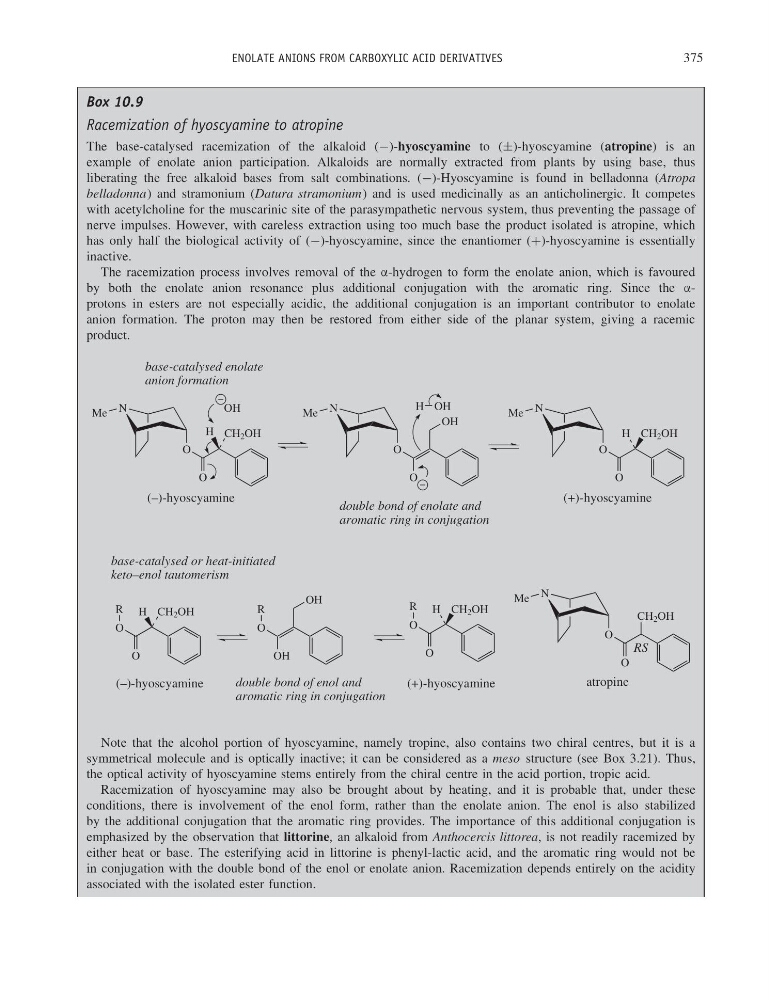
The racemization process involves removal of the α-hydrogen to form the enolate anion, which is favoured
by both the enolate anion resonance plus additional conjugation with the aromatic ring. Since the αprotons in esters are not especially acidic, the additional conjugation is an important contributor to enolate
anion formation. The proton may then be restored from either side of the planar system, giving a racemic
product.
O
O
R
O
O
R
O
OH
OH
H CH 2 OH
H CH 2 OH
(–)-hyoscyamine
(+)-hyoscyamine
base-catalysed or heat-initiated
keto–enol tautomerism
double bond of enol and
aromatic ring in conjugation
N
Me
O
O
N
Me
O
O
N
Me
O
OH
O
H CH 2 OH
H CH 2 OH
(–)-hyoscyamine
(+)-hyoscyamine
OH
H OH
double bond of enolate and
aromatic ring in conjugation
R
N
Me
O
O
CH 2 OH
RS
atropine
base-catalysed enolate
anion formation
Note that the alcohol portion of hyoscyamine, namely tropine, also contains two chiral centres, but it is a
symmetrical molecule and is optically inactive; it can be considered as a meso structure (see Box 3.21). Thus,
the optical activity of hyoscyamine stems entirely from the chiral centre in the acid portion, tropic acid.
Racemization of hyoscyamine may also be brought about by heating, and it is probable that, under these
conditions, there is involvement of the enol form, rather than the enolate anion. The enol is also stabilized
by the additional conjugation that the aromatic ring provides. The importance of this additional conjugation is
emphasized by the observation that littorine, an alkaloid from Anthocercis littorea, is not readily racemized by
either heat or base. The esterifying acid in littorine is phenyl-lactic acid, and the aromatic ring would not be
in conjugation with the double bond of the enol or enolate anion. Racemization depends entirely on the acidity
associated with the isolated ester function.
375
Box 10.9
Racemization of hyoscyamine to atropine
The base-catalysed racemization of the alkaloid (−)-hyoscyamine to (±)-hyoscyamine (atropine) is an
example of enolate anion participation. Alkaloids are normally extracted from plants by using base, thus
liberating the free alkaloid bases from salt combinations. (−)-Hyoscyamine is found in belladonna (Atropa
belladonna) and stramonium (Datura stramonium) and is used medicinally as an anticholinergic. It competes
with acetylcholine for the muscarinic site of the parasympathetic nervous system, thus preventing the passage of
nerve impulses. However, with careless extraction using too much base the product isolated is atropine, which
has only half the biological activity of (−)-hyoscyamine, since the enantiomer (+)-hyoscyamine is essentially
inactive.
The racemization process involves removal of the α-hydrogen to form the enolate anion, which is favoured
by both the enolate anion resonance plus additional conjugation with the aromatic ring. Since the αprotons in esters are not especially acidic, the additional conjugation is an important contributor to enolate
anion formation. The proton may then be restored from either side of the planar system, giving a racemic
product.
O
O
R
O
O
R
O
OH
OH
H CH 2 OH
H CH 2 OH
(–)-hyoscyamine
(+)-hyoscyamine
base-catalysed or heat-initiated
keto–enol tautomerism
double bond of enol and
aromatic ring in conjugation
N
Me
O
O
N
Me
O
O
N
Me
O
OH
O
H CH 2 OH
H CH 2 OH
(–)-hyoscyamine
(+)-hyoscyamine
OH
H OH
double bond of enolate and
aromatic ring in conjugation
R
N
Me
O
O
CH 2 OH
RS
atropine
base-catalysed enolate
anion formation
Note that the alcohol portion of hyoscyamine, namely tropine, also contains two chiral centres, but it is a
symmetrical molecule and is optically inactive; it can be considered as a meso structure (see Box 3.21). Thus,
the optical activity of hyoscyamine stems entirely from the chiral centre in the acid portion, tropic acid.
Racemization of hyoscyamine may also be brought about by heating, and it is probable that, under these
conditions, there is involvement of the enol form, rather than the enolate anion. The enol is also stabilized
by the additional conjugation that the aromatic ring provides. The importance of this additional conjugation is
emphasized by the observation that littorine, an alkaloid from Anthocercis littorea, is not readily racemized by
either heat or base. The esterifying acid in littorine is phenyl-lactic acid, and the aromatic ring would not be
in conjugation with the double bond of the enol or enolate anion. Racemization depends entirely on the acidity
associated with the isolated ester function.