

348
NUCLEOPHILIC REACTIONS INVOLVING ENOLATE ANIONS
Table 10.1 Keto–enol equilibria
Keto tautomer
Enol tautomer
K =
[enol]
[keto]
% Enol
Acetaldehyde
H
O
H
OH
2 × 10
−5 (water)
2 × 10
−3
Acetone
O
OH
2.5 × 10
−6 (water)
2.5 × 10
−4
Cyclohexanone
O
OH
2 × 10
−4 (water)
0.02
Ethyl acetoacetate
OEt
O
O
OEt
OH O
4 × 10
−3 (water)
8.7 × 10
−2 (liquid)
0.85 (hexane)
0.4
46
8
Acetylacetone
O
O
OH O
0.25 (water)
11.5 (hexane)
3.2 (liquid)
20
92
76
Phenol
O
OH
>10
13 (water)
100
hydrogen bonding
leads to favourable
six-membered ring
keto form
enol form
enol form
formation of
conjugated system
H 3 C
CH 3
O
O
H 3 C
CH 3
O
O
acetylacetone
H
H H
H
H 2 C
CH 3
O
O
H H
H
lacks conjugation
H 3 C
CH 3
O
O
H
H
or
enol form
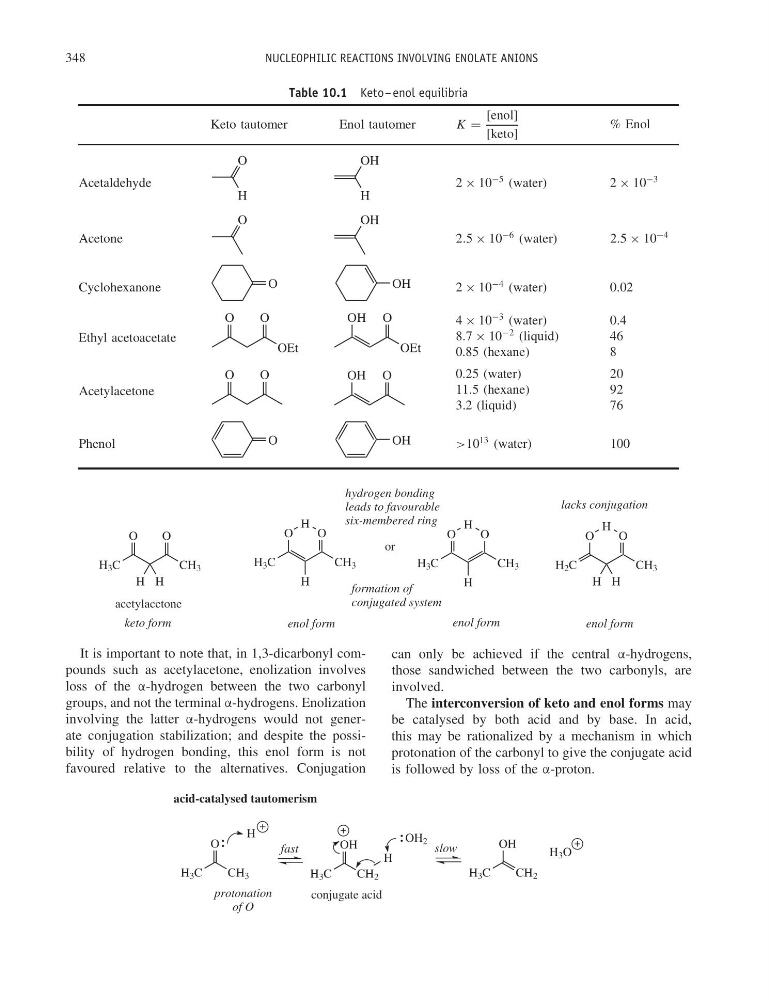
It is important to note that, in 1,3-dicarbonyl compounds such as acetylacetone, enolization involves
loss of the α-hydrogen between the two carbonyl
groups, and not the terminal α-hydrogens. Enolization
involving the latter α-hydrogens would not generate conjugation stabilization; and despite the possibility of hydrogen bonding, this enol form is not
favoured relative to the alternatives. Conjugation
can only be achieved if the central α-hydrogens,
those sandwiched between the two carbonyls, are
involved.
The interconversion of keto and enol forms may
be catalysed by both acid and by base. In acid,
this may be rationalized by a mechanism in which
protonation of the carbonyl to give the conjugate acid
is followed by loss of the α-proton.
acid-catalysed tautomerism
fast
slow
protonation
of O
conjugate acid
O
H 3 C
CH 3
OH
H 3 C
CH 2
H
H
OH
H 3 C
CH 2
H 3 O
OH 2
NUCLEOPHILIC REACTIONS INVOLVING ENOLATE ANIONS
Table 10.1 Keto–enol equilibria
Keto tautomer
Enol tautomer
K =
[enol]
[keto]
% Enol
Acetaldehyde
H
O
H
OH
2 × 10
−5 (water)
2 × 10
−3
Acetone
O
OH
2.5 × 10
−6 (water)
2.5 × 10
−4
Cyclohexanone
O
OH
2 × 10
−4 (water)
0.02
Ethyl acetoacetate
OEt
O
O
OEt
OH O
4 × 10
−3 (water)
8.7 × 10
−2 (liquid)
0.85 (hexane)
0.4
46
8
Acetylacetone
O
O
OH O
0.25 (water)
11.5 (hexane)
3.2 (liquid)
20
92
76
Phenol
O
OH
>10
13 (water)
100
hydrogen bonding
leads to favourable
six-membered ring
keto form
enol form
enol form
formation of
conjugated system
H 3 C
CH 3
O
O
H 3 C
CH 3
O
O
acetylacetone
H
H H
H
H 2 C
CH 3
O
O
H H
H
lacks conjugation
H 3 C
CH 3
O
O
H
H
or
enol form
It is important to note that, in 1,3-dicarbonyl compounds such as acetylacetone, enolization involves
loss of the α-hydrogen between the two carbonyl
groups, and not the terminal α-hydrogens. Enolization
involving the latter α-hydrogens would not generate conjugation stabilization; and despite the possibility of hydrogen bonding, this enol form is not
favoured relative to the alternatives. Conjugation
can only be achieved if the central α-hydrogens,
those sandwiched between the two carbonyls, are
involved.
The interconversion of keto and enol forms may
be catalysed by both acid and by base. In acid,
this may be rationalized by a mechanism in which
protonation of the carbonyl to give the conjugate acid
is followed by loss of the α-proton.
acid-catalysed tautomerism
fast
slow
protonation
of O
conjugate acid
O
H 3 C
CH 3
OH
H 3 C
CH 2
H
H
OH
H 3 C
CH 2
H 3 O
OH 2