

10
Nucleophilic reactions involving
enolate anions
10.1 Enols and enolization
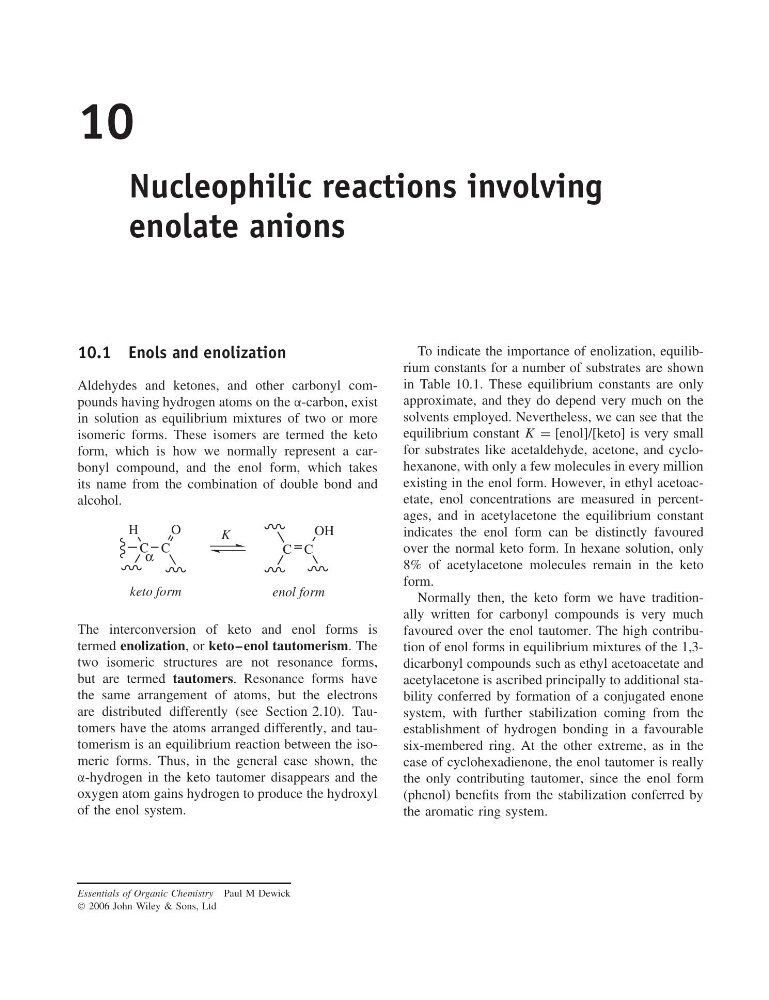
Aldehydes and ketones, and other carbonyl compounds having hydrogen atoms on the α-carbon, exist
in solution as equilibrium mixtures of two or more
isomeric forms. These isomers are termed the keto
form, which is how we normally represent a carbonyl compound, and the enol form, which takes
its name from the combination of double bond and
alcohol.
C C
OH
keto form
enol form
α
C C
O
H
K
The interconversion of keto and enol forms is
termed enolization, or keto–enol tautomerism. The
two isomeric structures are not resonance forms,
but are termed tautomers. Resonance forms have
the same arrangement of atoms, but the electrons
are distributed differently (see Section 2.10). Tautomers have the atoms arranged differently, and tautomerism is an equilibrium reaction between the isomeric forms. Thus, in the general case shown, the
α-hydrogen in the keto tautomer disappears and the
oxygen atom gains hydrogen to produce the hydroxyl
of the enol system.
To indicate the importance of enolization, equilibrium constants for a number of substrates are shown
in Table 10.1. These equilibrium constants are only
approximate, and they do depend very much on the
solvents employed. Nevertheless, we can see that the
equilibrium constant K = [enol]/[keto] is very small
for substrates like acetaldehyde, acetone, and cyclohexanone, with only a few molecules in every million
existing in the enol form. However, in ethyl acetoacetate, enol concentrations are measured in percentages, and in acetylacetone the equilibrium constant
indicates the enol form can be distinctly favoured
over the normal keto form. In hexane solution, only
8% of acetylacetone molecules remain in the keto
form.
Normally then, the keto form we have traditionally written for carbonyl compounds is very much
favoured over the enol tautomer. The high contribution of enol forms in equilibrium mixtures of the 1,3dicarbonyl compounds such as ethyl acetoacetate and
acetylacetone is ascribed principally to additional stability conferred by formation of a conjugated enone
system, with further stabilization coming from the
establishment of hydrogen bonding in a favourable
six-membered ring. At the other extreme, as in the
case of cyclohexadienone, the enol tautomer is really
the only contributing tautomer, since the enol form
(phenol) benefits from the stabilization conferred by
the aromatic ring system.
Essentials of Organic Chemistry Paul M Dewick
2006 John Wiley & Sons, Ltd
Nucleophilic reactions involving
enolate anions
10.1 Enols and enolization
Aldehydes and ketones, and other carbonyl compounds having hydrogen atoms on the α-carbon, exist
in solution as equilibrium mixtures of two or more
isomeric forms. These isomers are termed the keto
form, which is how we normally represent a carbonyl compound, and the enol form, which takes
its name from the combination of double bond and
alcohol.
C C
OH
keto form
enol form
α
C C
O
H
K
The interconversion of keto and enol forms is
termed enolization, or keto–enol tautomerism. The
two isomeric structures are not resonance forms,
but are termed tautomers. Resonance forms have
the same arrangement of atoms, but the electrons
are distributed differently (see Section 2.10). Tautomers have the atoms arranged differently, and tautomerism is an equilibrium reaction between the isomeric forms. Thus, in the general case shown, the
α-hydrogen in the keto tautomer disappears and the
oxygen atom gains hydrogen to produce the hydroxyl
of the enol system.
To indicate the importance of enolization, equilibrium constants for a number of substrates are shown
in Table 10.1. These equilibrium constants are only
approximate, and they do depend very much on the
solvents employed. Nevertheless, we can see that the
equilibrium constant K = [enol]/[keto] is very small
for substrates like acetaldehyde, acetone, and cyclohexanone, with only a few molecules in every million
existing in the enol form. However, in ethyl acetoacetate, enol concentrations are measured in percentages, and in acetylacetone the equilibrium constant
indicates the enol form can be distinctly favoured
over the normal keto form. In hexane solution, only
8% of acetylacetone molecules remain in the keto
form.
Normally then, the keto form we have traditionally written for carbonyl compounds is very much
favoured over the enol tautomer. The high contribution of enol forms in equilibrium mixtures of the 1,3dicarbonyl compounds such as ethyl acetoacetate and
acetylacetone is ascribed principally to additional stability conferred by formation of a conjugated enone
system, with further stabilization coming from the
establishment of hydrogen bonding in a favourable
six-membered ring. At the other extreme, as in the
case of cyclohexadienone, the enol tautomer is really
the only contributing tautomer, since the enol form
(phenol) benefits from the stabilization conferred by
the aromatic ring system.
Essentials of Organic Chemistry Paul M Dewick
2006 John Wiley & Sons, Ltd