

ENOLS AND ENOLIZATION
349
It is important to appreciate the role of the solvent in
this transformation, removing and supplying protons,
and to understand that tautomerism is not merely
transfer of a proton from the α-carbon to the carbonyl
oxygen. The rate-determining step in tautomerism
will be removal of the α-hydrogen; protonation of
the carbonyl (formation of the conjugate acid) can be
considered rapid.
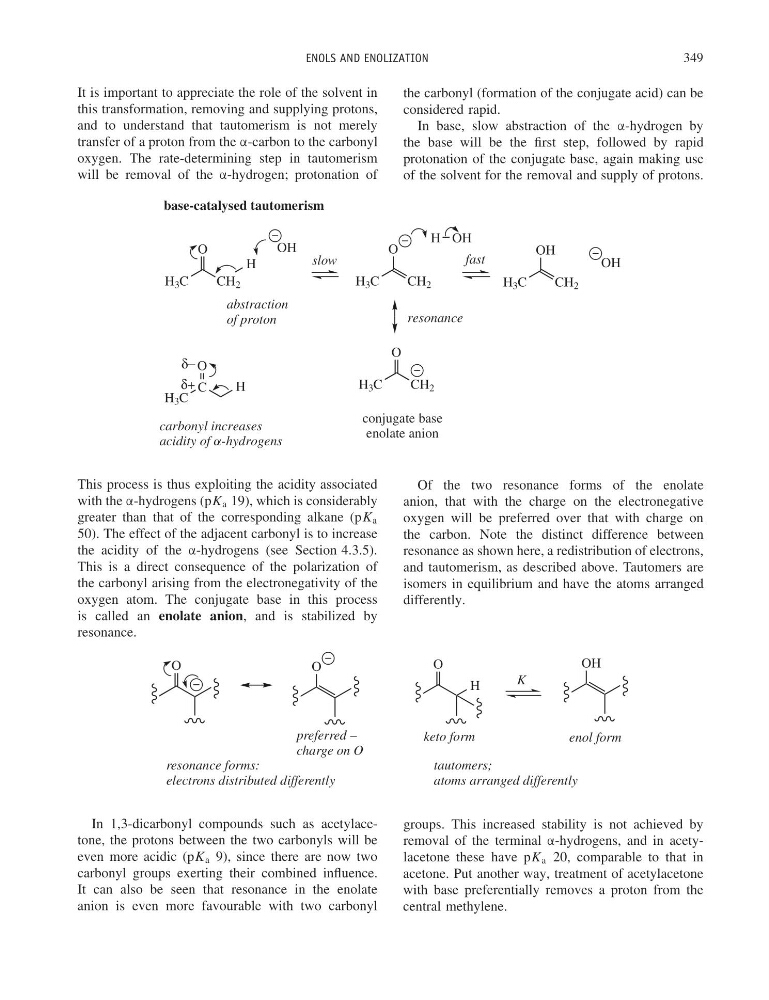
In base, slow abstraction of the α-hydrogen by
the base will be the first step, followed by rapid
protonation of the conjugate base, again making use
of the solvent for the removal and supply of protons.
H OH
base-catalysed tautomerism
fast
slow
conjugate base
enolate anion
abstraction
of proton
O
H 3 C
CH 2
H
OH
O
H 3 C
CH 2
resonance
O
H 3 C
CH 2
OH
H 3 C
CH 2
OH
C
O
H 3 C
H
δ+
δ−
carbonyl increases
acidity of a-hydrogens
This process is thus exploiting the acidity associated
with the α-hydrogens (pK a 19), which is considerably
greater than that of the corresponding alkane (pK a
50). The effect of the adjacent carbonyl is to increase
the acidity of the α-hydrogens (see Section 4.3.5).
This is a direct consequence of the polarization of
the carbonyl arising from the electronegativity of the
oxygen atom. The conjugate base in this process
is called an enolate anion, and is stabilized by
resonance.
Of the two resonance forms of the enolate
anion, that with the charge on the electronegative
oxygen will be preferred over that with charge on
the carbon. Note the distinct difference between
resonance as shown here, a redistribution of electrons,
and tautomerism, as described above. Tautomers are
isomers in equilibrium and have the atoms arranged
differently.
resonance forms:
electrons distributed differently
preferred –
charge on O
O
O
keto form
enol form
O
H
OH
tautomers;
atoms arranged differently
K
In 1,3-dicarbonyl compounds such as acetylacetone, the protons between the two carbonyls will be
even more acidic (pK a 9), since there are now two
carbonyl groups exerting their combined influence.
It can also be seen that resonance in the enolate
anion is even more favourable with two carbonyl
groups. This increased stability is not achieved by
removal of the terminal α-hydrogens, and in acetylacetone these have pK a 20, comparable to that in
acetone. Put another way, treatment of acetylacetone
with base preferentially removes a proton from the
central methylene.
349
It is important to appreciate the role of the solvent in
this transformation, removing and supplying protons,
and to understand that tautomerism is not merely
transfer of a proton from the α-carbon to the carbonyl
oxygen. The rate-determining step in tautomerism
will be removal of the α-hydrogen; protonation of
the carbonyl (formation of the conjugate acid) can be
considered rapid.
In base, slow abstraction of the α-hydrogen by
the base will be the first step, followed by rapid
protonation of the conjugate base, again making use
of the solvent for the removal and supply of protons.
H OH
base-catalysed tautomerism
fast
slow
conjugate base
enolate anion
abstraction
of proton
O
H 3 C
CH 2
H
OH
O
H 3 C
CH 2
resonance
O
H 3 C
CH 2
OH
H 3 C
CH 2
OH
C
O
H 3 C
H
δ+
δ−
carbonyl increases
acidity of a-hydrogens
This process is thus exploiting the acidity associated
with the α-hydrogens (pK a 19), which is considerably
greater than that of the corresponding alkane (pK a
50). The effect of the adjacent carbonyl is to increase
the acidity of the α-hydrogens (see Section 4.3.5).
This is a direct consequence of the polarization of
the carbonyl arising from the electronegativity of the
oxygen atom. The conjugate base in this process
is called an enolate anion, and is stabilized by
resonance.
Of the two resonance forms of the enolate
anion, that with the charge on the electronegative
oxygen will be preferred over that with charge on
the carbon. Note the distinct difference between
resonance as shown here, a redistribution of electrons,
and tautomerism, as described above. Tautomers are
isomers in equilibrium and have the atoms arranged
differently.
resonance forms:
electrons distributed differently
preferred –
charge on O
O
O
keto form
enol form
O
H
OH
tautomers;
atoms arranged differently
K
In 1,3-dicarbonyl compounds such as acetylacetone, the protons between the two carbonyls will be
even more acidic (pK a 9), since there are now two
carbonyl groups exerting their combined influence.
It can also be seen that resonance in the enolate
anion is even more favourable with two carbonyl
groups. This increased stability is not achieved by
removal of the terminal α-hydrogens, and in acetylacetone these have pK a 20, comparable to that in
acetone. Put another way, treatment of acetylacetone
with base preferentially removes a proton from the
central methylene.