

ATOMIC ORBITALS
21
The second quantum number, the orbital angular
momentum quantum number l, is generally related
to the shape of the orbital and depends upon n, taking
integral values from 0 to n − 1. The different values
are always referred to by letters: s for l = 0, p for
l = 1, d for l = 2, and f for l = 3.
The third quantum number is related to the
orientation of the orbital in space. It is called the
magnetic quantum number m l , and depends upon
l. It can take integral values from −l to +l. For
p orbitals, suffix letters are used to define the
direction of the orbital along the x-, y-, or zaxes. Organic chemists seldom need to consider
subdivisions relating to d orbitals.
Finally, there is the spin quantum number s,
which may have only two values, i.e. ±
1
2
. This relates
to the angular momentum of an electron spinning on
its own axis. The magnitude of an electron’s spin is
constant, but it can take two orientations.
Table 2.1 shows the possible combinations of
quantum numbers for n = 1 to 3.
For a hydrogen atom, the lowest energy solution
of the wave equation describes a spherical region
about the nucleus, a 1s atomic orbital. When the
wave equation is solved to provide the next higher
energy level, we also get a spherical region of high
probability, but this 2s orbital is further away from
the nucleus than the 1s orbital. It also contains a
node, or point of zero probability within the sphere
Table 2.1 Quantum number combinations and atomic
orbitals
Principle
quantum
number
n
Orbital
angular
momentum
quantum
Magnetic
quantum
number
m l
Spin
quantum
number
s
Atomic
orbital
designation
number l
1
0
0
±1/2
1s
2
0
0
±1/2
2s
2
1
−1
±1/2
2p
2
1
0
±1/2
2p
2
1
+1
±1/2
2p
3
0
0
±1/2
3s
3
1
−1
±1/2
3p
3
1
0
±1/2
3p
3
1
+1
±1/2
3p
3
2
−2
±1/2
3d
3
2
−1
±1/2
3d
3
2
0
±1/2
3d
3
2
+1
±1/2
3d
3
2
+2
±1/2
3d
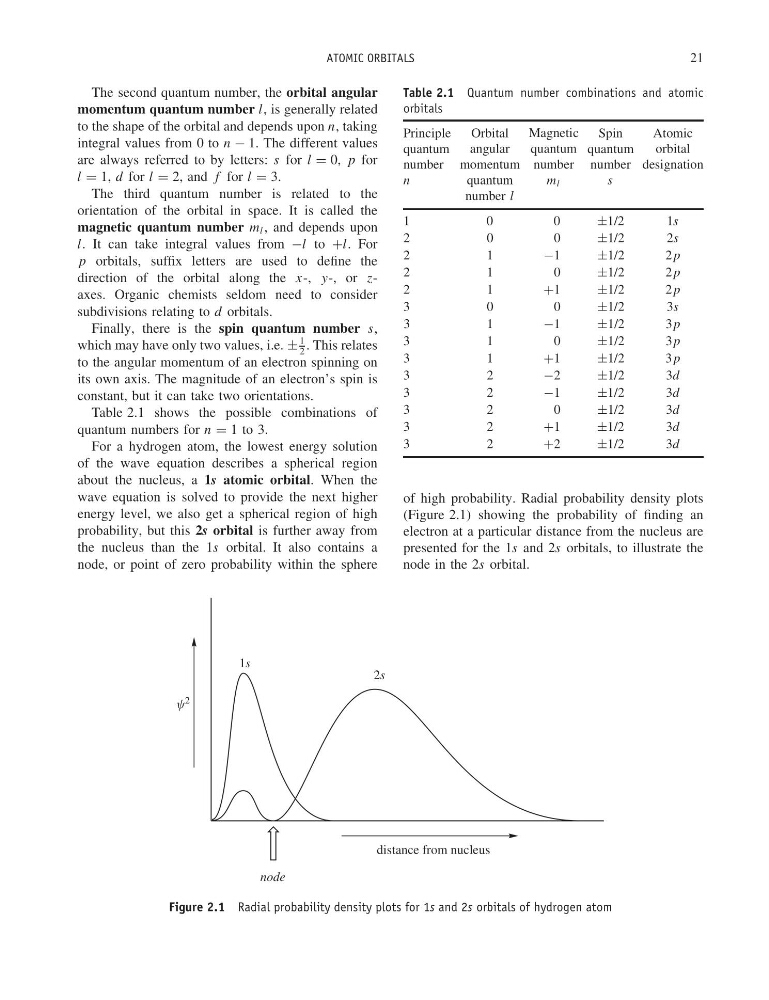
of high probability. Radial probability density plots
(Figure 2.1) showing the probability of finding an
electron at a particular distance from the nucleus are
presented for the 1s and 2s orbitals, to illustrate the
node in the 2s orbital.
y
2
distance from nucleus
1s
2s
node
Figure 2.1 Radial probability density plots for 1s and 2s orbitals of hydrogen atom
21
The second quantum number, the orbital angular
momentum quantum number l, is generally related
to the shape of the orbital and depends upon n, taking
integral values from 0 to n − 1. The different values
are always referred to by letters: s for l = 0, p for
l = 1, d for l = 2, and f for l = 3.
The third quantum number is related to the
orientation of the orbital in space. It is called the
magnetic quantum number m l , and depends upon
l. It can take integral values from −l to +l. For
p orbitals, suffix letters are used to define the
direction of the orbital along the x-, y-, or zaxes. Organic chemists seldom need to consider
subdivisions relating to d orbitals.
Finally, there is the spin quantum number s,
which may have only two values, i.e. ±
1
2
. This relates
to the angular momentum of an electron spinning on
its own axis. The magnitude of an electron’s spin is
constant, but it can take two orientations.
Table 2.1 shows the possible combinations of
quantum numbers for n = 1 to 3.
For a hydrogen atom, the lowest energy solution
of the wave equation describes a spherical region
about the nucleus, a 1s atomic orbital. When the
wave equation is solved to provide the next higher
energy level, we also get a spherical region of high
probability, but this 2s orbital is further away from
the nucleus than the 1s orbital. It also contains a
node, or point of zero probability within the sphere
Table 2.1 Quantum number combinations and atomic
orbitals
Principle
quantum
number
n
Orbital
angular
momentum
quantum
Magnetic
quantum
number
m l
Spin
quantum
number
s
Atomic
orbital
designation
number l
1
0
0
±1/2
1s
2
0
0
±1/2
2s
2
1
−1
±1/2
2p
2
1
0
±1/2
2p
2
1
+1
±1/2
2p
3
0
0
±1/2
3s
3
1
−1
±1/2
3p
3
1
0
±1/2
3p
3
1
+1
±1/2
3p
3
2
−2
±1/2
3d
3
2
−1
±1/2
3d
3
2
0
±1/2
3d
3
2
+1
±1/2
3d
3
2
+2
±1/2
3d
of high probability. Radial probability density plots
(Figure 2.1) showing the probability of finding an
electron at a particular distance from the nucleus are
presented for the 1s and 2s orbitals, to illustrate the
node in the 2s orbital.
y
2
distance from nucleus
1s
2s
node
Figure 2.1 Radial probability density plots for 1s and 2s orbitals of hydrogen atom