

20
ATOMIC STRUCTURE AND BONDING
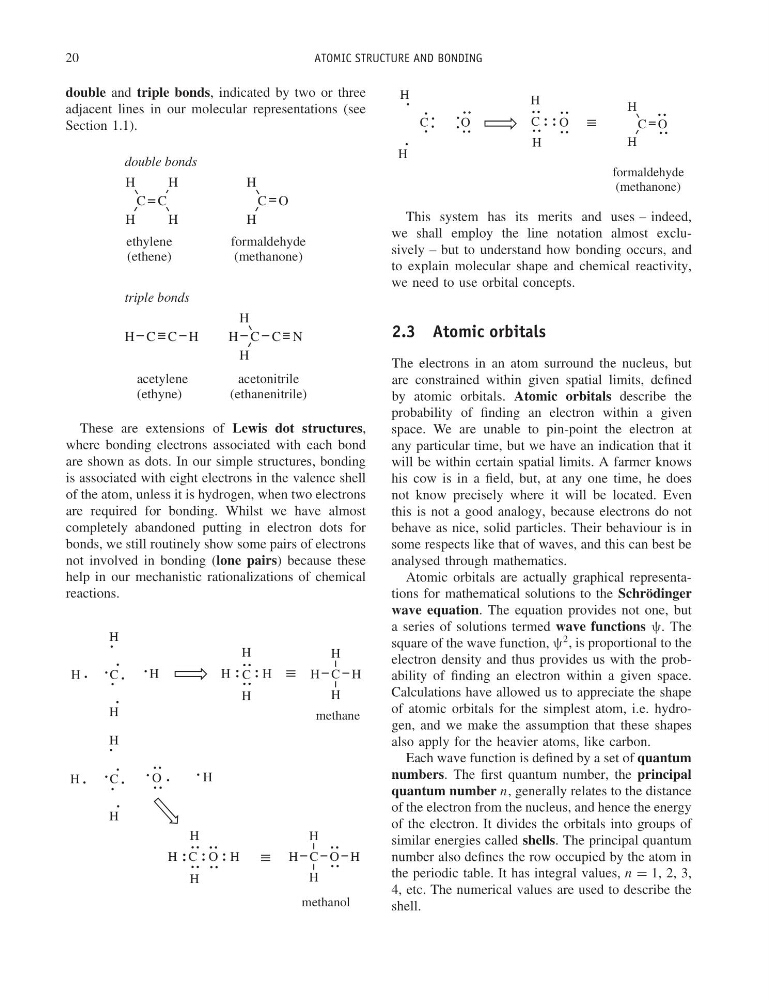
double and triple bonds, indicated by two or three
adjacent lines in our molecular representations (see
Section 1.1).
C C
H
H
H
H
C O
H
H
H C C H
C C N
ethylene
(ethene)
formaldehyde
(methanone)
acetylene
(ethyne)
acetonitrile
(ethanenitrile)
H
H
H
double bonds
triple bonds
These are extensions of Lewis dot structures,
where bonding electrons associated with each bond
are shown as dots. In our simple structures, bonding
is associated with eight electrons in the valence shell
of the atom, unless it is hydrogen, when two electrons
are required for bonding. Whilst we have almost
completely abandoned putting in electron dots for
bonds, we still routinely show some pairs of electrons
not involved in bonding (lone pairs) because these
help in our mechanistic rationalizations of chemical
reactions.
C
H
H
methane
H
H
C
H
H
H
H
H
C
H
H
H
≡
H
C
H
O
H
H
methanol
C
H
H
H
H
O
C
H
O
H
H
H
≡
C O
H
H
formaldehyde
(methanone)
C
H
H
O
C
H
O
H
≡
This system has its merits and uses – indeed,
we shall employ the line notation almost exclusively – but to understand how bonding occurs, and
to explain molecular shape and chemical reactivity,
we need to use orbital concepts.
2.3 Atomic orbitals
The electrons in an atom surround the nucleus, but
are constrained within given spatial limits, defined
by atomic orbitals. Atomic orbitals describe the
probability of finding an electron within a given
space. We are unable to pin-point the electron at
any particular time, but we have an indication that it
will be within certain spatial limits. A farmer knows
his cow is in a field, but, at any one time, he does
not know precisely where it will be located. Even
this is not a good analogy, because electrons do not
behave as nice, solid particles. Their behaviour is in
some respects like that of waves, and this can best be
analysed through mathematics.
Atomic orbitals are actually graphical representations for mathematical solutions to the Schr¨ odinger
wave equation. The equation provides not one, but
a series of solutions termed wave functions ψ. The
square of the wave function, ψ
2 , is proportional to the
electron density and thus provides us with the probability of finding an electron within a given space.
Calculations have allowed us to appreciate the shape
of atomic orbitals for the simplest atom, i.e. hydrogen, and we make the assumption that these shapes
also apply for the heavier atoms, like carbon.
Each wave function is defined by a set of quantum
numbers. The first quantum number, the principal
quantum number n, generally relates to the distance
of the electron from the nucleus, and hence the energy
of the electron. It divides the orbitals into groups of
similar energies called shells. The principal quantum
number also defines the row occupied by the atom in
the periodic table. It has integral values, n = 1, 2, 3,
4, etc. The numerical values are used to describe the
shell.
ATOMIC STRUCTURE AND BONDING
double and triple bonds, indicated by two or three
adjacent lines in our molecular representations (see
Section 1.1).
C C
H
H
H
H
C O
H
H
H C C H
C C N
ethylene
(ethene)
formaldehyde
(methanone)
acetylene
(ethyne)
acetonitrile
(ethanenitrile)
H
H
H
double bonds
triple bonds
These are extensions of Lewis dot structures,
where bonding electrons associated with each bond
are shown as dots. In our simple structures, bonding
is associated with eight electrons in the valence shell
of the atom, unless it is hydrogen, when two electrons
are required for bonding. Whilst we have almost
completely abandoned putting in electron dots for
bonds, we still routinely show some pairs of electrons
not involved in bonding (lone pairs) because these
help in our mechanistic rationalizations of chemical
reactions.
C
H
H
methane
H
H
C
H
H
H
H
H
C
H
H
H
≡
H
C
H
O
H
H
methanol
C
H
H
H
H
O
C
H
O
H
H
H
≡
C O
H
H
formaldehyde
(methanone)
C
H
H
O
C
H
O
H
≡
This system has its merits and uses – indeed,
we shall employ the line notation almost exclusively – but to understand how bonding occurs, and
to explain molecular shape and chemical reactivity,
we need to use orbital concepts.
2.3 Atomic orbitals
The electrons in an atom surround the nucleus, but
are constrained within given spatial limits, defined
by atomic orbitals. Atomic orbitals describe the
probability of finding an electron within a given
space. We are unable to pin-point the electron at
any particular time, but we have an indication that it
will be within certain spatial limits. A farmer knows
his cow is in a field, but, at any one time, he does
not know precisely where it will be located. Even
this is not a good analogy, because electrons do not
behave as nice, solid particles. Their behaviour is in
some respects like that of waves, and this can best be
analysed through mathematics.
Atomic orbitals are actually graphical representations for mathematical solutions to the Schr¨ odinger
wave equation. The equation provides not one, but
a series of solutions termed wave functions ψ. The
square of the wave function, ψ
2 , is proportional to the
electron density and thus provides us with the probability of finding an electron within a given space.
Calculations have allowed us to appreciate the shape
of atomic orbitals for the simplest atom, i.e. hydrogen, and we make the assumption that these shapes
also apply for the heavier atoms, like carbon.
Each wave function is defined by a set of quantum
numbers. The first quantum number, the principal
quantum number n, generally relates to the distance
of the electron from the nucleus, and hence the energy
of the electron. It divides the orbitals into groups of
similar energies called shells. The principal quantum
number also defines the row occupied by the atom in
the periodic table. It has integral values, n = 1, 2, 3,
4, etc. The numerical values are used to describe the
shell.