

342
RADICAL REACTIONS
OH
NaOH
O
O
K 3 Fe(CN) 6
1-naphthol
O
O
OH
OH
OH
OH
OH
OH
para–para coupling
ortho–ortho coupling
para–ortho coupling
× 2
× 2
Box 9.4
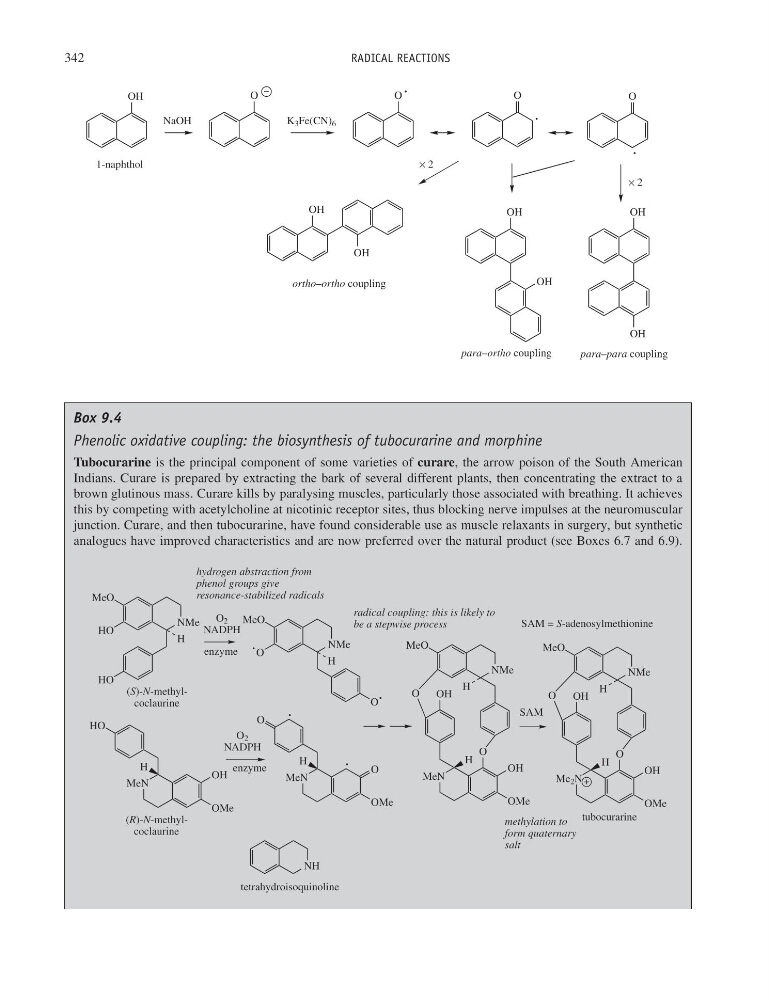
Phenolic oxidative coupling: the biosynthesis of tubocurarine and morphine
Tubocurarine is the principal component of some varieties of curare, the arrow poison of the South American
Indians. Curare is prepared by extracting the bark of several different plants, then concentrating the extract to a
brown glutinous mass. Curare kills by paralysing muscles, particularly those associated with breathing. It achieves
this by competing with acetylcholine at nicotinic receptor sites, thus blocking nerve impulses at the neuromuscular
junction. Curare, and then tubocurarine, have found considerable use as muscle relaxants in surgery, but synthetic
analogues have improved characteristics and are now preferred over the natural product (see Boxes 6.7 and 6.9).
HO
NMe
MeO
HO
H
O
NMe
MeO
H
O
MeN
OMe
H
O
O
O
NMe
MeO
H
MeN
O
OH
OMe
H
OH
(S)-N-methylcoclaurine
(R)-N-methylcoclaurine
O 2
NADPH
hydrogen abstraction from
phenol groups give
resonance-stabilized radicals
O 2
NADPH
O
NMe
MeO
radical coupling: this is likely to
be a stepwise process
H
Me 2 N
O
OH
OMe
H
OH
tubocurarine
OH
MeN
OMe
H
HO
methylation to
form quaternary
salt
SAM = S-adenosylmethionine
enzyme
enzyme
NH
tetrahydroisoquinoline
SAM
RADICAL REACTIONS
OH
NaOH
O
O
K 3 Fe(CN) 6
1-naphthol
O
O
OH
OH
OH
OH
OH
OH
para–para coupling
ortho–ortho coupling
para–ortho coupling
× 2
× 2
Box 9.4
Phenolic oxidative coupling: the biosynthesis of tubocurarine and morphine
Tubocurarine is the principal component of some varieties of curare, the arrow poison of the South American
Indians. Curare is prepared by extracting the bark of several different plants, then concentrating the extract to a
brown glutinous mass. Curare kills by paralysing muscles, particularly those associated with breathing. It achieves
this by competing with acetylcholine at nicotinic receptor sites, thus blocking nerve impulses at the neuromuscular
junction. Curare, and then tubocurarine, have found considerable use as muscle relaxants in surgery, but synthetic
analogues have improved characteristics and are now preferred over the natural product (see Boxes 6.7 and 6.9).
HO
NMe
MeO
HO
H
O
NMe
MeO
H
O
MeN
OMe
H
O
O
O
NMe
MeO
H
MeN
O
OH
OMe
H
OH
(S)-N-methylcoclaurine
(R)-N-methylcoclaurine
O 2
NADPH
hydrogen abstraction from
phenol groups give
resonance-stabilized radicals
O 2
NADPH
O
NMe
MeO
radical coupling: this is likely to
be a stepwise process
H
Me 2 N
O
OH
OMe
H
OH
tubocurarine
OH
MeN
OMe
H
HO
methylation to
form quaternary
salt
SAM = S-adenosylmethionine
enzyme
enzyme
NH
tetrahydroisoquinoline
SAM