

PHENOLIC OXIDATIVE COUPLING
341
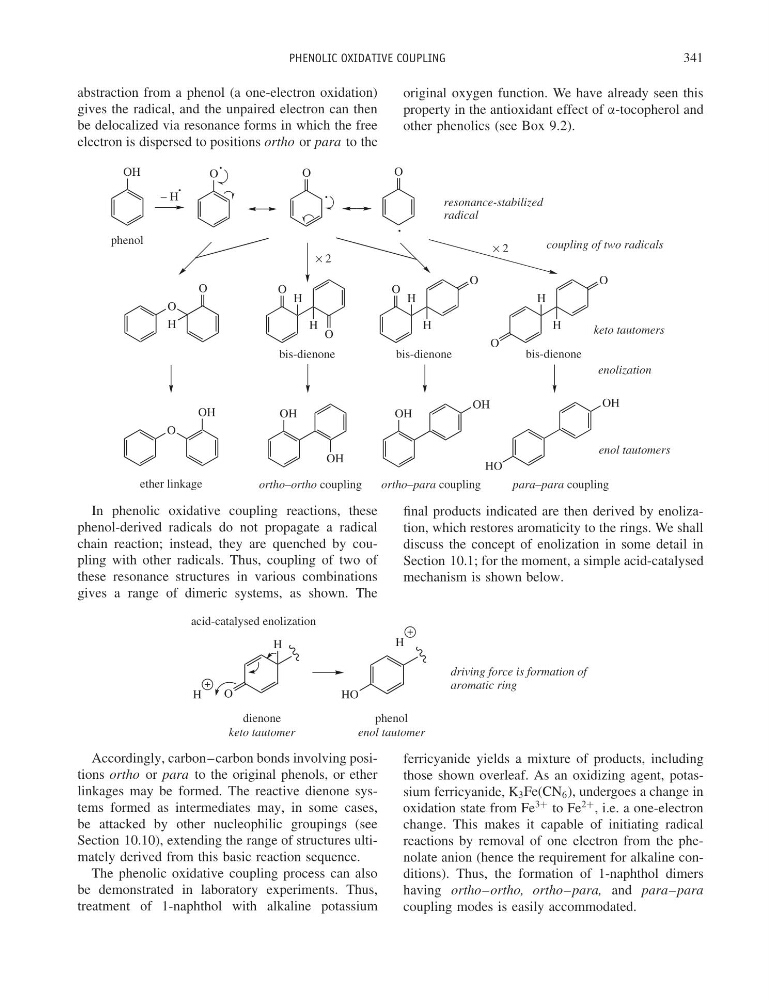
abstraction from a phenol (a one-electron oxidation)
gives the radical, and the unpaired electron can then
be delocalized via resonance forms in which the free
electron is dispersed to positions ortho or para to the
original oxygen function. We have already seen this
property in the antioxidant effect of α-tocopherol and
other phenolics (see Box 9.2).
OH
O
O
O
O
O
H
O
OH
O
H
O
H
OH
OH
H
O
H
OH
O
OH
× 2
phenol
resonance-stabilized
radical
bis-dienone
bis-dienone
ether linkage
keto tautomers
enol tautomers
enolization
O
H
H
OH
bis-dienone
O
– H
HO
coupling of two radicals
ortho–ortho coupling
ortho–para coupling
para–para coupling
× 2
In phenolic oxidative coupling reactions, these
phenol-derived radicals do not propagate a radical
chain reaction; instead, they are quenched by coupling with other radicals. Thus, coupling of two of
these resonance structures in various combinations
gives a range of dimeric systems, as shown. The
final products indicated are then derived by enolization, which restores aromaticity to the rings. We shall
discuss the concept of enolization in some detail in
Section 10.1; for the moment, a simple acid-catalysed
mechanism is shown below.
H
O
H
HO
H
acid-catalysed enolization
dienone
keto tautomer
driving force is formation of
aromatic ring
phenol
enol tautomer
Accordingly, carbon–carbon bonds involving positions ortho or para to the original phenols, or ether
linkages may be formed. The reactive dienone systems formed as intermediates may, in some cases,
be attacked by other nucleophilic groupings (see
Section 10.10), extending the range of structures ultimately derived from this basic reaction sequence.
The phenolic oxidative coupling process can also
be demonstrated in laboratory experiments. Thus,
treatment of 1-naphthol with alkaline potassium
ferricyanide yields a mixture of products, including
those shown overleaf. As an oxidizing agent, potassium ferricyanide, K 3 Fe(CN 6 ), undergoes a change in
oxidation state from Fe
3+ to Fe
2+ , i.e. a one-electron
change. This makes it capable of initiating radical
reactions by removal of one electron from the phenolate anion (hence the requirement for alkaline conditions). Thus, the formation of 1-naphthol dimers
having ortho–ortho, ortho–para, and para–para
coupling modes is easily accommodated.
341
abstraction from a phenol (a one-electron oxidation)
gives the radical, and the unpaired electron can then
be delocalized via resonance forms in which the free
electron is dispersed to positions ortho or para to the
original oxygen function. We have already seen this
property in the antioxidant effect of α-tocopherol and
other phenolics (see Box 9.2).
OH
O
O
O
O
O
H
O
OH
O
H
O
H
OH
OH
H
O
H
OH
O
OH
× 2
phenol
resonance-stabilized
radical
bis-dienone
bis-dienone
ether linkage
keto tautomers
enol tautomers
enolization
O
H
H
OH
bis-dienone
O
– H
HO
coupling of two radicals
ortho–ortho coupling
ortho–para coupling
para–para coupling
× 2
In phenolic oxidative coupling reactions, these
phenol-derived radicals do not propagate a radical
chain reaction; instead, they are quenched by coupling with other radicals. Thus, coupling of two of
these resonance structures in various combinations
gives a range of dimeric systems, as shown. The
final products indicated are then derived by enolization, which restores aromaticity to the rings. We shall
discuss the concept of enolization in some detail in
Section 10.1; for the moment, a simple acid-catalysed
mechanism is shown below.
H
O
H
HO
H
acid-catalysed enolization
dienone
keto tautomer
driving force is formation of
aromatic ring
phenol
enol tautomer
Accordingly, carbon–carbon bonds involving positions ortho or para to the original phenols, or ether
linkages may be formed. The reactive dienone systems formed as intermediates may, in some cases,
be attacked by other nucleophilic groupings (see
Section 10.10), extending the range of structures ultimately derived from this basic reaction sequence.
The phenolic oxidative coupling process can also
be demonstrated in laboratory experiments. Thus,
treatment of 1-naphthol with alkaline potassium
ferricyanide yields a mixture of products, including
those shown overleaf. As an oxidizing agent, potassium ferricyanide, K 3 Fe(CN 6 ), undergoes a change in
oxidation state from Fe
3+ to Fe
2+ , i.e. a one-electron
change. This makes it capable of initiating radical
reactions by removal of one electron from the phenolate anion (hence the requirement for alkaline conditions). Thus, the formation of 1-naphthol dimers
having ortho–ortho, ortho–para, and para–para
coupling modes is easily accommodated.