

340
RADICAL REACTIONS
Box 9.3 (continued)
blood pressure, gastric secretion, smooth muscle contraction and platelet aggregation. Inflammation is a condition
that occurs as a direct result of increased prostaglandin synthesis, and many of the non-steroidal anti-inflammatory
drugs (NSAIDs), such as aspirin and ibuprofen, exert their beneficial effects by reducing prostaglandin formation.
Prostaglandin biosynthesis from the unsaturated fatty acid arachidonic acid looks very complicated. Breaking
the process down into separate steps should reassure us that we have actually met these reactions already. In
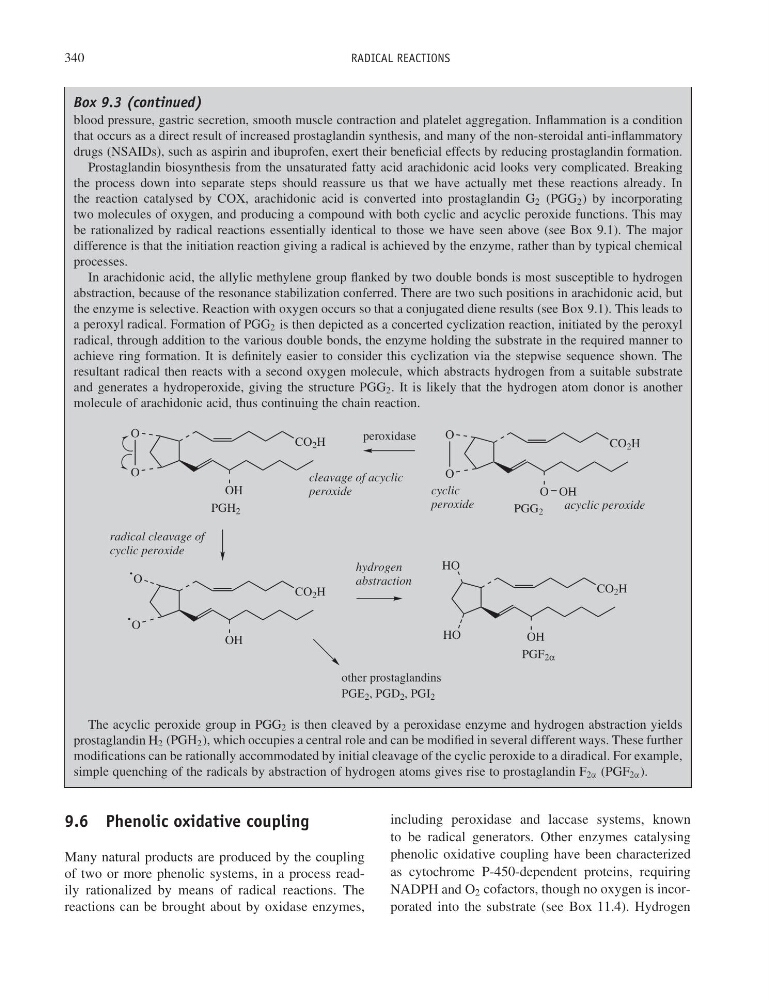
the reaction catalysed by COX, arachidonic acid is converted into prostaglandin G 2 (PGG 2 ) by incorporating
two molecules of oxygen, and producing a compound with both cyclic and acyclic peroxide functions. This may
be rationalized by radical reactions essentially identical to those we have seen above (see Box 9.1). The major
difference is that the initiation reaction giving a radical is achieved by the enzyme, rather than by typical chemical
processes.
In arachidonic acid, the allylic methylene group flanked by two double bonds is most susceptible to hydrogen
abstraction, because of the resonance stabilization conferred. There are two such positions in arachidonic acid, but
the enzyme is selective. Reaction with oxygen occurs so that a conjugated diene results (see Box 9.1). This leads to
a peroxyl radical. Formation of PGG 2 is then depicted as a concerted cyclization reaction, initiated by the peroxyl
radical, through addition to the various double bonds, the enzyme holding the substrate in the required manner to
achieve ring formation. It is definitely easier to consider this cyclization via the stepwise sequence shown. The
resultant radical then reacts with a second oxygen molecule, which abstracts hydrogen from a suitable substrate
and generates a hydroperoxide, giving the structure PGG 2 . It is likely that the hydrogen atom donor is another
molecule of arachidonic acid, thus continuing the chain reaction.
CO 2 H
O
O
O OH
CO 2 H
O
O
OH
CO 2 H
OH
HO
HO
peroxidase
PGG 2
PGH 2
PGF 2α
cyclic
peroxide
acyclic peroxide
CO 2 H
O
OH
cleavage of acyclic
peroxide
radical cleavage of
cyclic peroxide
O
other prostaglandins
PGE 2 , PGD 2 , PGI 2
hydrogen
abstraction
The acyclic peroxide group in PGG 2 is then cleaved by a peroxidase enzyme and hydrogen abstraction yields
prostaglandin H 2 (PGH 2 ), which occupies a central role and can be modified in several different ways. These further
modifications can be rationally accommodated by initial cleavage of the cyclic peroxide to a diradical. For example,
simple quenching of the radicals by abstraction of hydrogen atoms gives rise to prostaglandin F 2α (PGF 2α ).
9.6 Phenolic oxidative coupling
Many natural products are produced by the coupling
of two or more phenolic systems, in a process readily rationalized by means of radical reactions. The
reactions can be brought about by oxidase enzymes,
including peroxidase and laccase systems, known
to be radical generators. Other enzymes catalysing
phenolic oxidative coupling have been characterized
as cytochrome P-450-dependent proteins, requiring
NADPH and O 2 cofactors, though no oxygen is incorporated into the substrate (see Box 11.4). Hydrogen
RADICAL REACTIONS
Box 9.3 (continued)
blood pressure, gastric secretion, smooth muscle contraction and platelet aggregation. Inflammation is a condition
that occurs as a direct result of increased prostaglandin synthesis, and many of the non-steroidal anti-inflammatory
drugs (NSAIDs), such as aspirin and ibuprofen, exert their beneficial effects by reducing prostaglandin formation.
Prostaglandin biosynthesis from the unsaturated fatty acid arachidonic acid looks very complicated. Breaking
the process down into separate steps should reassure us that we have actually met these reactions already. In
the reaction catalysed by COX, arachidonic acid is converted into prostaglandin G 2 (PGG 2 ) by incorporating
two molecules of oxygen, and producing a compound with both cyclic and acyclic peroxide functions. This may
be rationalized by radical reactions essentially identical to those we have seen above (see Box 9.1). The major
difference is that the initiation reaction giving a radical is achieved by the enzyme, rather than by typical chemical
processes.
In arachidonic acid, the allylic methylene group flanked by two double bonds is most susceptible to hydrogen
abstraction, because of the resonance stabilization conferred. There are two such positions in arachidonic acid, but
the enzyme is selective. Reaction with oxygen occurs so that a conjugated diene results (see Box 9.1). This leads to
a peroxyl radical. Formation of PGG 2 is then depicted as a concerted cyclization reaction, initiated by the peroxyl
radical, through addition to the various double bonds, the enzyme holding the substrate in the required manner to
achieve ring formation. It is definitely easier to consider this cyclization via the stepwise sequence shown. The
resultant radical then reacts with a second oxygen molecule, which abstracts hydrogen from a suitable substrate
and generates a hydroperoxide, giving the structure PGG 2 . It is likely that the hydrogen atom donor is another
molecule of arachidonic acid, thus continuing the chain reaction.
CO 2 H
O
O
O OH
CO 2 H
O
O
OH
CO 2 H
OH
HO
HO
peroxidase
PGG 2
PGH 2
PGF 2α
cyclic
peroxide
acyclic peroxide
CO 2 H
O
OH
cleavage of acyclic
peroxide
radical cleavage of
cyclic peroxide
O
other prostaglandins
PGE 2 , PGD 2 , PGI 2
hydrogen
abstraction
The acyclic peroxide group in PGG 2 is then cleaved by a peroxidase enzyme and hydrogen abstraction yields
prostaglandin H 2 (PGH 2 ), which occupies a central role and can be modified in several different ways. These further
modifications can be rationally accommodated by initial cleavage of the cyclic peroxide to a diradical. For example,
simple quenching of the radicals by abstraction of hydrogen atoms gives rise to prostaglandin F 2α (PGF 2α ).
9.6 Phenolic oxidative coupling
Many natural products are produced by the coupling
of two or more phenolic systems, in a process readily rationalized by means of radical reactions. The
reactions can be brought about by oxidase enzymes,
including peroxidase and laccase systems, known
to be radical generators. Other enzymes catalysing
phenolic oxidative coupling have been characterized
as cytochrome P-450-dependent proteins, requiring
NADPH and O 2 cofactors, though no oxygen is incorporated into the substrate (see Box 11.4). Hydrogen