

PHENOLIC OXIDATIVE COUPLING
343
The structure of tubocurarine has two benzyltetrahydroisoquinoline alkaloid units linked together, and this
linking is achieved through phenolic oxidative coupling. We shall meet tetrahydroisoquinoline alkaloids as a
product of biochemical Mannich-like reactions (see Box 10.7). Tubocurarine is formed in nature from two
molecules of N-methylcoclaurine, one of each configuration. The coupling enzyme is a cytochrome P-450dependent mono-oxygenase. Radical coupling is readily rationalized. The two diradicals, formed by hydrogen
abstraction from the phenol group in each ring, couple to give ether bridges. This would be a consequence of the
free electrons being localized on carbon in one system and on oxygen in the other. It is not proven, but more
likely, that the radical coupling is a stepwise process involving simple monoradicals rather than the diradicals
shown in the scheme. Tubocurarine is finally elaborated by enzymic methylation of one nitrogen atom to form
the quaternary ammonium salt. This involves the participation of SAM as the methyl donor (see Box 6.5).
In natural alkaloids, the coupling of two benzyltetrahydroisoquinoline molecules by ether bridges, as in
tubocurarine above, is rather less frequent than that involving carbon–carbon bonding between aromatic rings.
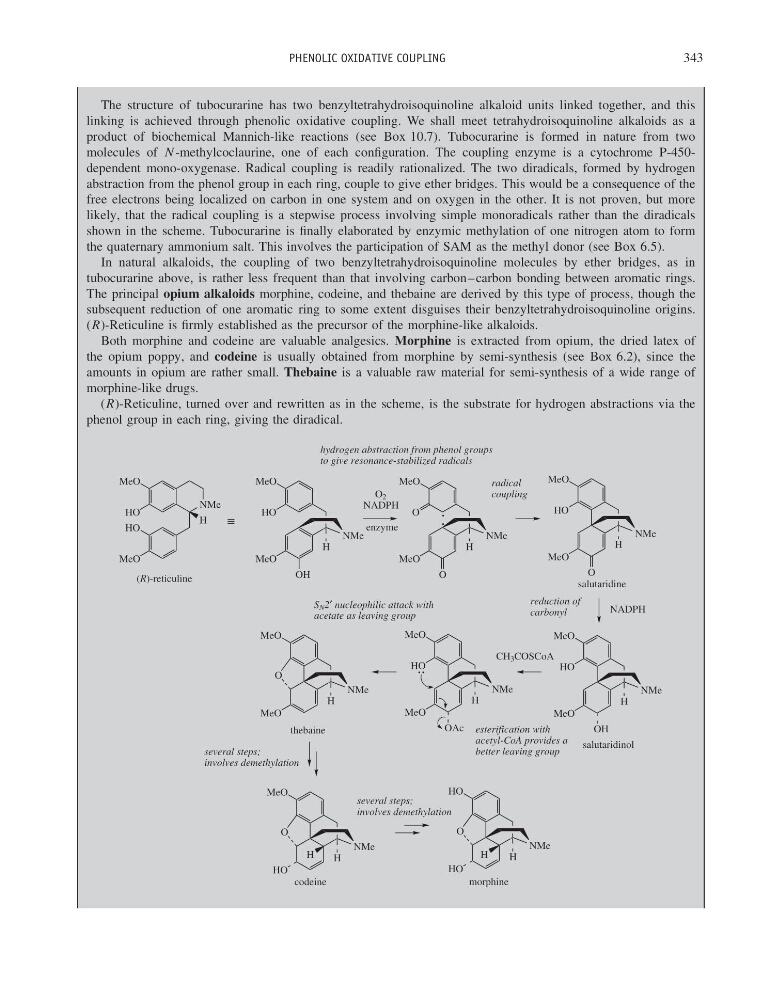
The principal opium alkaloids morphine, codeine, and thebaine are derived by this type of process, though the
subsequent reduction of one aromatic ring to some extent disguises their benzyltetrahydroisoquinoline origins.
(R)-Reticuline is firmly established as the precursor of the morphine-like alkaloids.
Both morphine and codeine are valuable analgesics. Morphine is extracted from opium, the dried latex of
the opium poppy, and codeine is usually obtained from morphine by semi-synthesis (see Box 6.2), since the
amounts in opium are rather small. Thebaine is a valuable raw material for semi-synthesis of a wide range of
morphine-like drugs.
(R)-Reticuline, turned over and rewritten as in the scheme, is the substrate for hydrogen abstractions via the
phenol group in each ring, giving the diradical.
HO
NMe
MeO
MeO
H
HO
MeO
HO
OH
MeO
H
NMe
MeO
O
O
MeO
H
NMe
MeO
HO
O
MeO
H
NMe
(R)-reticuline
≡
salutaridine
radical
coupling
O 2
NADPH
hydrogen abstraction from phenol groups
to give resonance-stabilized radicals
MeO
O
MeO
H
NMe
thebaine
morphine
MeO
O
HO
H
NMe
HO
O
HO
H
NMe
H
H
codeine
MeO
HO
OH
MeO
H
NMe
MeO
HO
OAc
MeO
H
NMe
salutaridinol
NADPH
reduction of
carbonyl
S N 2′ nucleophilic attack with
acetate as leaving group
esterification with
acetyl-CoA provides a
better leaving group
several steps;
involves demethylation
several steps;
involves demethylation
enzyme
CH 3 COSCoA
343
The structure of tubocurarine has two benzyltetrahydroisoquinoline alkaloid units linked together, and this
linking is achieved through phenolic oxidative coupling. We shall meet tetrahydroisoquinoline alkaloids as a
product of biochemical Mannich-like reactions (see Box 10.7). Tubocurarine is formed in nature from two
molecules of N-methylcoclaurine, one of each configuration. The coupling enzyme is a cytochrome P-450dependent mono-oxygenase. Radical coupling is readily rationalized. The two diradicals, formed by hydrogen
abstraction from the phenol group in each ring, couple to give ether bridges. This would be a consequence of the
free electrons being localized on carbon in one system and on oxygen in the other. It is not proven, but more
likely, that the radical coupling is a stepwise process involving simple monoradicals rather than the diradicals
shown in the scheme. Tubocurarine is finally elaborated by enzymic methylation of one nitrogen atom to form
the quaternary ammonium salt. This involves the participation of SAM as the methyl donor (see Box 6.5).
In natural alkaloids, the coupling of two benzyltetrahydroisoquinoline molecules by ether bridges, as in
tubocurarine above, is rather less frequent than that involving carbon–carbon bonding between aromatic rings.
The principal opium alkaloids morphine, codeine, and thebaine are derived by this type of process, though the
subsequent reduction of one aromatic ring to some extent disguises their benzyltetrahydroisoquinoline origins.
(R)-Reticuline is firmly established as the precursor of the morphine-like alkaloids.
Both morphine and codeine are valuable analgesics. Morphine is extracted from opium, the dried latex of
the opium poppy, and codeine is usually obtained from morphine by semi-synthesis (see Box 6.2), since the
amounts in opium are rather small. Thebaine is a valuable raw material for semi-synthesis of a wide range of
morphine-like drugs.
(R)-Reticuline, turned over and rewritten as in the scheme, is the substrate for hydrogen abstractions via the
phenol group in each ring, giving the diradical.
HO
NMe
MeO
MeO
H
HO
MeO
HO
OH
MeO
H
NMe
MeO
O
O
MeO
H
NMe
MeO
HO
O
MeO
H
NMe
(R)-reticuline
≡
salutaridine
radical
coupling
O 2
NADPH
hydrogen abstraction from phenol groups
to give resonance-stabilized radicals
MeO
O
MeO
H
NMe
thebaine
morphine
MeO
O
HO
H
NMe
HO
O
HO
H
NMe
H
H
codeine
MeO
HO
OH
MeO
H
NMe
MeO
HO
OAc
MeO
H
NMe
salutaridinol
NADPH
reduction of
carbonyl
S N 2′ nucleophilic attack with
acetate as leaving group
esterification with
acetyl-CoA provides a
better leaving group
several steps;
involves demethylation
several steps;
involves demethylation
enzyme
CH 3 COSCoA