

332
RADICAL REACTIONS
tetrafluoroethylene
polytetrafluoroethylene (PTFE; Teflon
)
F
F
F
F
F
F
F F
F
F
F
F
F
F
F
F
F
F
F
F
F
F
F
F
F
F
F F
We met a rather similar process, cationic polymerization, under electrophilic reactions in Section 8.3.
In practice, radical polymerization is more effective
than cationic polymerization, and industrial polymers
are usually produced by radical processes.
9.4.3 Addition of hydrogen to alkenes and
alkynes: catalytic hydrogenation
The addition of hydrogen to carbon–carbon multiple bonds (reduction) may be achieved using gaseous
hydrogen in the presence of a finely divided noble
metal catalyst. This is termed catalytic hydrogenation. It is not a radical reaction as we have seen
above, and does not feature initiation, propagation
and termination steps. However, since it appears to
involve atomic hydrogen, it has much more in common with radical reactions than ionic ones, and we
consider it here for convenience.
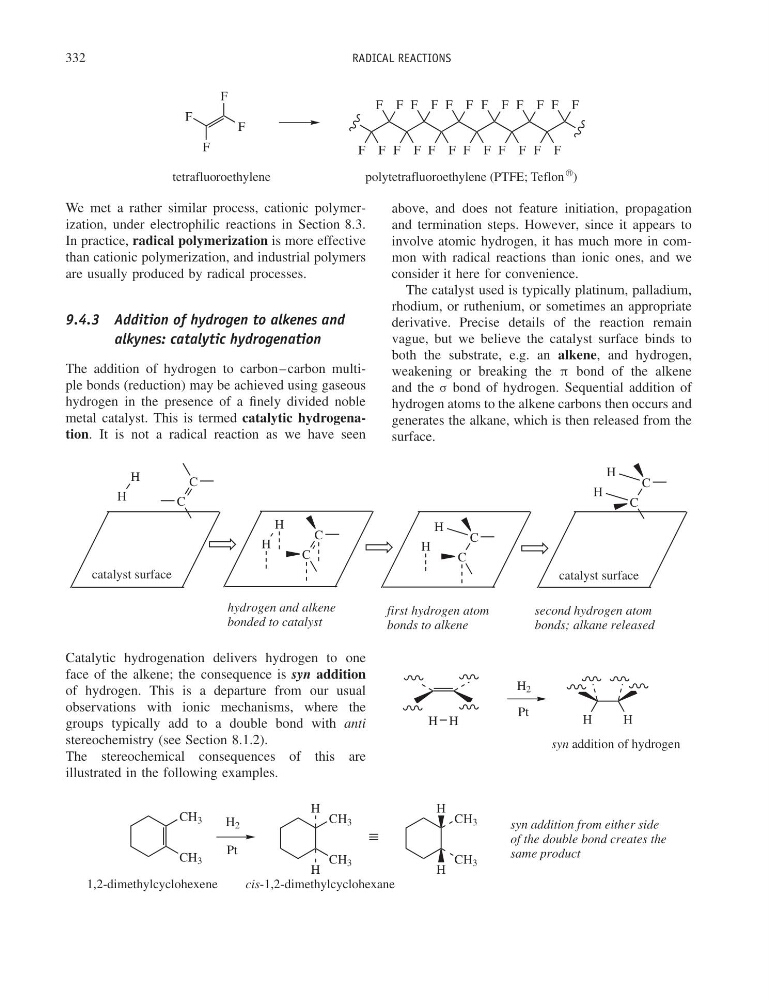
The catalyst used is typically platinum, palladium,
rhodium, or ruthenium, or sometimes an appropriate
derivative. Precise details of the reaction remain
vague, but we believe the catalyst surface binds to
both the substrate, e.g. an alkene, and hydrogen,
weakening or breaking the π bond of the alkene
and the σ bond of hydrogen. Sequential addition of
hydrogen atoms to the alkene carbons then occurs and
generates the alkane, which is then released from the
surface.
H
H
C
C
H
H
C
C
H
H
C
C
H
H
C
C
catalyst surface
catalyst surface
hydrogen and alkene
bonded to catalyst
first hydrogen atom
bonds to alkene
second hydrogen atom
bonds; alkane released
Catalytic hydrogenation delivers hydrogen to one
face of the alkene; the consequence is syn addition
of hydrogen. This is a departure from our usual
observations with ionic mechanisms, where the
groups typically add to a double bond with anti
stereochemistry (see Section 8.1.2).
The stereochemical consequences of this are
illustrated in the following examples.
H H
H 2
Pt
H
H
syn addition of hydrogen
CH 3
CH 3
H 2
Pt
CH 3
CH 3
H
H
1,2-dimethylcyclohexene
cis-1,2-dimethylcyclohexane
syn addition from either side
of the double bond creates the
same product
≡
CH 3
CH 3
H
H
RADICAL REACTIONS
tetrafluoroethylene
polytetrafluoroethylene (PTFE; Teflon
)
F
F
F
F
F
F
F F
F
F
F
F
F
F
F
F
F
F
F
F
F
F
F
F
F
F
F F
We met a rather similar process, cationic polymerization, under electrophilic reactions in Section 8.3.
In practice, radical polymerization is more effective
than cationic polymerization, and industrial polymers
are usually produced by radical processes.
9.4.3 Addition of hydrogen to alkenes and
alkynes: catalytic hydrogenation
The addition of hydrogen to carbon–carbon multiple bonds (reduction) may be achieved using gaseous
hydrogen in the presence of a finely divided noble
metal catalyst. This is termed catalytic hydrogenation. It is not a radical reaction as we have seen
above, and does not feature initiation, propagation
and termination steps. However, since it appears to
involve atomic hydrogen, it has much more in common with radical reactions than ionic ones, and we
consider it here for convenience.
The catalyst used is typically platinum, palladium,
rhodium, or ruthenium, or sometimes an appropriate
derivative. Precise details of the reaction remain
vague, but we believe the catalyst surface binds to
both the substrate, e.g. an alkene, and hydrogen,
weakening or breaking the π bond of the alkene
and the σ bond of hydrogen. Sequential addition of
hydrogen atoms to the alkene carbons then occurs and
generates the alkane, which is then released from the
surface.
H
H
C
C
H
H
C
C
H
H
C
C
H
H
C
C
catalyst surface
catalyst surface
hydrogen and alkene
bonded to catalyst
first hydrogen atom
bonds to alkene
second hydrogen atom
bonds; alkane released
Catalytic hydrogenation delivers hydrogen to one
face of the alkene; the consequence is syn addition
of hydrogen. This is a departure from our usual
observations with ionic mechanisms, where the
groups typically add to a double bond with anti
stereochemistry (see Section 8.1.2).
The stereochemical consequences of this are
illustrated in the following examples.
H H
H 2
Pt
H
H
syn addition of hydrogen
CH 3
CH 3
H 2
Pt
CH 3
CH 3
H
H
1,2-dimethylcyclohexene
cis-1,2-dimethylcyclohexane
syn addition from either side
of the double bond creates the
same product
≡
CH 3
CH 3
H
H