

RADICAL ADDITION OF OXYGEN: AUTOXIDATION REACTIONS
333
H 3 C
Ph
Ph
CH 3
H 2
Pd
H 3 C
Ph
Ph
CH 3
H
H
trans-2,3-diphenylbut-2-ene
(±)-2,3-diphenylbutane
H 3 C
Ph
Ph
CH 3
H
H
S
S
+
R
R
syn addition from either side of
the double bond creates a pair
of enantiomers
Ph
CH 3
Ph
CH 3
H 2
Pd
Ph
CH 3
Ph
CH 3
H
H
cis-2,3-diphenylbut-2-ene
meso-2,3-diphenylbutane
≡
Ph
CH 3
Ph
CH 3
H
H
S
R
R
S
syn addition from either side
of the double bond creates the
meso isomer
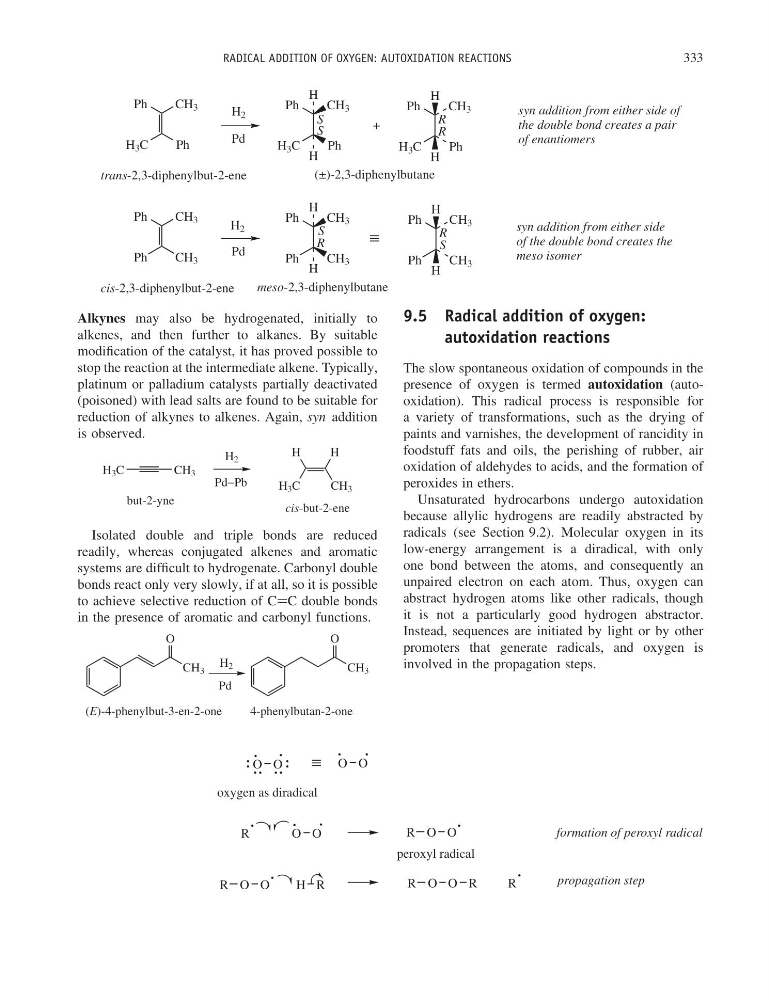
Alkynes may also be hydrogenated, initially to
alkenes, and then further to alkanes. By suitable
modification of the catalyst, it has proved possible to
stop the reaction at the intermediate alkene. Typically,
platinum or palladium catalysts partially deactivated
(poisoned) with lead salts are found to be suitable for
reduction of alkynes to alkenes. Again, syn addition
is observed.
H 3 C
CH 3
H 2
Pd−Pb
CH 3
H
H 3 C
H
but-2-yne
cis-but-2-ene
Isolated double and triple bonds are reduced
readily, whereas conjugated alkenes and aromatic
systems are difficult to hydrogenate. Carbonyl double
bonds react only very slowly, if at all, so it is possible
to achieve selective reduction of C=C double bonds
in the presence of aromatic and carbonyl functions.
CH 3
O
H 2
Pd
CH 3
O
(E)-4-phenylbut-3-en-2-one
4-phenylbutan-2-one
9.5 Radical addition of oxygen:
autoxidation reactions
The slow spontaneous oxidation of compounds in the
presence of oxygen is termed autoxidation (autooxidation). This radical process is responsible for
a variety of transformations, such as the drying of
paints and varnishes, the development of rancidity in
foodstuff fats and oils, the perishing of rubber, air
oxidation of aldehydes to acids, and the formation of
peroxides in ethers.
Unsaturated hydrocarbons undergo autoxidation
because allylic hydrogens are readily abstracted by
radicals (see Section 9.2). Molecular oxygen in its
low-energy arrangement is a diradical, with only
one bond between the atoms, and consequently an
unpaired electron on each atom. Thus, oxygen can
abstract hydrogen atoms like other radicals, though
it is not a particularly good hydrogen abstractor.
Instead, sequences are initiated by light or by other
promoters that generate radicals, and oxygen is
involved in the propagation steps.
O O
oxygen as diradical
R
O O
R O O
peroxyl radical
R O O
H R
R O O R
R
propagation step
formation of peroxyl radical
O O
≡
333
H 3 C
Ph
Ph
CH 3
H 2
Pd
H 3 C
Ph
Ph
CH 3
H
H
trans-2,3-diphenylbut-2-ene
(±)-2,3-diphenylbutane
H 3 C
Ph
Ph
CH 3
H
H
S
S
+
R
R
syn addition from either side of
the double bond creates a pair
of enantiomers
Ph
CH 3
Ph
CH 3
H 2
Pd
Ph
CH 3
Ph
CH 3
H
H
cis-2,3-diphenylbut-2-ene
meso-2,3-diphenylbutane
≡
Ph
CH 3
Ph
CH 3
H
H
S
R
R
S
syn addition from either side
of the double bond creates the
meso isomer
Alkynes may also be hydrogenated, initially to
alkenes, and then further to alkanes. By suitable
modification of the catalyst, it has proved possible to
stop the reaction at the intermediate alkene. Typically,
platinum or palladium catalysts partially deactivated
(poisoned) with lead salts are found to be suitable for
reduction of alkynes to alkenes. Again, syn addition
is observed.
H 3 C
CH 3
H 2
Pd−Pb
CH 3
H
H 3 C
H
but-2-yne
cis-but-2-ene
Isolated double and triple bonds are reduced
readily, whereas conjugated alkenes and aromatic
systems are difficult to hydrogenate. Carbonyl double
bonds react only very slowly, if at all, so it is possible
to achieve selective reduction of C=C double bonds
in the presence of aromatic and carbonyl functions.
CH 3
O
H 2
Pd
CH 3
O
(E)-4-phenylbut-3-en-2-one
4-phenylbutan-2-one
9.5 Radical addition of oxygen:
autoxidation reactions
The slow spontaneous oxidation of compounds in the
presence of oxygen is termed autoxidation (autooxidation). This radical process is responsible for
a variety of transformations, such as the drying of
paints and varnishes, the development of rancidity in
foodstuff fats and oils, the perishing of rubber, air
oxidation of aldehydes to acids, and the formation of
peroxides in ethers.
Unsaturated hydrocarbons undergo autoxidation
because allylic hydrogens are readily abstracted by
radicals (see Section 9.2). Molecular oxygen in its
low-energy arrangement is a diradical, with only
one bond between the atoms, and consequently an
unpaired electron on each atom. Thus, oxygen can
abstract hydrogen atoms like other radicals, though
it is not a particularly good hydrogen abstractor.
Instead, sequences are initiated by light or by other
promoters that generate radicals, and oxygen is
involved in the propagation steps.
O O
oxygen as diradical
R
O O
R O O
peroxyl radical
R O O
H R
R O O R
R
propagation step
formation of peroxyl radical
O O
≡