

RADICAL ADDITION REACTIONS: ADDITION OF HBr TO ALKENES
331
This is comparable to the electrophilic addition
of HBr to butadiene (see Section 8.2), though the
addition is in the reverse sense overall, in that Br
adds before H in the radical reaction, whereas H
adds before Br in the ionic mechanism. As with
the electrophilic addition, we shall usually obtain a
mixture of the two products.
9.4.2 Radical polymerization of alkenes
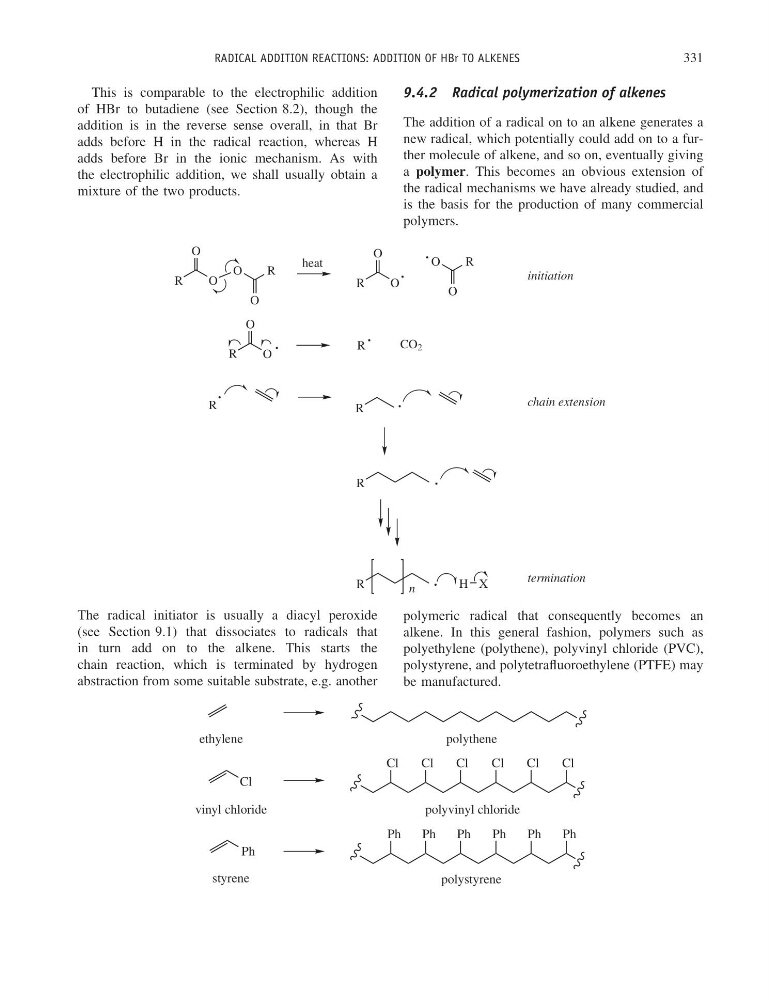
The addition of a radical on to an alkene generates a
new radical, which potentially could add on to a further molecule of alkene, and so on, eventually giving
a polymer. This becomes an obvious extension of
the radical mechanisms we have already studied, and
is the basis for the production of many commercial
polymers.
O
O
R
R
O
O
heat
O
R
O
O
R
O
R
R
R
R
n
H X
initiation
chain extension
termination
R
O
O
CO 2
R
The radical initiator is usually a diacyl peroxide
(see Section 9.1) that dissociates to radicals that
in turn add on to the alkene. This starts the
chain reaction, which is terminated by hydrogen
abstraction from some suitable substrate, e.g. another
polymeric radical that consequently becomes an
alkene. In this general fashion, polymers such as
polyethylene (polythene), polyvinyl chloride (PVC),
polystyrene, and polytetrafluoroethylene (PTFE) may
be manufactured.
Cl
Ph
ethylene
vinyl chloride
styrene
Cl
Cl
Cl
Cl
Cl
Cl
Ph
Ph
Ph
Ph
Ph
Ph
polythene
polyvinyl chloride
polystyrene
331
This is comparable to the electrophilic addition
of HBr to butadiene (see Section 8.2), though the
addition is in the reverse sense overall, in that Br
adds before H in the radical reaction, whereas H
adds before Br in the ionic mechanism. As with
the electrophilic addition, we shall usually obtain a
mixture of the two products.
9.4.2 Radical polymerization of alkenes
The addition of a radical on to an alkene generates a
new radical, which potentially could add on to a further molecule of alkene, and so on, eventually giving
a polymer. This becomes an obvious extension of
the radical mechanisms we have already studied, and
is the basis for the production of many commercial
polymers.
O
O
R
R
O
O
heat
O
R
O
O
R
O
R
R
R
R
n
H X
initiation
chain extension
termination
R
O
O
CO 2
R
The radical initiator is usually a diacyl peroxide
(see Section 9.1) that dissociates to radicals that
in turn add on to the alkene. This starts the
chain reaction, which is terminated by hydrogen
abstraction from some suitable substrate, e.g. another
polymeric radical that consequently becomes an
alkene. In this general fashion, polymers such as
polyethylene (polythene), polyvinyl chloride (PVC),
polystyrene, and polytetrafluoroethylene (PTFE) may
be manufactured.
Cl
Ph
ethylene
vinyl chloride
styrene
Cl
Cl
Cl
Cl
Cl
Cl
Ph
Ph
Ph
Ph
Ph
Ph
polythene
polyvinyl chloride
polystyrene