

330
RADICAL REACTIONS
Electrophilic addition of HBr to propene gives
predominantly the so-called Markovnikov orientation; Markovnikov’s rule states that addition of HX
across a carbon–carbon multiple bond proceeds in
such a way that the proton adds to the less-substituted
carbon atom, i.e. that already bearing the greater
number of hydrogen atoms (see Section 8.1.1). We
rationalized this in terms of formation of the more
favourable carbocation, which in the case of propene
is the secondary carbocation rather than the alternative primary carbocation.
Now, just the same sort of rationalization can
be applied to the radical addition, in that the
more favourable secondary radical is predominantly
produced. This, in turn, leads to addition of HBr
in what is the anti-Markovnikov orientation. The
apparent difference is because the electrophile in
the ionic mechanism is a proton, and bromide
then quenches the resultant cation. In the radical
reaction, the attacking species is a bromine atom,
and a hydrogen atom is then used to quench the
radical. This is effectively a reverse sequence for
the addition process; but, nevertheless, the stability
of the intermediate carbocation or radical is the
defining feature. The terminologies Markovnikov or
anti-Markovnikov orientation may be confusing and
difficult to remember; consider the mechanism and it
all makes sense.
This radical anti-Markovnikov addition of HX
to alkenes is restricted to HBr; both HI and
HCl add in a Markovnikov fashion by an ionic
mechanism, because the radical propagation steps are
not favoured. The C–I bond is relatively weak, so
that addition of an iodine atom to the double bond
is not favoured. On the other hand, the H–Cl bond
is relatively strong and hydrogen abstraction using a
radical is unfavourable. For many years, the addition
of HBr to an alkene seemed quite mysterious and
erratic, with Markovnikov or anti-Markovnikov orientation occurring apparently at random. Eventually,
the problem was solved and traced to the purity of the
compounds used. Impure reagents containing traces
of peroxides led to addition with anti-Markovnikov
orientation, and we can now see that this is the consequence of a radical reaction. Reagents free from peroxides react via the ionic electrophilic addition mechanism, and we thus get predominantly Markovnikov
orientation.
9.4.1 Radical addition of HBr to conjugated
dienes
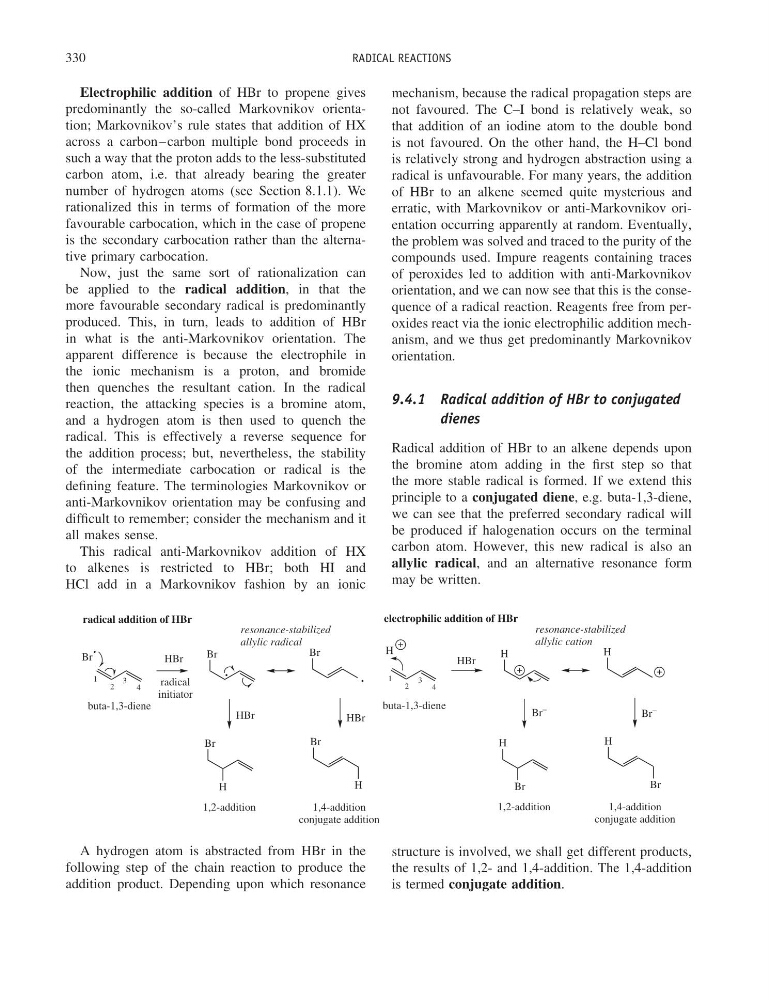
Radical addition of HBr to an alkene depends upon
the bromine atom adding in the first step so that
the more stable radical is formed. If we extend this
principle to a conjugated diene, e.g. buta-1,3-diene,
we can see that the preferred secondary radical will
be produced if halogenation occurs on the terminal
carbon atom. However, this new radical is also an
allylic radical, and an alternative resonance form
may be written.
buta-1,3-diene
Br
Br
resonance-stabilized
allylic radical
1
2
3
4
Br
Br
H
H
1,2-addition
1,4-addition
conjugate addition
Br
HBr
HBr
buta-1,3-diene
H
H
HBr
H
resonance-stabilized
allylic cation
1
2
3
4
H
H
Br
Br
1,2-addition
1,4-addition
conjugate addition
electrophilic addition of HBr
radical addition of HBr
Br −
Br −
HBr
radical
initiator
A hydrogen atom is abstracted from HBr in the
following step of the chain reaction to produce the
addition product. Depending upon which resonance
structure is involved, we shall get different products,
the results of 1,2- and 1,4-addition. The 1,4-addition
is termed conjugate addition.
RADICAL REACTIONS
Electrophilic addition of HBr to propene gives
predominantly the so-called Markovnikov orientation; Markovnikov’s rule states that addition of HX
across a carbon–carbon multiple bond proceeds in
such a way that the proton adds to the less-substituted
carbon atom, i.e. that already bearing the greater
number of hydrogen atoms (see Section 8.1.1). We
rationalized this in terms of formation of the more
favourable carbocation, which in the case of propene
is the secondary carbocation rather than the alternative primary carbocation.
Now, just the same sort of rationalization can
be applied to the radical addition, in that the
more favourable secondary radical is predominantly
produced. This, in turn, leads to addition of HBr
in what is the anti-Markovnikov orientation. The
apparent difference is because the electrophile in
the ionic mechanism is a proton, and bromide
then quenches the resultant cation. In the radical
reaction, the attacking species is a bromine atom,
and a hydrogen atom is then used to quench the
radical. This is effectively a reverse sequence for
the addition process; but, nevertheless, the stability
of the intermediate carbocation or radical is the
defining feature. The terminologies Markovnikov or
anti-Markovnikov orientation may be confusing and
difficult to remember; consider the mechanism and it
all makes sense.
This radical anti-Markovnikov addition of HX
to alkenes is restricted to HBr; both HI and
HCl add in a Markovnikov fashion by an ionic
mechanism, because the radical propagation steps are
not favoured. The C–I bond is relatively weak, so
that addition of an iodine atom to the double bond
is not favoured. On the other hand, the H–Cl bond
is relatively strong and hydrogen abstraction using a
radical is unfavourable. For many years, the addition
of HBr to an alkene seemed quite mysterious and
erratic, with Markovnikov or anti-Markovnikov orientation occurring apparently at random. Eventually,
the problem was solved and traced to the purity of the
compounds used. Impure reagents containing traces
of peroxides led to addition with anti-Markovnikov
orientation, and we can now see that this is the consequence of a radical reaction. Reagents free from peroxides react via the ionic electrophilic addition mechanism, and we thus get predominantly Markovnikov
orientation.
9.4.1 Radical addition of HBr to conjugated
dienes
Radical addition of HBr to an alkene depends upon
the bromine atom adding in the first step so that
the more stable radical is formed. If we extend this
principle to a conjugated diene, e.g. buta-1,3-diene,
we can see that the preferred secondary radical will
be produced if halogenation occurs on the terminal
carbon atom. However, this new radical is also an
allylic radical, and an alternative resonance form
may be written.
buta-1,3-diene
Br
Br
resonance-stabilized
allylic radical
1
2
3
4
Br
Br
H
H
1,2-addition
1,4-addition
conjugate addition
Br
HBr
HBr
buta-1,3-diene
H
H
HBr
H
resonance-stabilized
allylic cation
1
2
3
4
H
H
Br
Br
1,2-addition
1,4-addition
conjugate addition
electrophilic addition of HBr
radical addition of HBr
Br −
Br −
HBr
radical
initiator
A hydrogen atom is abstracted from HBr in the
following step of the chain reaction to produce the
addition product. Depending upon which resonance
structure is involved, we shall get different products,
the results of 1,2- and 1,4-addition. The 1,4-addition
is termed conjugate addition.