

RADICAL ADDITION REACTIONS: ADDITION OF HBr TO ALKENES
329
R O O R
RO
OR
radical initiation by
homolysis of a peroxide
RO
H Br
heat
RO H
Br
alkoxyl radical abstracts hydrogen
from HBr, generating bromine atom
Br
Br
bromine atom adds to double bond,
producing more stable secondary radical
Br
H Br
Br
H
Br
secondary radical abstracts hydrogen
from HBr, generating bromine atom;
chain reaction continues
Br
Br
Br
Br
Br
Br
Br
Br
termination steps, supported by
formation of minor products
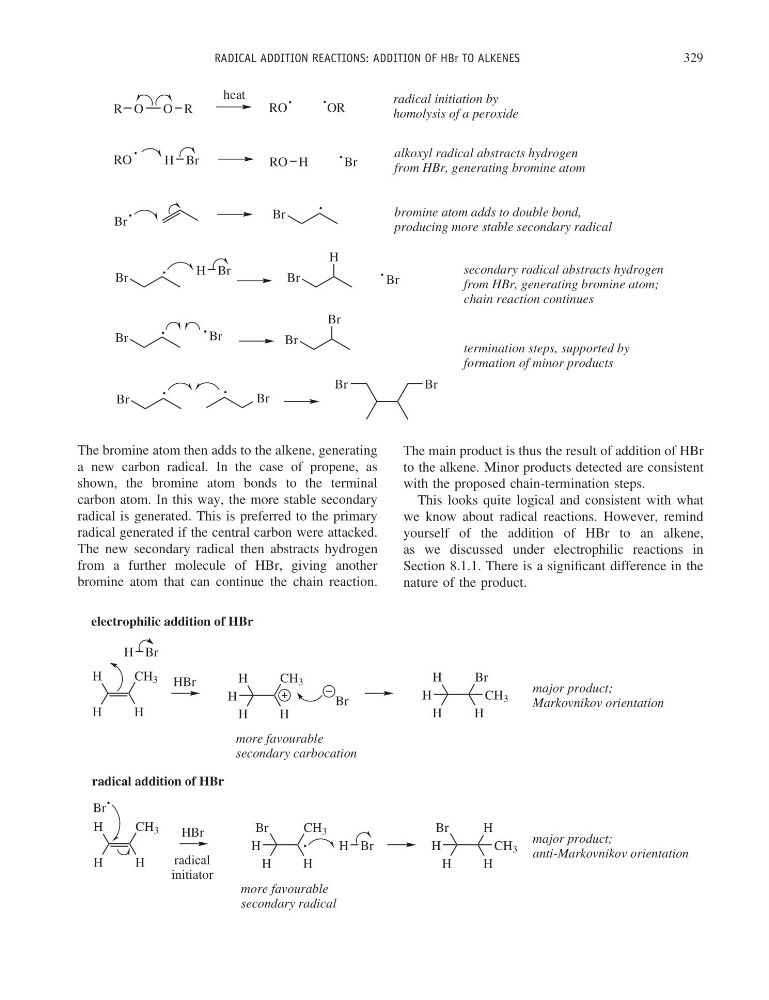
The bromine atom then adds to the alkene, generating
a new carbon radical. In the case of propene, as
shown, the bromine atom bonds to the terminal
carbon atom. In this way, the more stable secondary
radical is generated. This is preferred to the primary
radical generated if the central carbon were attacked.
The new secondary radical then abstracts hydrogen
from a further molecule of HBr, giving another
bromine atom that can continue the chain reaction.
The main product is thus the result of addition of HBr
to the alkene. Minor products detected are consistent
with the proposed chain-termination steps.
This looks quite logical and consistent with what
we know about radical reactions. However, remind
yourself of the addition of HBr to an alkene,
as we discussed under electrophilic reactions in
Section 8.1.1. There is a significant difference in the
nature of the product.
H
H
H
CH 3
H Br
H
H
H
CH 3
H
Br
H
H
H
Br
H
CH 3
more favourable
secondary carbocation
major product;
Markovnikov orientation
HBr
H
H
H
CH 3
HBr
radical
initiator
Br
H
Br
H
CH 3
H
more favourable
secondary radical
H Br
H
Br
H
H
H
CH 3
major product;
anti-Markovnikov orientation
electrophilic addition of HBr
radical addition of HBr
329
R O O R
RO
OR
radical initiation by
homolysis of a peroxide
RO
H Br
heat
RO H
Br
alkoxyl radical abstracts hydrogen
from HBr, generating bromine atom
Br
Br
bromine atom adds to double bond,
producing more stable secondary radical
Br
H Br
Br
H
Br
secondary radical abstracts hydrogen
from HBr, generating bromine atom;
chain reaction continues
Br
Br
Br
Br
Br
Br
Br
Br
termination steps, supported by
formation of minor products
The bromine atom then adds to the alkene, generating
a new carbon radical. In the case of propene, as
shown, the bromine atom bonds to the terminal
carbon atom. In this way, the more stable secondary
radical is generated. This is preferred to the primary
radical generated if the central carbon were attacked.
The new secondary radical then abstracts hydrogen
from a further molecule of HBr, giving another
bromine atom that can continue the chain reaction.
The main product is thus the result of addition of HBr
to the alkene. Minor products detected are consistent
with the proposed chain-termination steps.
This looks quite logical and consistent with what
we know about radical reactions. However, remind
yourself of the addition of HBr to an alkene,
as we discussed under electrophilic reactions in
Section 8.1.1. There is a significant difference in the
nature of the product.
H
H
H
CH 3
H Br
H
H
H
CH 3
H
Br
H
H
H
Br
H
CH 3
more favourable
secondary carbocation
major product;
Markovnikov orientation
HBr
H
H
H
CH 3
HBr
radical
initiator
Br
H
Br
H
CH 3
H
more favourable
secondary radical
H Br
H
Br
H
H
H
CH 3
major product;
anti-Markovnikov orientation
electrophilic addition of HBr
radical addition of HBr