

328
RADICAL REACTIONS
benzyl radical stabilized by
resonance delocalization
H
Br Br
hn
Br
Br
Br
Br Br
Br
Br
HBr
benzyl bromide
toluene
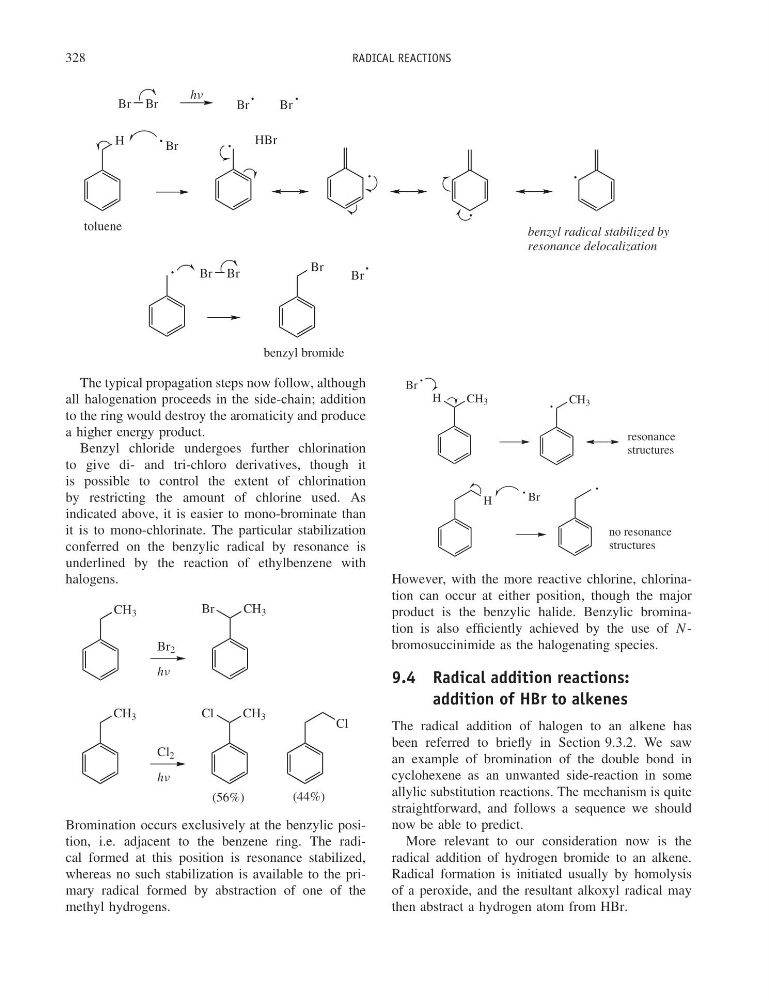
The typical propagation steps now follow, although
all halogenation proceeds in the side-chain; addition
to the ring would destroy the aromaticity and produce
a higher energy product.
Benzyl chloride undergoes further chlorination
to give di- and tri-chloro derivatives, though it
is possible to control the extent of chlorination
by restricting the amount of chlorine used. As
indicated above, it is easier to mono-brominate than
it is to mono-chlorinate. The particular stabilization
conferred on the benzylic radical by resonance is
underlined by the reaction of ethylbenzene with
halogens.
CH 3
Br
CH 3
Br 2
hn
CH 3
CH 3
Cl
Cl 2
hn
Cl
(56%)
(44%)
Bromination occurs exclusively at the benzylic position, i.e. adjacent to the benzene ring. The radical formed at this position is resonance stabilized,
whereas no such stabilization is available to the primary radical formed by abstraction of one of the
methyl hydrogens.
CH 3
H
H
Br
Br
CH 3
resonance
structures
no resonance
structures
However, with the more reactive chlorine, chlorination can occur at either position, though the major
product is the benzylic halide. Benzylic bromination is also efficiently achieved by the use of N -
bromosuccinimide as the halogenating species.
9.4 Radical addition reactions:
addition of HBr to alkenes
The radical addition of halogen to an alkene has
been referred to briefly in Section 9.3.2. We saw
an example of bromination of the double bond in
cyclohexene as an unwanted side-reaction in some
allylic substitution reactions. The mechanism is quite
straightforward, and follows a sequence we should
now be able to predict.
More relevant to our consideration now is the
radical addition of hydrogen bromide to an alkene.
Radical formation is initiated usually by homolysis
of a peroxide, and the resultant alkoxyl radical may
then abstract a hydrogen atom from HBr.
RADICAL REACTIONS
benzyl radical stabilized by
resonance delocalization
H
Br Br
hn
Br
Br
Br
Br Br
Br
Br
HBr
benzyl bromide
toluene
The typical propagation steps now follow, although
all halogenation proceeds in the side-chain; addition
to the ring would destroy the aromaticity and produce
a higher energy product.
Benzyl chloride undergoes further chlorination
to give di- and tri-chloro derivatives, though it
is possible to control the extent of chlorination
by restricting the amount of chlorine used. As
indicated above, it is easier to mono-brominate than
it is to mono-chlorinate. The particular stabilization
conferred on the benzylic radical by resonance is
underlined by the reaction of ethylbenzene with
halogens.
CH 3
Br
CH 3
Br 2
hn
CH 3
CH 3
Cl
Cl 2
hn
Cl
(56%)
(44%)
Bromination occurs exclusively at the benzylic position, i.e. adjacent to the benzene ring. The radical formed at this position is resonance stabilized,
whereas no such stabilization is available to the primary radical formed by abstraction of one of the
methyl hydrogens.
CH 3
H
H
Br
Br
CH 3
resonance
structures
no resonance
structures
However, with the more reactive chlorine, chlorination can occur at either position, though the major
product is the benzylic halide. Benzylic bromination is also efficiently achieved by the use of N -
bromosuccinimide as the halogenating species.
9.4 Radical addition reactions:
addition of HBr to alkenes
The radical addition of halogen to an alkene has
been referred to briefly in Section 9.3.2. We saw
an example of bromination of the double bond in
cyclohexene as an unwanted side-reaction in some
allylic substitution reactions. The mechanism is quite
straightforward, and follows a sequence we should
now be able to predict.
More relevant to our consideration now is the
radical addition of hydrogen bromide to an alkene.
Radical formation is initiated usually by homolysis
of a peroxide, and the resultant alkoxyl radical may
then abstract a hydrogen atom from HBr.