

RADICAL SUBSTITUTION REACTIONS: HALOGENATION
327
Of course, we have also seen that bromine can
react with a double bond via electrophilic addition
(see Section 8.1.2); further, it can add to a double
bond via a radical mechanism.
Br
Br
Br Br
Br
Br
This could complicate an allylic bromination reaction,
and it is necessary to choose conditions that minimize
any addition to the double bond. This is achieved
by carrying out the reaction in a solvent of low
polarity, e.g. CCl 4 , which suppresses the possibility
of the polar electrophilic addition, whilst keeping the
concentration of bromine very low to suppress radical
addition.
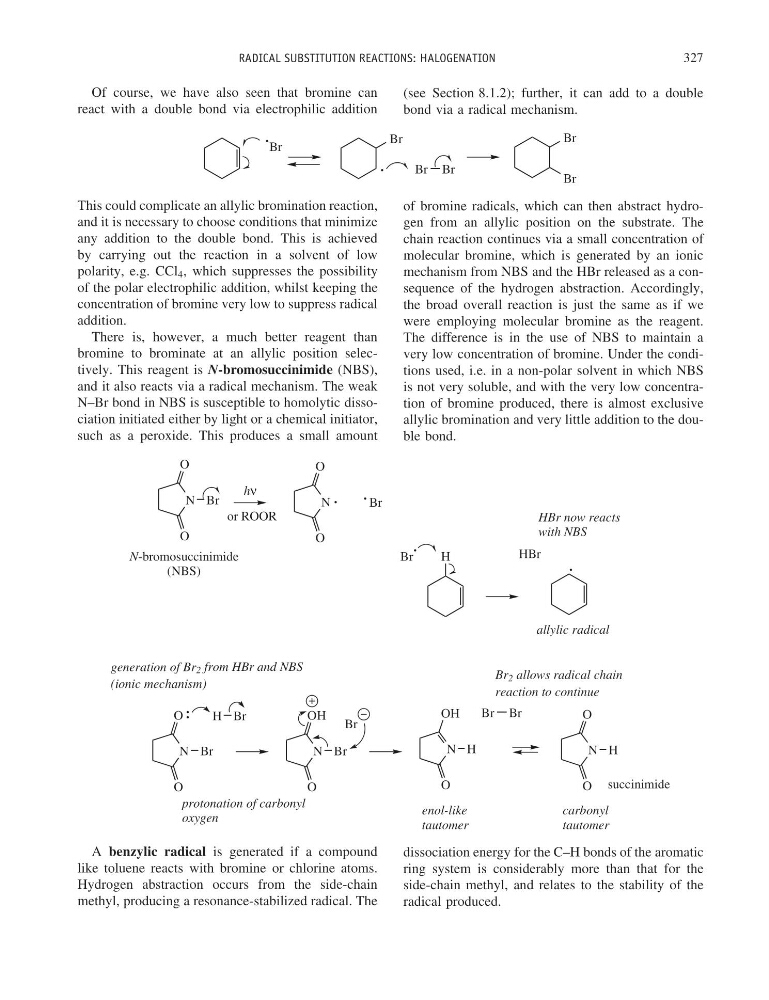
There is, however, a much better reagent than
bromine to brominate at an allylic position selectively. This reagent is N-bromosuccinimide (NBS),
and it also reacts via a radical mechanism. The weak
N–Br bond in NBS is susceptible to homolytic dissociation initiated either by light or a chemical initiator,
such as a peroxide. This produces a small amount
of bromine radicals, which can then abstract hydrogen from an allylic position on the substrate. The
chain reaction continues via a small concentration of
molecular bromine, which is generated by an ionic
mechanism from NBS and the HBr released as a consequence of the hydrogen abstraction. Accordingly,
the broad overall reaction is just the same as if we
were employing molecular bromine as the reagent.
The difference is in the use of NBS to maintain a
very low concentration of bromine. Under the conditions used, i.e. in a non-polar solvent in which NBS
is not very soluble, and with the very low concentration of bromine produced, there is almost exclusive
allylic bromination and very little addition to the double bond.
N
O
O
Br
N-bromosuccinimide
(NBS)
hν
N
O
O
Br
N
O
O
Br
H Br
N
O
O
H
Br Br
succinimide
H
Br
HBr
or ROOR
N
OH
O
Br
Br
N
OH
O
H
protonation of carbonyl
oxygen
enol-like
tautomer
carbonyl
tautomer
generation of Br 2 from HBr and NBS
(ionic mechanism)
HBr now reacts
with NBS
allylic radical
Br 2 allows radical chain
reaction to continue
A benzylic radical is generated if a compound
like toluene reacts with bromine or chlorine atoms.
Hydrogen abstraction occurs from the side-chain
methyl, producing a resonance-stabilized radical. The
dissociation energy for the C–H bonds of the aromatic
ring system is considerably more than that for the
side-chain methyl, and relates to the stability of the
radical produced.
327
Of course, we have also seen that bromine can
react with a double bond via electrophilic addition
(see Section 8.1.2); further, it can add to a double
bond via a radical mechanism.
Br
Br
Br Br
Br
Br
This could complicate an allylic bromination reaction,
and it is necessary to choose conditions that minimize
any addition to the double bond. This is achieved
by carrying out the reaction in a solvent of low
polarity, e.g. CCl 4 , which suppresses the possibility
of the polar electrophilic addition, whilst keeping the
concentration of bromine very low to suppress radical
addition.
There is, however, a much better reagent than
bromine to brominate at an allylic position selectively. This reagent is N-bromosuccinimide (NBS),
and it also reacts via a radical mechanism. The weak
N–Br bond in NBS is susceptible to homolytic dissociation initiated either by light or a chemical initiator,
such as a peroxide. This produces a small amount
of bromine radicals, which can then abstract hydrogen from an allylic position on the substrate. The
chain reaction continues via a small concentration of
molecular bromine, which is generated by an ionic
mechanism from NBS and the HBr released as a consequence of the hydrogen abstraction. Accordingly,
the broad overall reaction is just the same as if we
were employing molecular bromine as the reagent.
The difference is in the use of NBS to maintain a
very low concentration of bromine. Under the conditions used, i.e. in a non-polar solvent in which NBS
is not very soluble, and with the very low concentration of bromine produced, there is almost exclusive
allylic bromination and very little addition to the double bond.
N
O
O
Br
N-bromosuccinimide
(NBS)
hν
N
O
O
Br
N
O
O
Br
H Br
N
O
O
H
Br Br
succinimide
H
Br
HBr
or ROOR
N
OH
O
Br
Br
N
OH
O
H
protonation of carbonyl
oxygen
enol-like
tautomer
carbonyl
tautomer
generation of Br 2 from HBr and NBS
(ionic mechanism)
HBr now reacts
with NBS
allylic radical
Br 2 allows radical chain
reaction to continue
A benzylic radical is generated if a compound
like toluene reacts with bromine or chlorine atoms.
Hydrogen abstraction occurs from the side-chain
methyl, producing a resonance-stabilized radical. The
dissociation energy for the C–H bonds of the aromatic
ring system is considerably more than that for the
side-chain methyl, and relates to the stability of the
radical produced.