

RADICAL SUBSTITUTION REACTIONS: HALOGENATION
323
Cl 2
hn
Cl
HCl
+
cyclohexane
cyclohexyl chloride
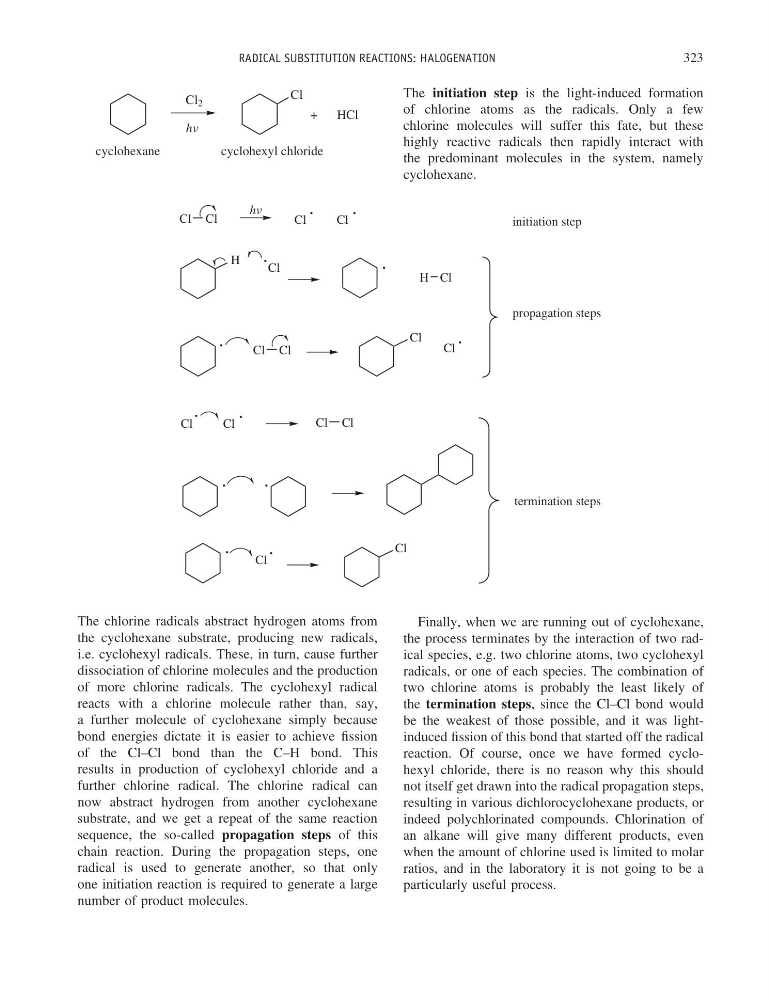
The initiation step is the light-induced formation
of chlorine atoms as the radicals. Only a few
chlorine molecules will suffer this fate, but these
highly reactive radicals then rapidly interact with
the predominant molecules in the system, namely
cyclohexane.
Cl Cl
hn
Cl
Cl
initiation step
H
Cl
H Cl
Cl Cl
Cl
Cl
propagation steps
Cl
Cl
Cl Cl
Cl
Cl
termination steps
The chlorine radicals abstract hydrogen atoms from
the cyclohexane substrate, producing new radicals,
i.e. cyclohexyl radicals. These, in turn, cause further
dissociation of chlorine molecules and the production
of more chlorine radicals. The cyclohexyl radical
reacts with a chlorine molecule rather than, say,
a further molecule of cyclohexane simply because
bond energies dictate it is easier to achieve fission
of the Cl–Cl bond than the C–H bond. This
results in production of cyclohexyl chloride and a
further chlorine radical. The chlorine radical can
now abstract hydrogen from another cyclohexane
substrate, and we get a repeat of the same reaction
sequence, the so-called propagation steps of this
chain reaction. During the propagation steps, one
radical is used to generate another, so that only
one initiation reaction is required to generate a large
number of product molecules.
Finally, when we are running out of cyclohexane,
the process terminates by the interaction of two radical species, e.g. two chlorine atoms, two cyclohexyl
radicals, or one of each species. The combination of
two chlorine atoms is probably the least likely of
the termination steps, since the Cl–Cl bond would
be the weakest of those possible, and it was lightinduced fission of this bond that started off the radical
reaction. Of course, once we have formed cyclohexyl chloride, there is no reason why this should
not itself get drawn into the radical propagation steps,
resulting in various dichlorocyclohexane products, or
indeed polychlorinated compounds. Chlorination of
an alkane will give many different products, even
when the amount of chlorine used is limited to molar
ratios, and in the laboratory it is not going to be a
particularly useful process.
323
Cl 2
hn
Cl
HCl
+
cyclohexane
cyclohexyl chloride
The initiation step is the light-induced formation
of chlorine atoms as the radicals. Only a few
chlorine molecules will suffer this fate, but these
highly reactive radicals then rapidly interact with
the predominant molecules in the system, namely
cyclohexane.
Cl Cl
hn
Cl
Cl
initiation step
H
Cl
H Cl
Cl Cl
Cl
Cl
propagation steps
Cl
Cl
Cl Cl
Cl
Cl
termination steps
The chlorine radicals abstract hydrogen atoms from
the cyclohexane substrate, producing new radicals,
i.e. cyclohexyl radicals. These, in turn, cause further
dissociation of chlorine molecules and the production
of more chlorine radicals. The cyclohexyl radical
reacts with a chlorine molecule rather than, say,
a further molecule of cyclohexane simply because
bond energies dictate it is easier to achieve fission
of the Cl–Cl bond than the C–H bond. This
results in production of cyclohexyl chloride and a
further chlorine radical. The chlorine radical can
now abstract hydrogen from another cyclohexane
substrate, and we get a repeat of the same reaction
sequence, the so-called propagation steps of this
chain reaction. During the propagation steps, one
radical is used to generate another, so that only
one initiation reaction is required to generate a large
number of product molecules.
Finally, when we are running out of cyclohexane,
the process terminates by the interaction of two radical species, e.g. two chlorine atoms, two cyclohexyl
radicals, or one of each species. The combination of
two chlorine atoms is probably the least likely of
the termination steps, since the Cl–Cl bond would
be the weakest of those possible, and it was lightinduced fission of this bond that started off the radical
reaction. Of course, once we have formed cyclohexyl chloride, there is no reason why this should
not itself get drawn into the radical propagation steps,
resulting in various dichlorocyclohexane products, or
indeed polychlorinated compounds. Chlorination of
an alkane will give many different products, even
when the amount of chlorine used is limited to molar
ratios, and in the laboratory it is not going to be a
particularly useful process.