

322
RADICAL REACTIONS
R
R
R
tertiary radical
R
R
H
secondary radical
R
H
H
primary radical
H
H
H
methyl radical
>
>
>
relative stabilities:
C
C
H
H
H
overlap from σ bond into
singly occupied p orbital
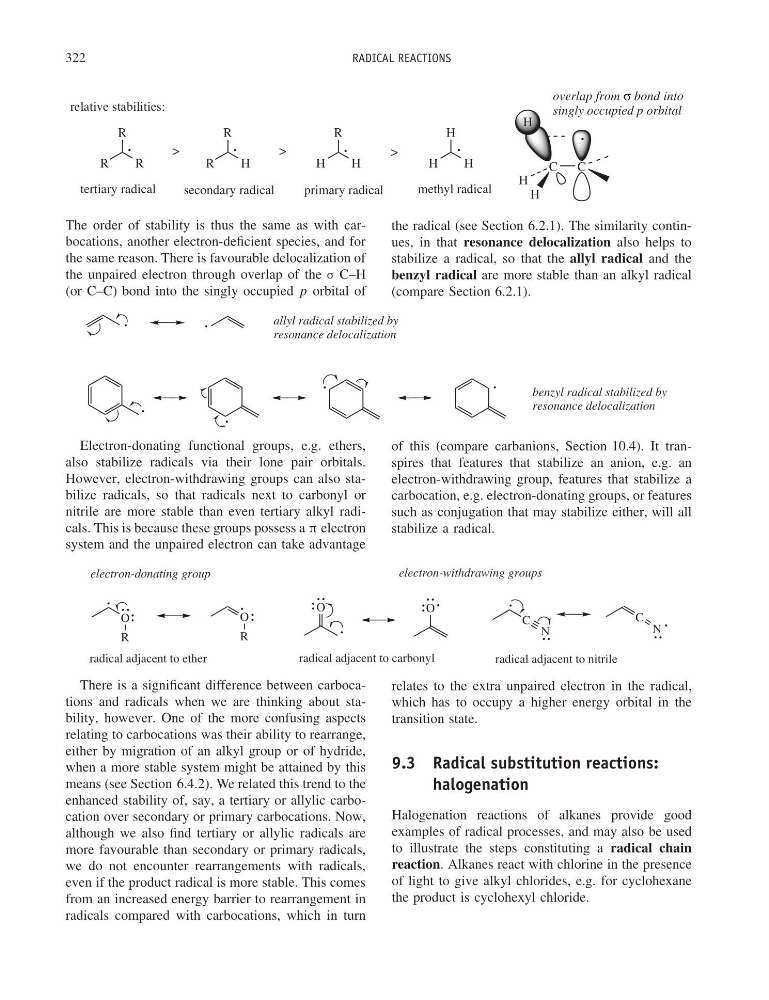
The order of stability is thus the same as with carbocations, another electron-deficient species, and for
the same reason. There is favourable delocalization of
the unpaired electron through overlap of the σ C–H
(or C–C) bond into the singly occupied p orbital of
the radical (see Section 6.2.1). The similarity continues, in that resonance delocalization also helps to
stabilize a radical, so that the allyl radical and the
benzyl radical are more stable than an alkyl radical
(compare Section 6.2.1).
allyl radical stabilized by
resonance delocalization
benzyl radical stabilized by
resonance delocalization
Electron-donating functional groups, e.g. ethers,
also stabilize radicals via their lone pair orbitals.
However, electron-withdrawing groups can also stabilize radicals, so that radicals next to carbonyl or
nitrile are more stable than even tertiary alkyl radicals. This is because these groups possess a π electron
system and the unpaired electron can take advantage
of this (compare carbanions, Section 10.4). It transpires that features that stabilize an anion, e.g. an
electron-withdrawing group, features that stabilize a
carbocation, e.g. electron-donating groups, or features
such as conjugation that may stabilize either, will all
stabilize a radical.
O
R
O
R
radical adjacent to ether
O
O
C
N
C
N
radical adjacent to carbonyl
radical adjacent to nitrile
electron-donating group
electron-withdrawing groups
There is a significant difference between carbocations and radicals when we are thinking about stability, however. One of the more confusing aspects
relating to carbocations was their ability to rearrange,
either by migration of an alkyl group or of hydride,
when a more stable system might be attained by this
means (see Section 6.4.2). We related this trend to the
enhanced stability of, say, a tertiary or allylic carbocation over secondary or primary carbocations. Now,
although we also find tertiary or allylic radicals are
more favourable than secondary or primary radicals,
we do not encounter rearrangements with radicals,
even if the product radical is more stable. This comes
from an increased energy barrier to rearrangement in
radicals compared with carbocations, which in turn
relates to the extra unpaired electron in the radical,
which has to occupy a higher energy orbital in the
transition state.
9.3 Radical substitution reactions:
halogenation
Halogenation reactions of alkanes provide good
examples of radical processes, and may also be used
to illustrate the steps constituting a radical chain
reaction. Alkanes react with chlorine in the presence
of light to give alkyl chlorides, e.g. for cyclohexane
the product is cyclohexyl chloride.
RADICAL REACTIONS
R
R
R
tertiary radical
R
R
H
secondary radical
R
H
H
primary radical
H
H
H
methyl radical
>
>
>
relative stabilities:
C
C
H
H
H
overlap from σ bond into
singly occupied p orbital
The order of stability is thus the same as with carbocations, another electron-deficient species, and for
the same reason. There is favourable delocalization of
the unpaired electron through overlap of the σ C–H
(or C–C) bond into the singly occupied p orbital of
the radical (see Section 6.2.1). The similarity continues, in that resonance delocalization also helps to
stabilize a radical, so that the allyl radical and the
benzyl radical are more stable than an alkyl radical
(compare Section 6.2.1).
allyl radical stabilized by
resonance delocalization
benzyl radical stabilized by
resonance delocalization
Electron-donating functional groups, e.g. ethers,
also stabilize radicals via their lone pair orbitals.
However, electron-withdrawing groups can also stabilize radicals, so that radicals next to carbonyl or
nitrile are more stable than even tertiary alkyl radicals. This is because these groups possess a π electron
system and the unpaired electron can take advantage
of this (compare carbanions, Section 10.4). It transpires that features that stabilize an anion, e.g. an
electron-withdrawing group, features that stabilize a
carbocation, e.g. electron-donating groups, or features
such as conjugation that may stabilize either, will all
stabilize a radical.
O
R
O
R
radical adjacent to ether
O
O
C
N
C
N
radical adjacent to carbonyl
radical adjacent to nitrile
electron-donating group
electron-withdrawing groups
There is a significant difference between carbocations and radicals when we are thinking about stability, however. One of the more confusing aspects
relating to carbocations was their ability to rearrange,
either by migration of an alkyl group or of hydride,
when a more stable system might be attained by this
means (see Section 6.4.2). We related this trend to the
enhanced stability of, say, a tertiary or allylic carbocation over secondary or primary carbocations. Now,
although we also find tertiary or allylic radicals are
more favourable than secondary or primary radicals,
we do not encounter rearrangements with radicals,
even if the product radical is more stable. This comes
from an increased energy barrier to rearrangement in
radicals compared with carbocations, which in turn
relates to the extra unpaired electron in the radical,
which has to occupy a higher energy orbital in the
transition state.
9.3 Radical substitution reactions:
halogenation
Halogenation reactions of alkanes provide good
examples of radical processes, and may also be used
to illustrate the steps constituting a radical chain
reaction. Alkanes react with chlorine in the presence
of light to give alkyl chlorides, e.g. for cyclohexane
the product is cyclohexyl chloride.