

STRUCTURE AND STABILITY OF RADICALS
321
R O
H Br
RO H
Br
hydrogen atom abstraction
R O
H Br
RO H
Br
proton removal − acidity
S N 2 reaction
R O
H 3 C Br
RO CH 3
Br
one-electron mechanism
two-electron mechanism
two-electron mechanism
Compare:
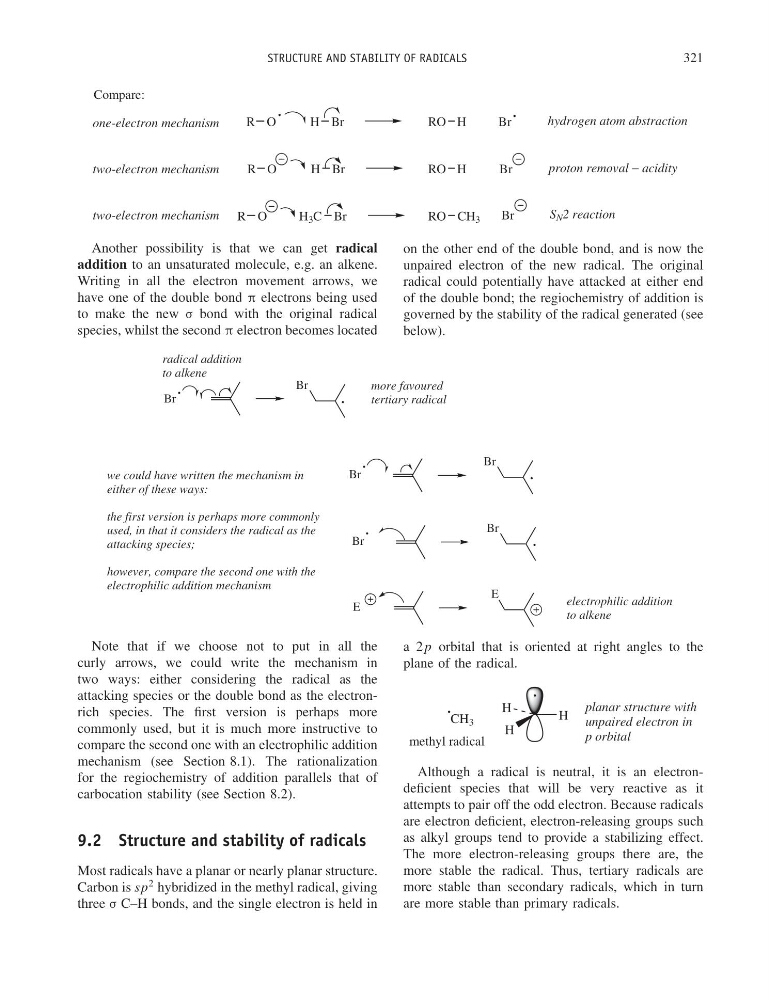
Another possibility is that we can get radical
addition to an unsaturated molecule, e.g. an alkene.
Writing in all the electron movement arrows, we
have one of the double bond π electrons being used
to make the new σ bond with the original radical
species, whilst the second π electron becomes located
on the other end of the double bond, and is now the
unpaired electron of the new radical. The original
radical could potentially have attacked at either end
of the double bond; the regiochemistry of addition is
governed by the stability of the radical generated (see
below).
Br
Br
radical addition
to alkene
Br
Br
E
E
Br
Br
more favoured
tertiary radical
electrophilic addition
to alkene
we could have written the mechanism in
either of these ways:
the first version is perhaps more commonly
used, in that it considers the radical as the
attacking species;
however, compare the second one with the
electrophilic addition mechanism
Note that if we choose not to put in all the
curly arrows, we could write the mechanism in
two ways: either considering the radical as the
attacking species or the double bond as the electronrich species. The first version is perhaps more
commonly used, but it is much more instructive to
compare the second one with an electrophilic addition
mechanism (see Section 8.1). The rationalization
for the regiochemistry of addition parallels that of
carbocation stability (see Section 8.2).
9.2 Structure and stability of radicals
Most radicals have a planar or nearly planar structure.
Carbon is sp
2 hybridized in the methyl radical, giving
three σ C–H bonds, and the single electron is held in
a 2p orbital that is oriented at right angles to the
plane of the radical.
H
H
H
CH 3
methyl radical
planar structure with
unpaired electron in
p orbital
Although a radical is neutral, it is an electrondeficient species that will be very reactive as it
attempts to pair off the odd electron. Because radicals
are electron deficient, electron-releasing groups such
as alkyl groups tend to provide a stabilizing effect.
The more electron-releasing groups there are, the
more stable the radical. Thus, tertiary radicals are
more stable than secondary radicals, which in turn
are more stable than primary radicals.
321
R O
H Br
RO H
Br
hydrogen atom abstraction
R O
H Br
RO H
Br
proton removal − acidity
S N 2 reaction
R O
H 3 C Br
RO CH 3
Br
one-electron mechanism
two-electron mechanism
two-electron mechanism
Compare:
Another possibility is that we can get radical
addition to an unsaturated molecule, e.g. an alkene.
Writing in all the electron movement arrows, we
have one of the double bond π electrons being used
to make the new σ bond with the original radical
species, whilst the second π electron becomes located
on the other end of the double bond, and is now the
unpaired electron of the new radical. The original
radical could potentially have attacked at either end
of the double bond; the regiochemistry of addition is
governed by the stability of the radical generated (see
below).
Br
Br
radical addition
to alkene
Br
Br
E
E
Br
Br
more favoured
tertiary radical
electrophilic addition
to alkene
we could have written the mechanism in
either of these ways:
the first version is perhaps more commonly
used, in that it considers the radical as the
attacking species;
however, compare the second one with the
electrophilic addition mechanism
Note that if we choose not to put in all the
curly arrows, we could write the mechanism in
two ways: either considering the radical as the
attacking species or the double bond as the electronrich species. The first version is perhaps more
commonly used, but it is much more instructive to
compare the second one with an electrophilic addition
mechanism (see Section 8.1). The rationalization
for the regiochemistry of addition parallels that of
carbocation stability (see Section 8.2).
9.2 Structure and stability of radicals
Most radicals have a planar or nearly planar structure.
Carbon is sp
2 hybridized in the methyl radical, giving
three σ C–H bonds, and the single electron is held in
a 2p orbital that is oriented at right angles to the
plane of the radical.
H
H
H
CH 3
methyl radical
planar structure with
unpaired electron in
p orbital
Although a radical is neutral, it is an electrondeficient species that will be very reactive as it
attempts to pair off the odd electron. Because radicals
are electron deficient, electron-releasing groups such
as alkyl groups tend to provide a stabilizing effect.
The more electron-releasing groups there are, the
more stable the radical. Thus, tertiary radicals are
more stable than secondary radicals, which in turn
are more stable than primary radicals.