

320
RADICAL REACTIONS
and azoisobutyronitrile (AIBN) are good sources of
radicals under typical reaction conditions.
At increased temperatures, the peroxide bond is
cleaved homolytically, giving radicals. Dibenzoyl
peroxide is a diacyl peroxide and cleaves rather
more readily than the dialkyl peroxide, but further
decomposition then occurs in which carbon dioxide
is lost, and the phenyl radical is produced. This
displacement is favoured by the inherent stability of
carbon dioxide.
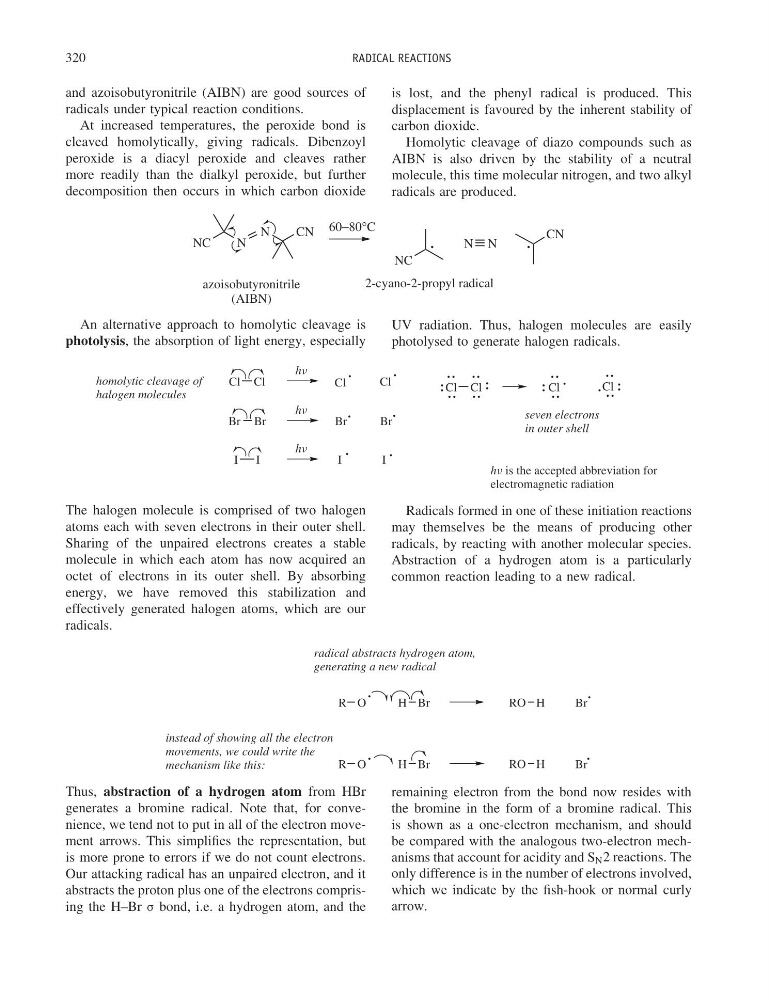
Homolytic cleavage of diazo compounds such as
AIBN is also driven by the stability of a neutral
molecule, this time molecular nitrogen, and two alkyl
radicals are produced.
NC
N
N
CN
azoisobutyronitrile
(AIBN)
NC
CN
N
N
60−80°C
2-cyano-2-propyl radical
An alternative approach to homolytic cleavage is
photolysis, the absorption of light energy, especially
UV radiation. Thus, halogen molecules are easily
photolysed to generate halogen radicals.
Cl Cl
hn
Cl
Cl
Br Br
hn
Br
Br
I I
hn
I
I
Cl Cl
Cl
Cl
seven electrons
in outer shell
homolytic cleavage of
halogen molecules
hn is the accepted abbreviation for
electromagnetic radiation
The halogen molecule is comprised of two halogen
atoms each with seven electrons in their outer shell.
Sharing of the unpaired electrons creates a stable
molecule in which each atom has now acquired an
octet of electrons in its outer shell. By absorbing
energy, we have removed this stabilization and
effectively generated halogen atoms, which are our
radicals.
Radicals formed in one of these initiation reactions
may themselves be the means of producing other
radicals, by reacting with another molecular species.
Abstraction of a hydrogen atom is a particularly
common reaction leading to a new radical.
R O
H Br
radical abstracts hydrogen atom,
generating a new radical
RO H
Br
R O
H Br
RO H
Br
instead of showing all the electron
movements, we could write the
mechanism like this:
Thus, abstraction of a hydrogen atom from HBr
generates a bromine radical. Note that, for convenience, we tend not to put in all of the electron movement arrows. This simplifies the representation, but
is more prone to errors if we do not count electrons.
Our attacking radical has an unpaired electron, and it
abstracts the proton plus one of the electrons comprising the H–Br σ bond, i.e. a hydrogen atom, and the
remaining electron from the bond now resides with
the bromine in the form of a bromine radical. This
is shown as a one-electron mechanism, and should
be compared with the analogous two-electron mechanisms that account for acidity and S N 2 reactions. The
only difference is in the number of electrons involved,
which we indicate by the fish-hook or normal curly
arrow.
RADICAL REACTIONS
and azoisobutyronitrile (AIBN) are good sources of
radicals under typical reaction conditions.
At increased temperatures, the peroxide bond is
cleaved homolytically, giving radicals. Dibenzoyl
peroxide is a diacyl peroxide and cleaves rather
more readily than the dialkyl peroxide, but further
decomposition then occurs in which carbon dioxide
is lost, and the phenyl radical is produced. This
displacement is favoured by the inherent stability of
carbon dioxide.
Homolytic cleavage of diazo compounds such as
AIBN is also driven by the stability of a neutral
molecule, this time molecular nitrogen, and two alkyl
radicals are produced.
NC
N
N
CN
azoisobutyronitrile
(AIBN)
NC
CN
N
N
60−80°C
2-cyano-2-propyl radical
An alternative approach to homolytic cleavage is
photolysis, the absorption of light energy, especially
UV radiation. Thus, halogen molecules are easily
photolysed to generate halogen radicals.
Cl Cl
hn
Cl
Cl
Br Br
hn
Br
Br
I I
hn
I
I
Cl Cl
Cl
Cl
seven electrons
in outer shell
homolytic cleavage of
halogen molecules
hn is the accepted abbreviation for
electromagnetic radiation
The halogen molecule is comprised of two halogen
atoms each with seven electrons in their outer shell.
Sharing of the unpaired electrons creates a stable
molecule in which each atom has now acquired an
octet of electrons in its outer shell. By absorbing
energy, we have removed this stabilization and
effectively generated halogen atoms, which are our
radicals.
Radicals formed in one of these initiation reactions
may themselves be the means of producing other
radicals, by reacting with another molecular species.
Abstraction of a hydrogen atom is a particularly
common reaction leading to a new radical.
R O
H Br
radical abstracts hydrogen atom,
generating a new radical
RO H
Br
R O
H Br
RO H
Br
instead of showing all the electron
movements, we could write the
mechanism like this:
Thus, abstraction of a hydrogen atom from HBr
generates a bromine radical. Note that, for convenience, we tend not to put in all of the electron movement arrows. This simplifies the representation, but
is more prone to errors if we do not count electrons.
Our attacking radical has an unpaired electron, and it
abstracts the proton plus one of the electrons comprising the H–Br σ bond, i.e. a hydrogen atom, and the
remaining electron from the bond now resides with
the bromine in the form of a bromine radical. This
is shown as a one-electron mechanism, and should
be compared with the analogous two-electron mechanisms that account for acidity and S N 2 reactions. The
only difference is in the number of electrons involved,
which we indicate by the fish-hook or normal curly
arrow.