

9
Radical reactions
9.1 Formation of radicals
The ionization of HBr distributes the two electrons
of the single H–Br bond so that the electronegative
bromine accepts electrons whilst hydrogen loses
electrons, and the resultant ions are thus H
+ and Br
− .
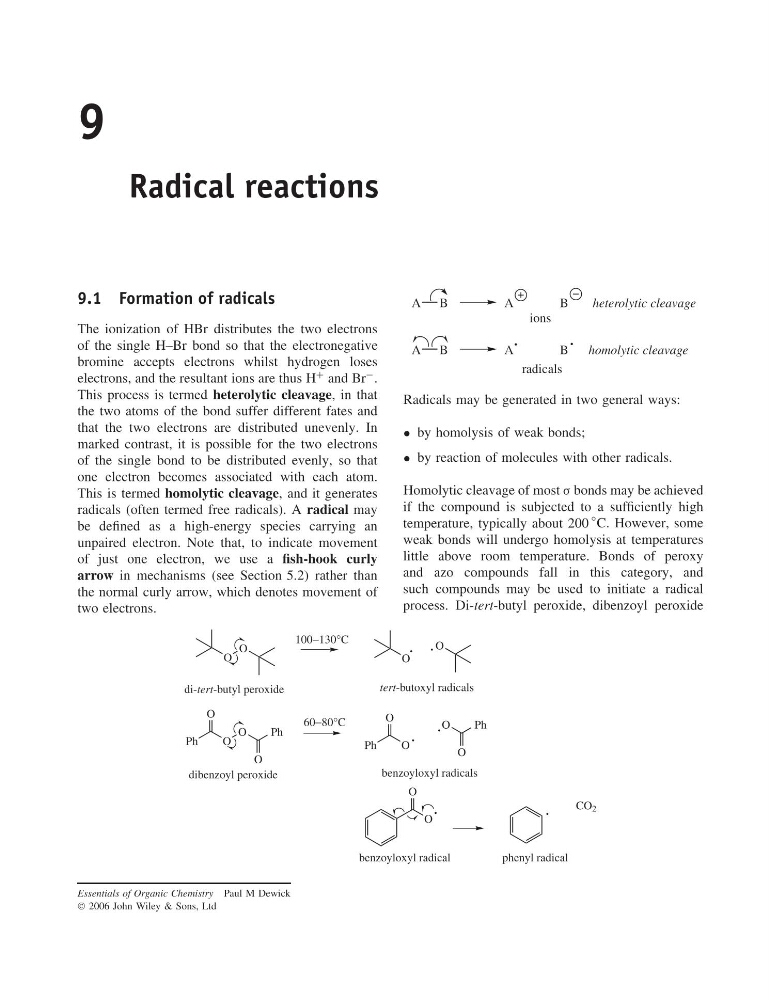
This process is termed heterolytic cleavage, in that
the two atoms of the bond suffer different fates and
that the two electrons are distributed unevenly. In
marked contrast, it is possible for the two electrons
of the single bond to be distributed evenly, so that
one electron becomes associated with each atom.
This is termed homolytic cleavage, and it generates
radicals (often termed free radicals). A radical may
be defined as a high-energy species carrying an
unpaired electron. Note that, to indicate movement
of just one electron, we use a fish-hook curly
arrow in mechanisms (see Section 5.2) rather than
the normal curly arrow, which denotes movement of
two electrons.
A B
A
B
A B
A
B
heterolytic cleavage
homolytic cleavage
radicals
ions
Radicals may be generated in two general ways:
• by homolysis of weak bonds;
• by reaction of molecules with other radicals.
Homolytic cleavage of most σ bonds may be achieved
if the compound is subjected to a sufficiently high
temperature, typically about 200
◦ C. However, some
weak bonds will undergo homolysis at temperatures
little above room temperature. Bonds of peroxy
and azo compounds fall in this category, and
such compounds may be used to initiate a radical
process. Di-tert-butyl peroxide, dibenzoyl peroxide
Ph
O
O
Ph
O
O
dibenzoyl peroxide
O
Ph
O
O
O
Ph
60−80°C
O
O
CO 2
phenyl radical
benzoyloxyl radicals
O
O
100−130°C
O
O
di-tert-butyl peroxide
tert-butoxyl radicals
benzoyloxyl radical
Essentials of Organic Chemistry Paul M Dewick
2006 John Wiley & Sons, Ltd
Radical reactions
9.1 Formation of radicals
The ionization of HBr distributes the two electrons
of the single H–Br bond so that the electronegative
bromine accepts electrons whilst hydrogen loses
electrons, and the resultant ions are thus H
+ and Br
− .
This process is termed heterolytic cleavage, in that
the two atoms of the bond suffer different fates and
that the two electrons are distributed unevenly. In
marked contrast, it is possible for the two electrons
of the single bond to be distributed evenly, so that
one electron becomes associated with each atom.
This is termed homolytic cleavage, and it generates
radicals (often termed free radicals). A radical may
be defined as a high-energy species carrying an
unpaired electron. Note that, to indicate movement
of just one electron, we use a fish-hook curly
arrow in mechanisms (see Section 5.2) rather than
the normal curly arrow, which denotes movement of
two electrons.
A B
A
B
A B
A
B
heterolytic cleavage
homolytic cleavage
radicals
ions
Radicals may be generated in two general ways:
• by homolysis of weak bonds;
• by reaction of molecules with other radicals.
Homolytic cleavage of most σ bonds may be achieved
if the compound is subjected to a sufficiently high
temperature, typically about 200
◦ C. However, some
weak bonds will undergo homolysis at temperatures
little above room temperature. Bonds of peroxy
and azo compounds fall in this category, and
such compounds may be used to initiate a radical
process. Di-tert-butyl peroxide, dibenzoyl peroxide
Ph
O
O
Ph
O
O
dibenzoyl peroxide
O
Ph
O
O
O
Ph
60−80°C
O
O
CO 2
phenyl radical
benzoyloxyl radicals
O
O
100−130°C
O
O
di-tert-butyl peroxide
tert-butoxyl radicals
benzoyloxyl radical
Essentials of Organic Chemistry Paul M Dewick
2006 John Wiley & Sons, Ltd