

324
RADICAL REACTIONS
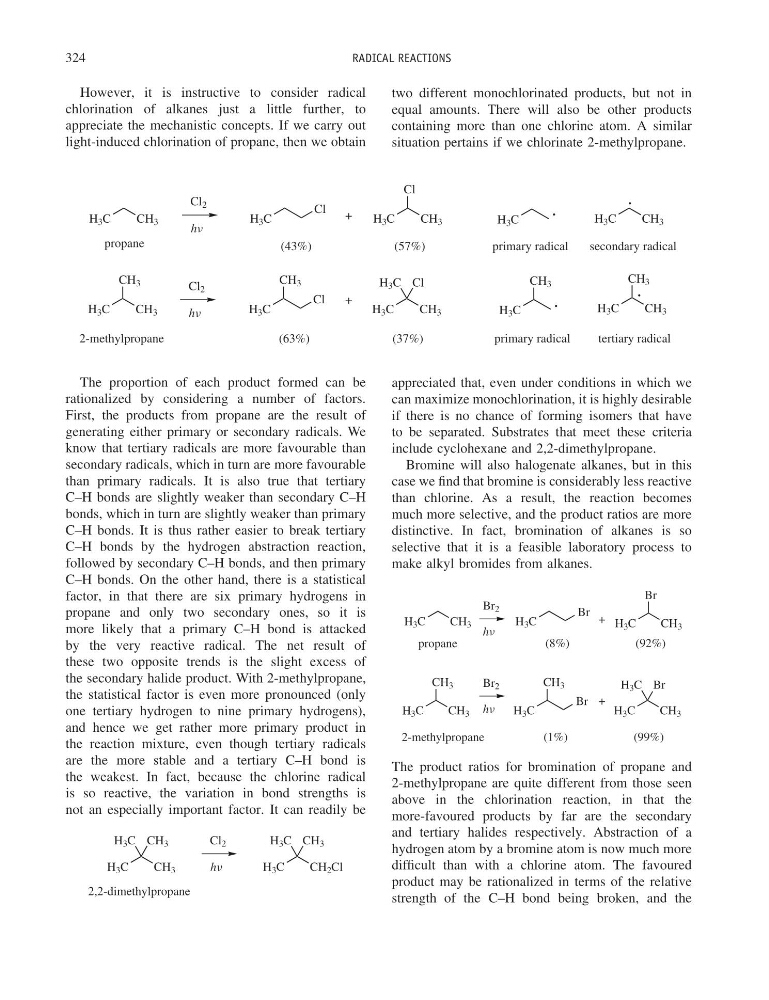
However, it is instructive to consider radical
chlorination of alkanes just a little further, to
appreciate the mechanistic concepts. If we carry out
light-induced chlorination of propane, then we obtain
two different monochlorinated products, but not in
equal amounts. There will also be other products
containing more than one chlorine atom. A similar
situation pertains if we chlorinate 2-methylpropane.
H 3 C
CH 3
Cl 2
hn
H 3 C
Cl
H 3 C
CH 3
+
Cl
(43%)
(57%)
H 3 C
CH 3
Cl 2
hn
H 3 C
Cl
H 3 C
CH 3
+
(63%)
(37%)
CH 3
CH 3
Cl
H 3 C
H 3 C
H 3 C
CH 3
H 3 C
H 3 C
CH 3
CH 3
CH 3
primary radical
secondary radical
primary radical
tertiary radical
propane
2-methylpropane
The proportion of each product formed can be
rationalized by considering a number of factors.
First, the products from propane are the result of
generating either primary or secondary radicals. We
know that tertiary radicals are more favourable than
secondary radicals, which in turn are more favourable
than primary radicals. It is also true that tertiary
C–H bonds are slightly weaker than secondary C–H
bonds, which in turn are slightly weaker than primary
C–H bonds. It is thus rather easier to break tertiary
C–H bonds by the hydrogen abstraction reaction,
followed by secondary C–H bonds, and then primary
C–H bonds. On the other hand, there is a statistical
factor, in that there are six primary hydrogens in
propane and only two secondary ones, so it is
more likely that a primary C–H bond is attacked
by the very reactive radical. The net result of
these two opposite trends is the slight excess of
the secondary halide product. With 2-methylpropane,
the statistical factor is even more pronounced (only
one tertiary hydrogen to nine primary hydrogens),
and hence we get rather more primary product in
the reaction mixture, even though tertiary radicals
are the more stable and a tertiary C–H bond is
the weakest. In fact, because the chlorine radical
is so reactive, the variation in bond strengths is
not an especially important factor. It can readily be
Cl 2
hn
2,2-dimethylpropane
H 3 C
CH 3
CH 3
H 3 C
H 3 C
CH 2 Cl
CH 3
H 3 C
appreciated that, even under conditions in which we
can maximize monochlorination, it is highly desirable
if there is no chance of forming isomers that have
to be separated. Substrates that meet these criteria
include cyclohexane and 2,2-dimethylpropane.
Bromine will also halogenate alkanes, but in this
case we find that bromine is considerably less reactive
than chlorine. As a result, the reaction becomes
much more selective, and the product ratios are more
distinctive. In fact, bromination of alkanes is so
selective that it is a feasible laboratory process to
make alkyl bromides from alkanes.
H 3 C
CH 3
Br 2
hn
H 3 C
Br
H 3 C
CH 3
+
Br
(8%)
(92%)
H 3 C
CH 3
H 3 C
Br
H 3 C
CH 3
+
(1%)
(99%)
CH 3
CH 3
Br
H 3 C
2-methylpropane
propane
Br 2
hn
The product ratios for bromination of propane and
2-methylpropane are quite different from those seen
above in the chlorination reaction, in that the
more-favoured products by far are the secondary
and tertiary halides respectively. Abstraction of a
hydrogen atom by a bromine atom is now much more
difficult than with a chlorine atom. The favoured
product may be rationalized in terms of the relative
strength of the C–H bond being broken, and the
RADICAL REACTIONS
However, it is instructive to consider radical
chlorination of alkanes just a little further, to
appreciate the mechanistic concepts. If we carry out
light-induced chlorination of propane, then we obtain
two different monochlorinated products, but not in
equal amounts. There will also be other products
containing more than one chlorine atom. A similar
situation pertains if we chlorinate 2-methylpropane.
H 3 C
CH 3
Cl 2
hn
H 3 C
Cl
H 3 C
CH 3
+
Cl
(43%)
(57%)
H 3 C
CH 3
Cl 2
hn
H 3 C
Cl
H 3 C
CH 3
+
(63%)
(37%)
CH 3
CH 3
Cl
H 3 C
H 3 C
H 3 C
CH 3
H 3 C
H 3 C
CH 3
CH 3
CH 3
primary radical
secondary radical
primary radical
tertiary radical
propane
2-methylpropane
The proportion of each product formed can be
rationalized by considering a number of factors.
First, the products from propane are the result of
generating either primary or secondary radicals. We
know that tertiary radicals are more favourable than
secondary radicals, which in turn are more favourable
than primary radicals. It is also true that tertiary
C–H bonds are slightly weaker than secondary C–H
bonds, which in turn are slightly weaker than primary
C–H bonds. It is thus rather easier to break tertiary
C–H bonds by the hydrogen abstraction reaction,
followed by secondary C–H bonds, and then primary
C–H bonds. On the other hand, there is a statistical
factor, in that there are six primary hydrogens in
propane and only two secondary ones, so it is
more likely that a primary C–H bond is attacked
by the very reactive radical. The net result of
these two opposite trends is the slight excess of
the secondary halide product. With 2-methylpropane,
the statistical factor is even more pronounced (only
one tertiary hydrogen to nine primary hydrogens),
and hence we get rather more primary product in
the reaction mixture, even though tertiary radicals
are the more stable and a tertiary C–H bond is
the weakest. In fact, because the chlorine radical
is so reactive, the variation in bond strengths is
not an especially important factor. It can readily be
Cl 2
hn
2,2-dimethylpropane
H 3 C
CH 3
CH 3
H 3 C
H 3 C
CH 2 Cl
CH 3
H 3 C
appreciated that, even under conditions in which we
can maximize monochlorination, it is highly desirable
if there is no chance of forming isomers that have
to be separated. Substrates that meet these criteria
include cyclohexane and 2,2-dimethylpropane.
Bromine will also halogenate alkanes, but in this
case we find that bromine is considerably less reactive
than chlorine. As a result, the reaction becomes
much more selective, and the product ratios are more
distinctive. In fact, bromination of alkanes is so
selective that it is a feasible laboratory process to
make alkyl bromides from alkanes.
H 3 C
CH 3
Br 2
hn
H 3 C
Br
H 3 C
CH 3
+
Br
(8%)
(92%)
H 3 C
CH 3
H 3 C
Br
H 3 C
CH 3
+
(1%)
(99%)
CH 3
CH 3
Br
H 3 C
2-methylpropane
propane
Br 2
hn
The product ratios for bromination of propane and
2-methylpropane are quite different from those seen
above in the chlorination reaction, in that the
more-favoured products by far are the secondary
and tertiary halides respectively. Abstraction of a
hydrogen atom by a bromine atom is now much more
difficult than with a chlorine atom. The favoured
product may be rationalized in terms of the relative
strength of the C–H bond being broken, and the