

316
ELECTROPHILIC REACTIONS
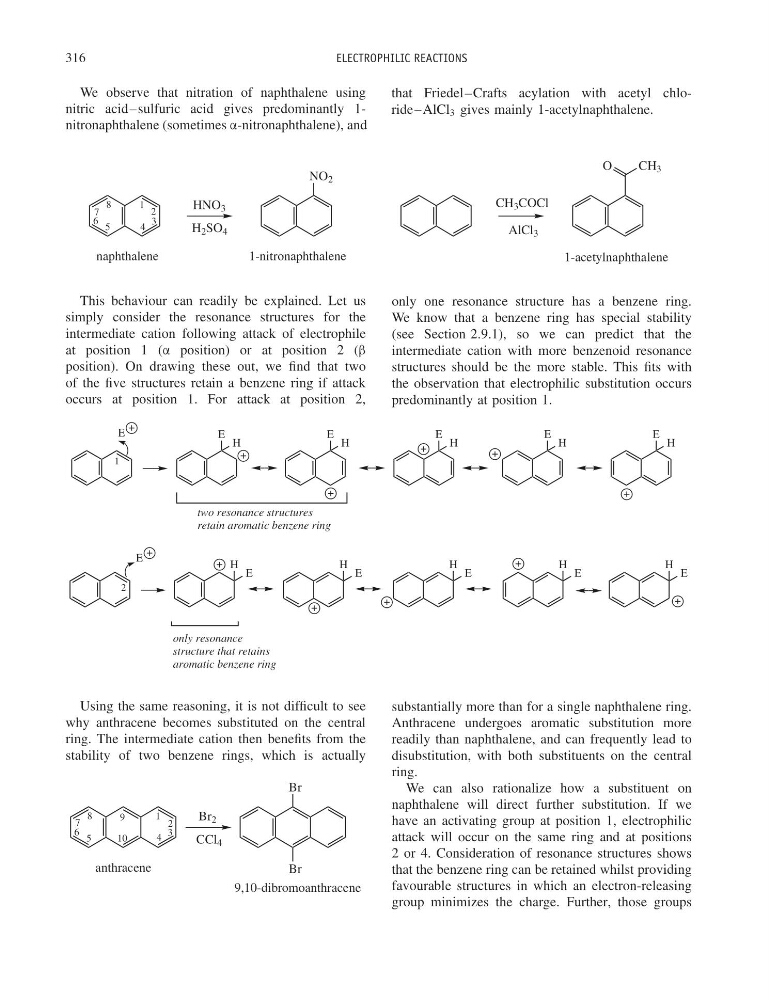
We observe that nitration of naphthalene using
nitric acid–sulfuric acid gives predominantly 1nitronaphthalene (sometimes α-nitronaphthalene), and
that Friedel–Crafts acylation with acetyl chloride–AlCl 3 gives mainly 1-acetylnaphthalene.
naphthalene
NO 2
HNO 3
H 2 SO 4
CH 3 COCl
AlCl 3
CH 3
O
1 2
3
4
5
6
7
8
1-nitronaphthalene
1-acetylnaphthalene
This behaviour can readily be explained. Let us
simply consider the resonance structures for the
intermediate cation following attack of electrophile
at position 1 (α position) or at position 2 (β
position). On drawing these out, we find that two
of the five structures retain a benzene ring if attack
occurs at position 1. For attack at position 2,
only one resonance structure has a benzene ring.
We know that a benzene ring has special stability
(see Section 2.9.1), so we can predict that the
intermediate cation with more benzenoid resonance
structures should be the more stable. This fits with
the observation that electrophilic substitution occurs
predominantly at position 1.
E
E
H
1
2
E
H
E
H
E
H
E
H
E
E
H
E
H
E
H
E
H
E
H
two resonance structures
retain aromatic benzene ring
only resonance
structure that retains
aromatic benzene ring
Using the same reasoning, it is not difficult to see
why anthracene becomes substituted on the central
ring. The intermediate cation then benefits from the
stability of two benzene rings, which is actually
anthracene
Br 2
CCl 4
1
2
3
4
5
6
7
8
9
10
Br
Br
9,10-dibromoanthracene
substantially more than for a single naphthalene ring.
Anthracene undergoes aromatic substitution more
readily than naphthalene, and can frequently lead to
disubstitution, with both substituents on the central
ring.
We can also rationalize how a substituent on
naphthalene will direct further substitution. If we
have an activating group at position 1, electrophilic
attack will occur on the same ring and at positions
2 or 4. Consideration of resonance structures shows
that the benzene ring can be retained whilst providing
favourable structures in which an electron-releasing
group minimizes the charge. Further, those groups
ELECTROPHILIC REACTIONS
We observe that nitration of naphthalene using
nitric acid–sulfuric acid gives predominantly 1nitronaphthalene (sometimes α-nitronaphthalene), and
that Friedel–Crafts acylation with acetyl chloride–AlCl 3 gives mainly 1-acetylnaphthalene.
naphthalene
NO 2
HNO 3
H 2 SO 4
CH 3 COCl
AlCl 3
CH 3
O
1 2
3
4
5
6
7
8
1-nitronaphthalene
1-acetylnaphthalene
This behaviour can readily be explained. Let us
simply consider the resonance structures for the
intermediate cation following attack of electrophile
at position 1 (α position) or at position 2 (β
position). On drawing these out, we find that two
of the five structures retain a benzene ring if attack
occurs at position 1. For attack at position 2,
only one resonance structure has a benzene ring.
We know that a benzene ring has special stability
(see Section 2.9.1), so we can predict that the
intermediate cation with more benzenoid resonance
structures should be the more stable. This fits with
the observation that electrophilic substitution occurs
predominantly at position 1.
E
E
H
1
2
E
H
E
H
E
H
E
H
E
E
H
E
H
E
H
E
H
E
H
two resonance structures
retain aromatic benzene ring
only resonance
structure that retains
aromatic benzene ring
Using the same reasoning, it is not difficult to see
why anthracene becomes substituted on the central
ring. The intermediate cation then benefits from the
stability of two benzene rings, which is actually
anthracene
Br 2
CCl 4
1
2
3
4
5
6
7
8
9
10
Br
Br
9,10-dibromoanthracene
substantially more than for a single naphthalene ring.
Anthracene undergoes aromatic substitution more
readily than naphthalene, and can frequently lead to
disubstitution, with both substituents on the central
ring.
We can also rationalize how a substituent on
naphthalene will direct further substitution. If we
have an activating group at position 1, electrophilic
attack will occur on the same ring and at positions
2 or 4. Consideration of resonance structures shows
that the benzene ring can be retained whilst providing
favourable structures in which an electron-releasing
group minimizes the charge. Further, those groups