

ELECTROPHILIC AROMATIC SUBSTITUTION
317
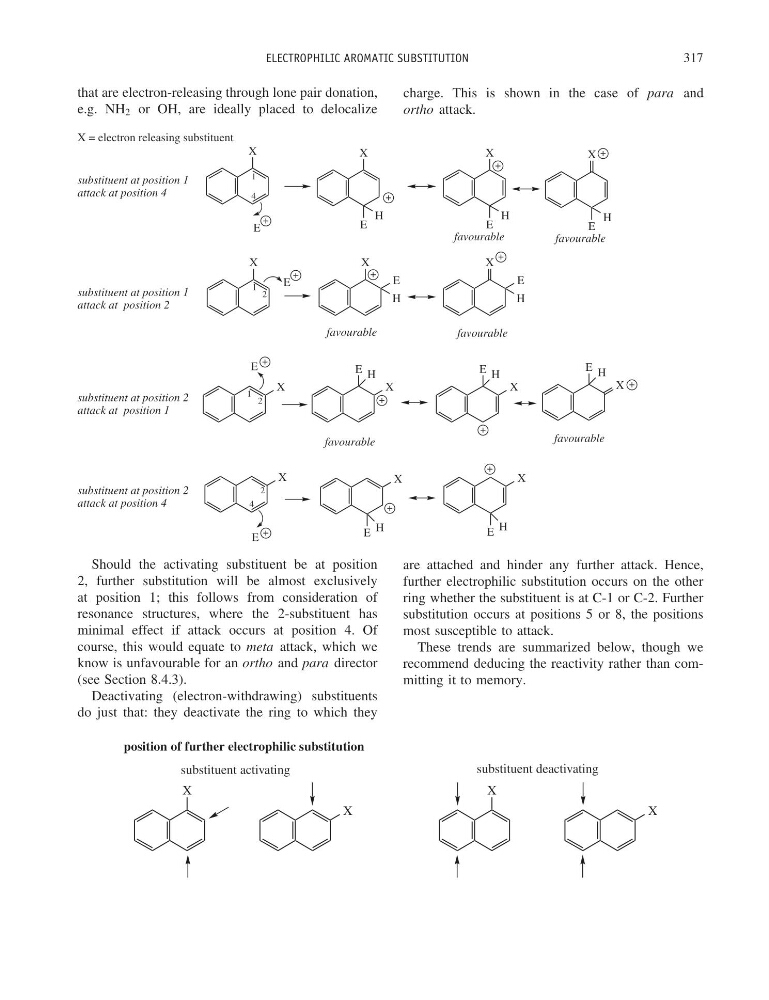
that are electron-releasing through lone pair donation,
e.g. NH 2 or OH, are ideally placed to delocalize
charge. This is shown in the case of para and
ortho attack.
X
E
X
E
H
X
E
H
X
E
H
E
X
X
E H
X
E H
X
E H
X
E H
X
E
X
E
H
X
E
H
E
X
X
E H
1
4
1
2
1
2
2
4
favourable
favourable
favourable
favourable
favourable
favourable
X = electron releasing substituent
substituent at position 1
attack at position 4
substituent at position 1
attack at position 2
substituent at position 2
attack at position 1
substituent at position 2
attack at position 4
Should the activating substituent be at position
2, further substitution will be almost exclusively
at position 1; this follows from consideration of
resonance structures, where the 2-substituent has
minimal effect if attack occurs at position 4. Of
course, this would equate to meta attack, which we
know is unfavourable for an ortho and para director
(see Section 8.4.3).
Deactivating (electron-withdrawing) substituents
do just that: they deactivate the ring to which they
are attached and hinder any further attack. Hence,
further electrophilic substitution occurs on the other
ring whether the substituent is at C-1 or C-2. Further
substitution occurs at positions 5 or 8, the positions
most susceptible to attack.
These trends are summarized below, though we
recommend deducing the reactivity rather than committing it to memory.
X
X
substituent activating
substituent deactivating
X
X
position of further electrophilic substitution
317
that are electron-releasing through lone pair donation,
e.g. NH 2 or OH, are ideally placed to delocalize
charge. This is shown in the case of para and
ortho attack.
X
E
X
E
H
X
E
H
X
E
H
E
X
X
E H
X
E H
X
E H
X
E H
X
E
X
E
H
X
E
H
E
X
X
E H
1
4
1
2
1
2
2
4
favourable
favourable
favourable
favourable
favourable
favourable
X = electron releasing substituent
substituent at position 1
attack at position 4
substituent at position 1
attack at position 2
substituent at position 2
attack at position 1
substituent at position 2
attack at position 4
Should the activating substituent be at position
2, further substitution will be almost exclusively
at position 1; this follows from consideration of
resonance structures, where the 2-substituent has
minimal effect if attack occurs at position 4. Of
course, this would equate to meta attack, which we
know is unfavourable for an ortho and para director
(see Section 8.4.3).
Deactivating (electron-withdrawing) substituents
do just that: they deactivate the ring to which they
are attached and hinder any further attack. Hence,
further electrophilic substitution occurs on the other
ring whether the substituent is at C-1 or C-2. Further
substitution occurs at positions 5 or 8, the positions
most susceptible to attack.
These trends are summarized below, though we
recommend deducing the reactivity rather than committing it to memory.
X
X
substituent activating
substituent deactivating
X
X
position of further electrophilic substitution