

ELECTROPHILIC AROMATIC SUBSTITUTION
315
Cl
H
AlCl 3
Cl AlCl 3
Friedel–Crafts
alkylation
rearrangement to
more favourable
tertiary carbocation
tert-butylbenzene
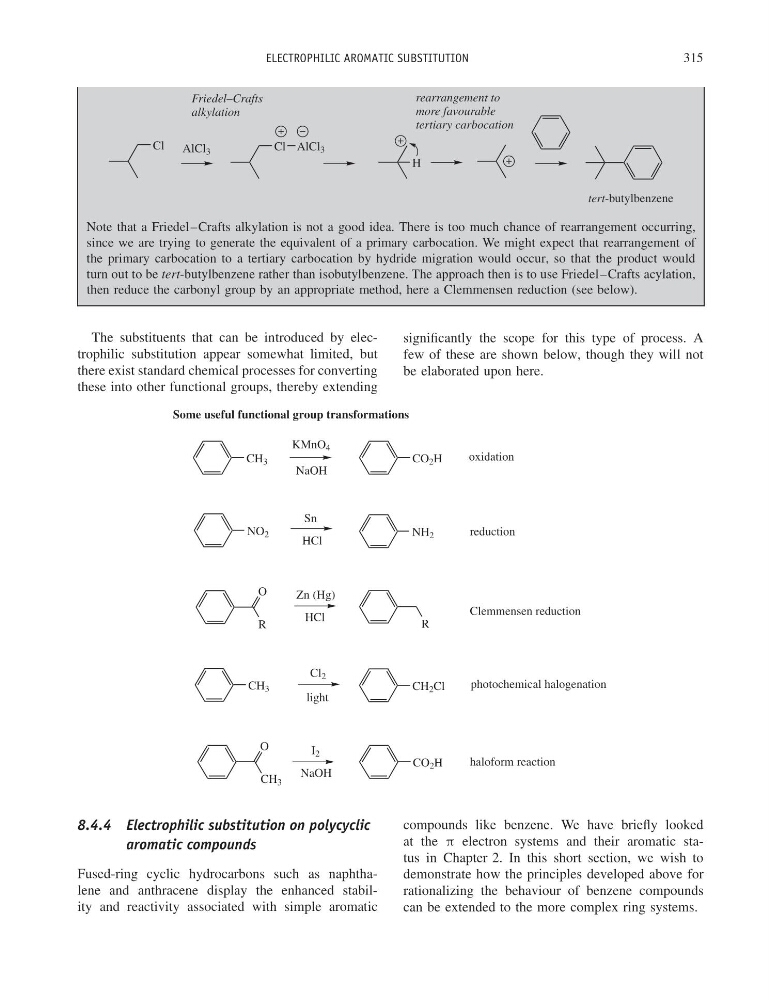
Note that a Friedel–Crafts alkylation is not a good idea. There is too much chance of rearrangement occurring,
since we are trying to generate the equivalent of a primary carbocation. We might expect that rearrangement of
the primary carbocation to a tertiary carbocation by hydride migration would occur, so that the product would
turn out to be tert-butylbenzene rather than isobutylbenzene. The approach then is to use Friedel–Crafts acylation,
then reduce the carbonyl group by an appropriate method, here a Clemmensen reduction (see below).
The substituents that can be introduced by electrophilic substitution appear somewhat limited, but
there exist standard chemical processes for converting
these into other functional groups, thereby extending
significantly the scope for this type of process. A
few of these are shown below, though they will not
be elaborated upon here.
CH 3
CO 2 H
NO 2
NH 2
R
O
R
CH 3
CH 2 Cl
Cl 2
light
Sn
HCl
HCl
KMnO 4
NaOH
CH 3
O
CO 2 H
I 2
NaOH
haloform reaction
photochemical halogenation
Clemmensen reduction
oxidation
reduction
Some useful functional group transformations
Zn (Hg)
8.4.4 Electrophilic substitution on polycyclic
aromatic compounds
Fused-ring cyclic hydrocarbons such as naphthalene and anthracene display the enhanced stability and reactivity associated with simple aromatic
compounds like benzene. We have briefly looked
at the π electron systems and their aromatic status in Chapter 2. In this short section, we wish to
demonstrate how the principles developed above for
rationalizing the behaviour of benzene compounds
can be extended to the more complex ring systems.
315
Cl
H
AlCl 3
Cl AlCl 3
Friedel–Crafts
alkylation
rearrangement to
more favourable
tertiary carbocation
tert-butylbenzene
Note that a Friedel–Crafts alkylation is not a good idea. There is too much chance of rearrangement occurring,
since we are trying to generate the equivalent of a primary carbocation. We might expect that rearrangement of
the primary carbocation to a tertiary carbocation by hydride migration would occur, so that the product would
turn out to be tert-butylbenzene rather than isobutylbenzene. The approach then is to use Friedel–Crafts acylation,
then reduce the carbonyl group by an appropriate method, here a Clemmensen reduction (see below).
The substituents that can be introduced by electrophilic substitution appear somewhat limited, but
there exist standard chemical processes for converting
these into other functional groups, thereby extending
significantly the scope for this type of process. A
few of these are shown below, though they will not
be elaborated upon here.
CH 3
CO 2 H
NO 2
NH 2
R
O
R
CH 3
CH 2 Cl
Cl 2
light
Sn
HCl
HCl
KMnO 4
NaOH
CH 3
O
CO 2 H
I 2
NaOH
haloform reaction
photochemical halogenation
Clemmensen reduction
oxidation
reduction
Some useful functional group transformations
Zn (Hg)
8.4.4 Electrophilic substitution on polycyclic
aromatic compounds
Fused-ring cyclic hydrocarbons such as naphthalene and anthracene display the enhanced stability and reactivity associated with simple aromatic
compounds like benzene. We have briefly looked
at the π electron systems and their aromatic status in Chapter 2. In this short section, we wish to
demonstrate how the principles developed above for
rationalizing the behaviour of benzene compounds
can be extended to the more complex ring systems.