

314
ELECTROPHILIC REACTIONS
This is a good time to have another brief look
at Sections 4.3.5 and 4.5.4, and compare how we
used similar reasoning to consider the likely stability,
or otherwise, of anions and cations in order to
predict the acid–base properties of aromatic amines
and phenols. The rationalizations are essentially
identical.
The effect of heteroatoms on electrophilic aromatic
substitution, e.g. the reactions of pyridine, will be
considered separately in Chapter 11.
Box 8.4
Synthesis of ibuprofen
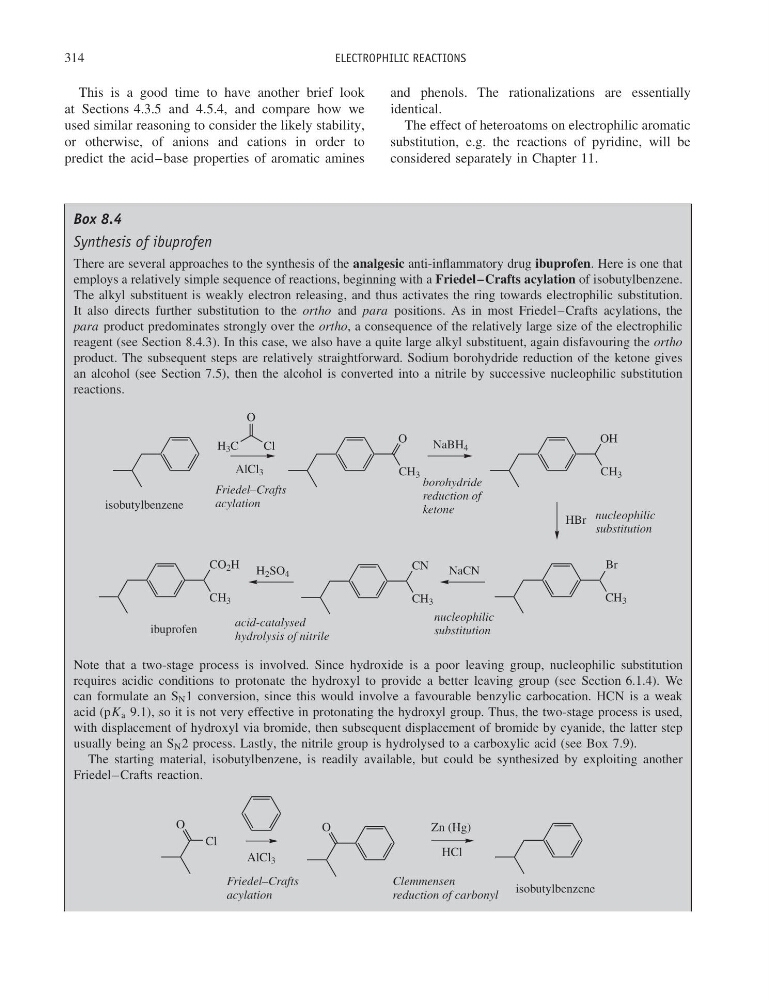
There are several approaches to the synthesis of the analgesic anti-inflammatory drug ibuprofen. Here is one that
employs a relatively simple sequence of reactions, beginning with a Friedel–Crafts acylation of isobutylbenzene.
The alkyl substituent is weakly electron releasing, and thus activates the ring towards electrophilic substitution.
It also directs further substitution to the ortho and para positions. As in most Friedel–Crafts acylations, the
para product predominates strongly over the ortho, a consequence of the relatively large size of the electrophilic
reagent (see Section 8.4.3). In this case, we also have a quite large alkyl substituent, again disfavouring the ortho
product. The subsequent steps are relatively straightforward. Sodium borohydride reduction of the ketone gives
an alcohol (see Section 7.5), then the alcohol is converted into a nitrile by successive nucleophilic substitution
reactions.
CH 3
O
CH 3
OH
CH 3
Br
CH 3
CN
CH 3
CO 2 H
ibuprofen
O
H 3 C
Cl
AlCl 3
NaBH 4
HBr
NaCN
H 2 SO 4
Friedel–Crafts
acylation
borohydride
reduction of
ketone
nucleophilic
substitution
nucleophilic
substitution
acid-catalysed
hydrolysis of nitrile
isobutylbenzene
Note that a two-stage process is involved. Since hydroxide is a poor leaving group, nucleophilic substitution
requires acidic conditions to protonate the hydroxyl to provide a better leaving group (see Section 6.1.4). We
can formulate an S N 1 conversion, since this would involve a favourable benzylic carbocation. HCN is a weak
acid (pK a 9.1), so it is not very effective in protonating the hydroxyl group. Thus, the two-stage process is used,
with displacement of hydroxyl via bromide, then subsequent displacement of bromide by cyanide, the latter step
usually being an S N 2 process. Lastly, the nitrile group is hydrolysed to a carboxylic acid (see Box 7.9).
The starting material, isobutylbenzene, is readily available, but could be synthesized by exploiting another
Friedel–Crafts reaction.
Cl
O
AlCl 3
O
HCl
Friedel–Crafts
acylation
Clemmensen
reduction of carbonyl isobutylbenzene
Zn (Hg)
ELECTROPHILIC REACTIONS
This is a good time to have another brief look
at Sections 4.3.5 and 4.5.4, and compare how we
used similar reasoning to consider the likely stability,
or otherwise, of anions and cations in order to
predict the acid–base properties of aromatic amines
and phenols. The rationalizations are essentially
identical.
The effect of heteroatoms on electrophilic aromatic
substitution, e.g. the reactions of pyridine, will be
considered separately in Chapter 11.
Box 8.4
Synthesis of ibuprofen
There are several approaches to the synthesis of the analgesic anti-inflammatory drug ibuprofen. Here is one that
employs a relatively simple sequence of reactions, beginning with a Friedel–Crafts acylation of isobutylbenzene.
The alkyl substituent is weakly electron releasing, and thus activates the ring towards electrophilic substitution.
It also directs further substitution to the ortho and para positions. As in most Friedel–Crafts acylations, the
para product predominates strongly over the ortho, a consequence of the relatively large size of the electrophilic
reagent (see Section 8.4.3). In this case, we also have a quite large alkyl substituent, again disfavouring the ortho
product. The subsequent steps are relatively straightforward. Sodium borohydride reduction of the ketone gives
an alcohol (see Section 7.5), then the alcohol is converted into a nitrile by successive nucleophilic substitution
reactions.
CH 3
O
CH 3
OH
CH 3
Br
CH 3
CN
CH 3
CO 2 H
ibuprofen
O
H 3 C
Cl
AlCl 3
NaBH 4
HBr
NaCN
H 2 SO 4
Friedel–Crafts
acylation
borohydride
reduction of
ketone
nucleophilic
substitution
nucleophilic
substitution
acid-catalysed
hydrolysis of nitrile
isobutylbenzene
Note that a two-stage process is involved. Since hydroxide is a poor leaving group, nucleophilic substitution
requires acidic conditions to protonate the hydroxyl to provide a better leaving group (see Section 6.1.4). We
can formulate an S N 1 conversion, since this would involve a favourable benzylic carbocation. HCN is a weak
acid (pK a 9.1), so it is not very effective in protonating the hydroxyl group. Thus, the two-stage process is used,
with displacement of hydroxyl via bromide, then subsequent displacement of bromide by cyanide, the latter step
usually being an S N 2 process. Lastly, the nitrile group is hydrolysed to a carboxylic acid (see Box 7.9).
The starting material, isobutylbenzene, is readily available, but could be synthesized by exploiting another
Friedel–Crafts reaction.
Cl
O
AlCl 3
O
HCl
Friedel–Crafts
acylation
Clemmensen
reduction of carbonyl isobutylbenzene
Zn (Hg)