

ELECTROPHILIC AROMATIC SUBSTITUTION
313
An understanding of electron-donating and electron-withdrawing substituent effects is crucial to
designing the synthesis of aromatic derivatives. For
example, from the electrophilic substitution reactions
we have studied, there are two potential approaches
for the synthesis of m-nitroacetophenone:
CH 3 COCl
AlCl 3
O
CH 3
O
CH 3
HNO 3
NO 2
HNO 3
NO 2
CH 3 COCl
AlCl 3
NO 2
CH 3
O
acyl group is
moderately
deactivating
nitro group is
strongly deactivating;
this reaction fails
m-nitroacetophenone
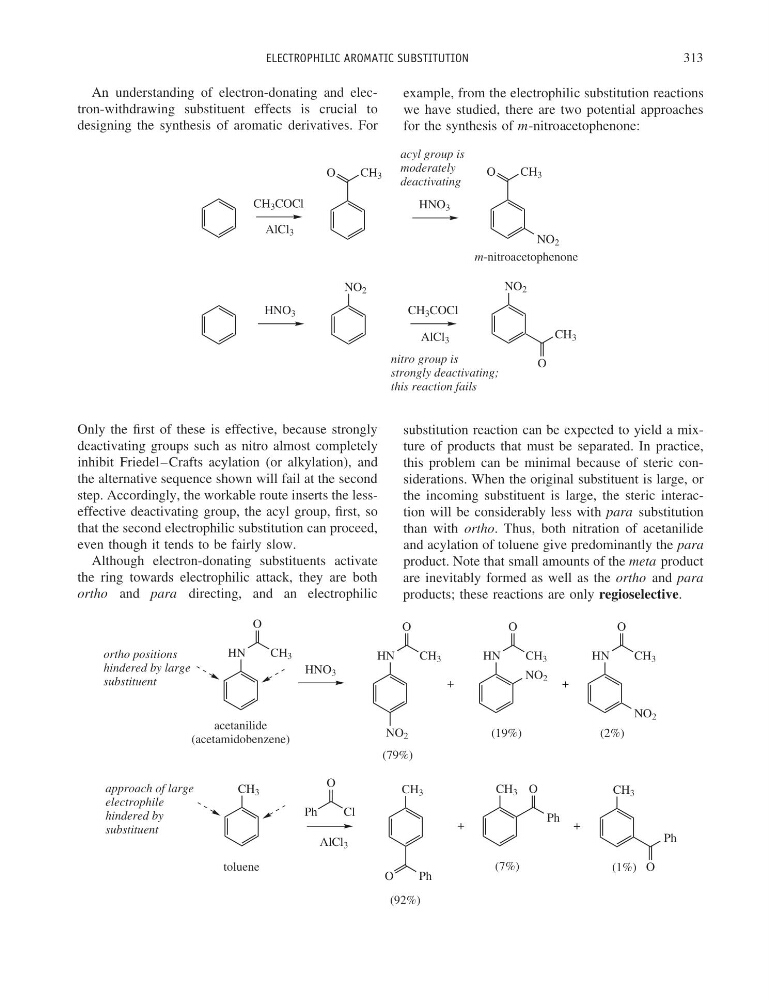
Only the first of these is effective, because strongly
deactivating groups such as nitro almost completely
inhibit Friedel–Crafts acylation (or alkylation), and
the alternative sequence shown will fail at the second
step. Accordingly, the workable route inserts the lesseffective deactivating group, the acyl group, first, so
that the second electrophilic substitution can proceed,
even though it tends to be fairly slow.
Although electron-donating substituents activate
the ring towards electrophilic attack, they are both
ortho and para directing, and an electrophilic
substitution reaction can be expected to yield a mixture of products that must be separated. In practice,
this problem can be minimal because of steric considerations. When the original substituent is large, or
the incoming substituent is large, the steric interaction will be considerably less with para substitution
than with ortho. Thus, both nitration of acetanilide
and acylation of toluene give predominantly the para
product. Note that small amounts of the meta product
are inevitably formed as well as the ortho and para
products; these reactions are only regioselective.
HN
CH 3
O
acetanilide
(acetamidobenzene)
HNO 3
HN
CH 3
O
HN
CH 3
O
+
NO 2
NO 2
(79%)
(19%)
+
HN
CH 3
O
(2%)
NO 2
ortho positions
hindered by large
substituent
CH 3
CH 3
approach of large
electrophile
hindered by
substituent
O
Ph
Cl
AlCl 3
O
Ph
(92%)
CH 3
+
(7%)
+
CH 3
(1%)
Ph
O
Ph
O
toluene
313
An understanding of electron-donating and electron-withdrawing substituent effects is crucial to
designing the synthesis of aromatic derivatives. For
example, from the electrophilic substitution reactions
we have studied, there are two potential approaches
for the synthesis of m-nitroacetophenone:
CH 3 COCl
AlCl 3
O
CH 3
O
CH 3
HNO 3
NO 2
HNO 3
NO 2
CH 3 COCl
AlCl 3
NO 2
CH 3
O
acyl group is
moderately
deactivating
nitro group is
strongly deactivating;
this reaction fails
m-nitroacetophenone
Only the first of these is effective, because strongly
deactivating groups such as nitro almost completely
inhibit Friedel–Crafts acylation (or alkylation), and
the alternative sequence shown will fail at the second
step. Accordingly, the workable route inserts the lesseffective deactivating group, the acyl group, first, so
that the second electrophilic substitution can proceed,
even though it tends to be fairly slow.
Although electron-donating substituents activate
the ring towards electrophilic attack, they are both
ortho and para directing, and an electrophilic
substitution reaction can be expected to yield a mixture of products that must be separated. In practice,
this problem can be minimal because of steric considerations. When the original substituent is large, or
the incoming substituent is large, the steric interaction will be considerably less with para substitution
than with ortho. Thus, both nitration of acetanilide
and acylation of toluene give predominantly the para
product. Note that small amounts of the meta product
are inevitably formed as well as the ortho and para
products; these reactions are only regioselective.
HN
CH 3
O
acetanilide
(acetamidobenzene)
HNO 3
HN
CH 3
O
HN
CH 3
O
+
NO 2
NO 2
(79%)
(19%)
+
HN
CH 3
O
(2%)
NO 2
ortho positions
hindered by large
substituent
CH 3
CH 3
approach of large
electrophile
hindered by
substituent
O
Ph
Cl
AlCl 3
O
Ph
(92%)
CH 3
+
(7%)
+
CH 3
(1%)
Ph
O
Ph
O
toluene