

310
ELECTROPHILIC REACTIONS
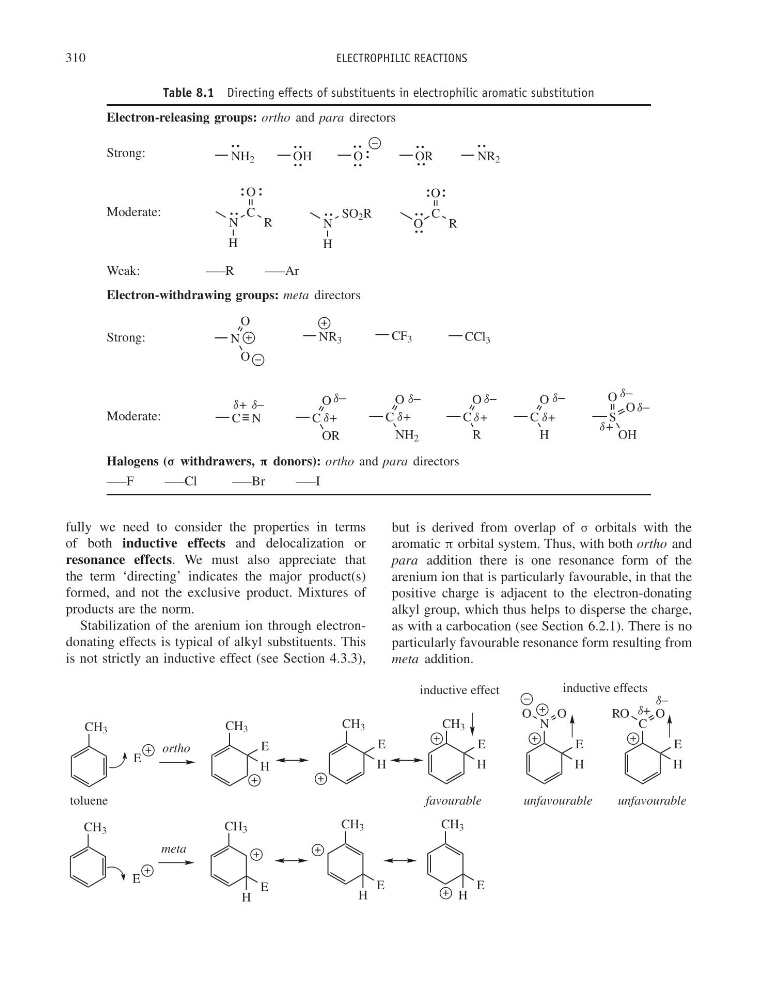
Table 8.1 Directing effects of substituents in electrophilic aromatic substitution
Electron-releasing groups: ortho and para directors
Strong:
NH 2
OH
O
OR
NR 2
Moderate:
N
C
R
H
O
N
SO 2 R
H
O
C
R
O
Weak:
–––R
–––Ar
Electron-withdrawing groups: meta directors
Strong:
N
O
O
NR 3
CF 3
CCl 3
Moderate:
C N
C
OR
O
C
NH 2
O
C
R
O
C
H
O
d+
d+ d−
d−
d+
d+
d+
d−
d−
d−
S
OH
O
O d−
d−
d+
Halogens (σ withdrawers, π donors): ortho and para directors
–––F
–––Cl
–––Br
–––I
fully we need to consider the properties in terms
of both inductive effects and delocalization or
resonance effects. We must also appreciate that
the term ‘directing’ indicates the major product(s)
formed, and not the exclusive product. Mixtures of
products are the norm.
Stabilization of the arenium ion through electrondonating effects is typical of alkyl substituents. This
is not strictly an inductive effect (see Section 4.3.3),
but is derived from overlap of σ orbitals with the
aromatic π orbital system. Thus, with both ortho and
para addition there is one resonance form of the
arenium ion that is particularly favourable, in that the
positive charge is adjacent to the electron-donating
alkyl group, which thus helps to disperse the charge,
as with a carbocation (see Section 6.2.1). There is no
particularly favourable resonance form resulting from
meta addition.
CH 3
E
ortho
CH 3
E
E
E
CH 3
CH 3
CH 3
E
meta
CH 3
CH 3
CH 3
E
E
E
H
H
H
H
H
H
favourable
E
N
H
unfavourable
O
O
E
C
H
unfavourable
RO
O
d+
d−
inductive effect
inductive effects
toluene
ELECTROPHILIC REACTIONS
Table 8.1 Directing effects of substituents in electrophilic aromatic substitution
Electron-releasing groups: ortho and para directors
Strong:
NH 2
OH
O
OR
NR 2
Moderate:
N
C
R
H
O
N
SO 2 R
H
O
C
R
O
Weak:
–––R
–––Ar
Electron-withdrawing groups: meta directors
Strong:
N
O
O
NR 3
CF 3
CCl 3
Moderate:
C N
C
OR
O
C
NH 2
O
C
R
O
C
H
O
d+
d+ d−
d−
d+
d+
d+
d−
d−
d−
S
OH
O
O d−
d−
d+
Halogens (σ withdrawers, π donors): ortho and para directors
–––F
–––Cl
–––Br
–––I
fully we need to consider the properties in terms
of both inductive effects and delocalization or
resonance effects. We must also appreciate that
the term ‘directing’ indicates the major product(s)
formed, and not the exclusive product. Mixtures of
products are the norm.
Stabilization of the arenium ion through electrondonating effects is typical of alkyl substituents. This
is not strictly an inductive effect (see Section 4.3.3),
but is derived from overlap of σ orbitals with the
aromatic π orbital system. Thus, with both ortho and
para addition there is one resonance form of the
arenium ion that is particularly favourable, in that the
positive charge is adjacent to the electron-donating
alkyl group, which thus helps to disperse the charge,
as with a carbocation (see Section 6.2.1). There is no
particularly favourable resonance form resulting from
meta addition.
CH 3
E
ortho
CH 3
E
E
E
CH 3
CH 3
CH 3
E
meta
CH 3
CH 3
CH 3
E
E
E
H
H
H
H
H
H
favourable
E
N
H
unfavourable
O
O
E
C
H
unfavourable
RO
O
d+
d−
inductive effect
inductive effects
toluene