

ELECTROPHILIC AROMATIC SUBSTITUTION
311
CH 3
E
para
CH 3
CH 3
CH 3
E
E
E
H
H
H
favourable
N
E
H
unfavourable
O
O
C
E
H
unfavourable
RO
O
d+
d−
inductive effect
inductive effects
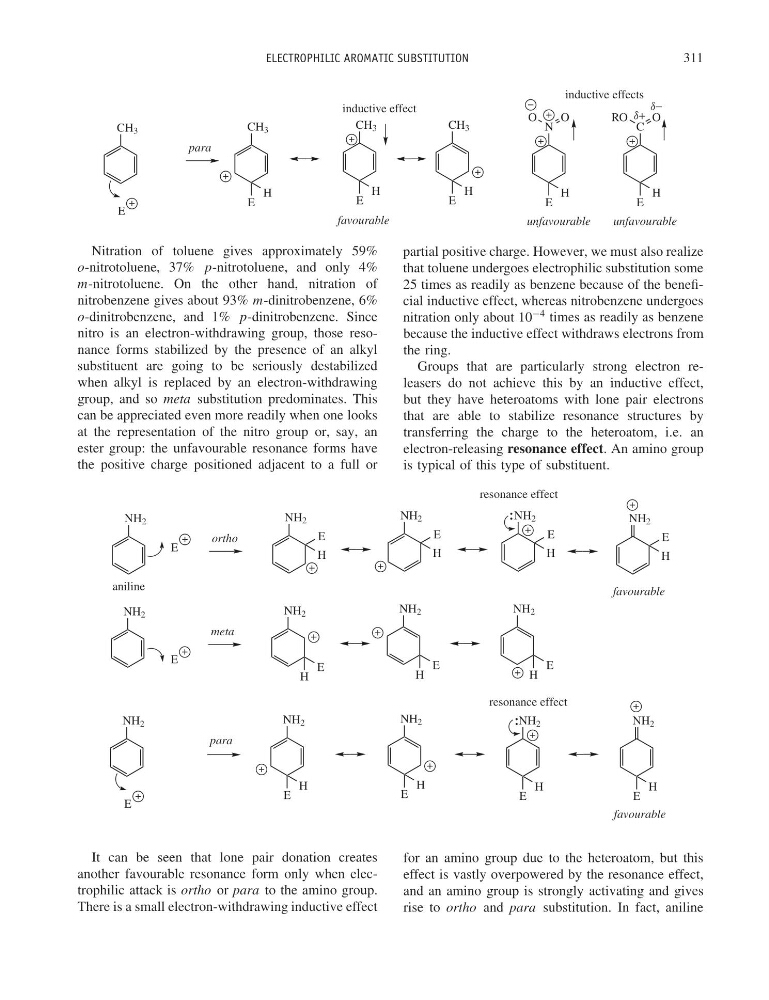
Nitration of toluene gives approximately 59%
o-nitrotoluene, 37% p-nitrotoluene, and only 4%
m-nitrotoluene. On the other hand, nitration of
nitrobenzene gives about 93% m-dinitrobenzene, 6%
o-dinitrobenzene, and 1% p-dinitrobenzene. Since
nitro is an electron-withdrawing group, those resonance forms stabilized by the presence of an alkyl
substituent are going to be seriously destabilized
when alkyl is replaced by an electron-withdrawing
group, and so meta substitution predominates. This
can be appreciated even more readily when one looks
at the representation of the nitro group or, say, an
ester group: the unfavourable resonance forms have
the positive charge positioned adjacent to a full or
partial positive charge. However, we must also realize
that toluene undergoes electrophilic substitution some
25 times as readily as benzene because of the beneficial inductive effect, whereas nitrobenzene undergoes
nitration only about 10
−4 times as readily as benzene
because the inductive effect withdraws electrons from
the ring.
Groups that are particularly strong electron releasers do not achieve this by an inductive effect,
but they have heteroatoms with lone pair electrons
that are able to stabilize resonance structures by
transferring the charge to the heteroatom, i.e. an
electron-releasing resonance effect. An amino group
is typical of this type of substituent.
NH 2
E
ortho
NH 2
E
E
E
NH 2
NH 2
NH 2
E
meta
NH 2
NH 2
NH 2
E
E
E
NH 2
E
para
NH 2
NH 2
NH 2
E
E
E
H
H
H
H
H
H
H
H
H
favourable
favourable
E
NH 2
H
NH 2
E
H
aniline
resonance effect
resonance effect
It can be seen that lone pair donation creates
another favourable resonance form only when electrophilic attack is ortho or para to the amino group.
There is a small electron-withdrawing inductive effect
for an amino group due to the heteroatom, but this
effect is vastly overpowered by the resonance effect,
and an amino group is strongly activating and gives
rise to ortho and para substitution. In fact, aniline
311
CH 3
E
para
CH 3
CH 3
CH 3
E
E
E
H
H
H
favourable
N
E
H
unfavourable
O
O
C
E
H
unfavourable
RO
O
d+
d−
inductive effect
inductive effects
Nitration of toluene gives approximately 59%
o-nitrotoluene, 37% p-nitrotoluene, and only 4%
m-nitrotoluene. On the other hand, nitration of
nitrobenzene gives about 93% m-dinitrobenzene, 6%
o-dinitrobenzene, and 1% p-dinitrobenzene. Since
nitro is an electron-withdrawing group, those resonance forms stabilized by the presence of an alkyl
substituent are going to be seriously destabilized
when alkyl is replaced by an electron-withdrawing
group, and so meta substitution predominates. This
can be appreciated even more readily when one looks
at the representation of the nitro group or, say, an
ester group: the unfavourable resonance forms have
the positive charge positioned adjacent to a full or
partial positive charge. However, we must also realize
that toluene undergoes electrophilic substitution some
25 times as readily as benzene because of the beneficial inductive effect, whereas nitrobenzene undergoes
nitration only about 10
−4 times as readily as benzene
because the inductive effect withdraws electrons from
the ring.
Groups that are particularly strong electron releasers do not achieve this by an inductive effect,
but they have heteroatoms with lone pair electrons
that are able to stabilize resonance structures by
transferring the charge to the heteroatom, i.e. an
electron-releasing resonance effect. An amino group
is typical of this type of substituent.
NH 2
E
ortho
NH 2
E
E
E
NH 2
NH 2
NH 2
E
meta
NH 2
NH 2
NH 2
E
E
E
NH 2
E
para
NH 2
NH 2
NH 2
E
E
E
H
H
H
H
H
H
H
H
H
favourable
favourable
E
NH 2
H
NH 2
E
H
aniline
resonance effect
resonance effect
It can be seen that lone pair donation creates
another favourable resonance form only when electrophilic attack is ortho or para to the amino group.
There is a small electron-withdrawing inductive effect
for an amino group due to the heteroatom, but this
effect is vastly overpowered by the resonance effect,
and an amino group is strongly activating and gives
rise to ortho and para substitution. In fact, aniline