

ELECTROPHILIC AROMATIC SUBSTITUTION
309
A similar problem of complex formation may
be encountered if either amino or phenol groups
are present in the substrate, and the reaction may
fail. Under such circumstances, these groups need
to be blocked (protected) by making a suitable
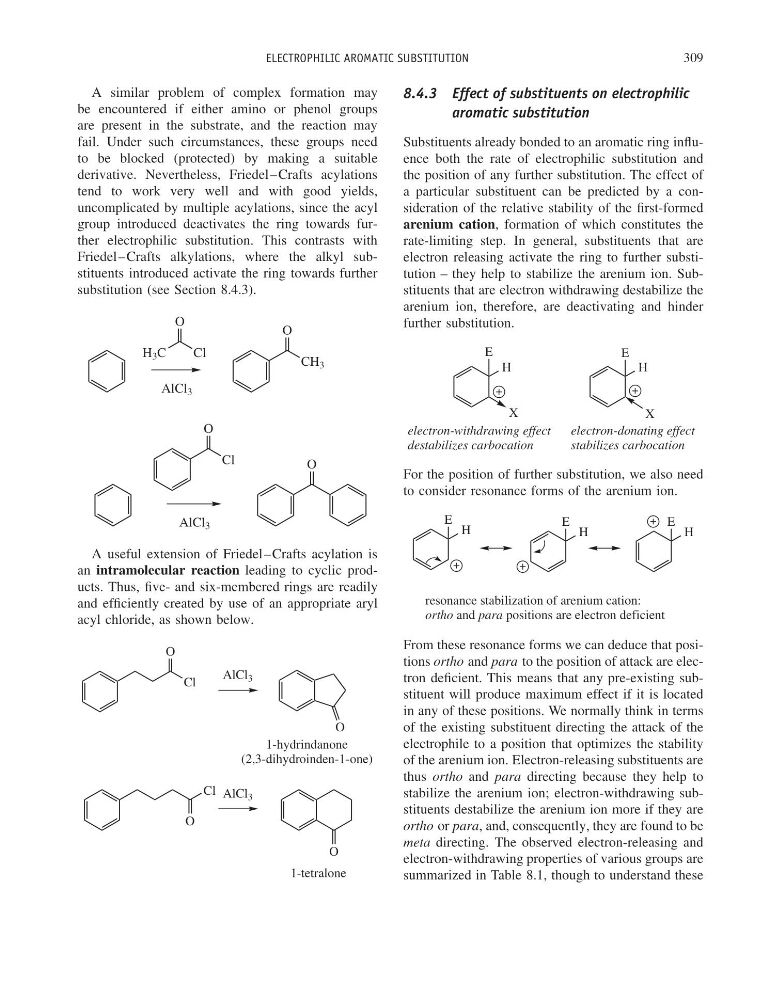
derivative. Nevertheless, Friedel–Crafts acylations
tend to work very well and with good yields,
uncomplicated by multiple acylations, since the acyl
group introduced deactivates the ring towards further electrophilic substitution. This contrasts with
Friedel–Crafts alkylations, where the alkyl substituents introduced activate the ring towards further
substitution (see Section 8.4.3).
AlCl 3
O
H 3 C
Cl
CH 3
O
AlCl 3
O
Cl
O
A useful extension of Friedel–Crafts acylation is
an intramolecular reaction leading to cyclic products. Thus, five- and six-membered rings are readily
and efficiently created by use of an appropriate aryl
acyl chloride, as shown below.
Cl
O
O
AlCl 3
Cl
O
AlCl 3
O
1-hydrindanone
(2,3-dihydroinden-1-one)
1-tetralone
8.4.3 Effect of substituents on electrophilic
aromatic substitution
Substituents already bonded to an aromatic ring influence both the rate of electrophilic substitution and
the position of any further substitution. The effect of
a particular substituent can be predicted by a consideration of the relative stability of the first-formed
arenium cation, formation of which constitutes the
rate-limiting step. In general, substituents that are
electron releasing activate the ring to further substitution – they help to stabilize the arenium ion. Substituents that are electron withdrawing destabilize the
arenium ion, therefore, are deactivating and hinder
further substitution.
H
E
H
E
electron-withdrawing effect
destabilizes carbocation
electron-donating effect
stabilizes carbocation
X
X
For the position of further substitution, we also need
to consider resonance forms of the arenium ion.
H
E
H
E
H
E
resonance stabilization of arenium cation:
ortho and para positions are electron deficient
From these resonance forms we can deduce that positions ortho and para to the position of attack are electron deficient. This means that any pre-existing substituent will produce maximum effect if it is located
in any of these positions. We normally think in terms
of the existing substituent directing the attack of the
electrophile to a position that optimizes the stability
of the arenium ion. Electron-releasing substituents are
thus ortho and para directing because they help to
stabilize the arenium ion; electron-withdrawing substituents destabilize the arenium ion more if they are
ortho or para, and, consequently, they are found to be
meta directing. The observed electron-releasing and
electron-withdrawing properties of various groups are
summarized in Table 8.1, though to understand these
309
A similar problem of complex formation may
be encountered if either amino or phenol groups
are present in the substrate, and the reaction may
fail. Under such circumstances, these groups need
to be blocked (protected) by making a suitable
derivative. Nevertheless, Friedel–Crafts acylations
tend to work very well and with good yields,
uncomplicated by multiple acylations, since the acyl
group introduced deactivates the ring towards further electrophilic substitution. This contrasts with
Friedel–Crafts alkylations, where the alkyl substituents introduced activate the ring towards further
substitution (see Section 8.4.3).
AlCl 3
O
H 3 C
Cl
CH 3
O
AlCl 3
O
Cl
O
A useful extension of Friedel–Crafts acylation is
an intramolecular reaction leading to cyclic products. Thus, five- and six-membered rings are readily
and efficiently created by use of an appropriate aryl
acyl chloride, as shown below.
Cl
O
O
AlCl 3
Cl
O
AlCl 3
O
1-hydrindanone
(2,3-dihydroinden-1-one)
1-tetralone
8.4.3 Effect of substituents on electrophilic
aromatic substitution
Substituents already bonded to an aromatic ring influence both the rate of electrophilic substitution and
the position of any further substitution. The effect of
a particular substituent can be predicted by a consideration of the relative stability of the first-formed
arenium cation, formation of which constitutes the
rate-limiting step. In general, substituents that are
electron releasing activate the ring to further substitution – they help to stabilize the arenium ion. Substituents that are electron withdrawing destabilize the
arenium ion, therefore, are deactivating and hinder
further substitution.
H
E
H
E
electron-withdrawing effect
destabilizes carbocation
electron-donating effect
stabilizes carbocation
X
X
For the position of further substitution, we also need
to consider resonance forms of the arenium ion.
H
E
H
E
H
E
resonance stabilization of arenium cation:
ortho and para positions are electron deficient
From these resonance forms we can deduce that positions ortho and para to the position of attack are electron deficient. This means that any pre-existing substituent will produce maximum effect if it is located
in any of these positions. We normally think in terms
of the existing substituent directing the attack of the
electrophile to a position that optimizes the stability
of the arenium ion. Electron-releasing substituents are
thus ortho and para directing because they help to
stabilize the arenium ion; electron-withdrawing substituents destabilize the arenium ion more if they are
ortho or para, and, consequently, they are found to be
meta directing. The observed electron-releasing and
electron-withdrawing properties of various groups are
summarized in Table 8.1, though to understand these