

308
ELECTROPHILIC REACTIONS
To be really satisfactory, a Friedel–Crafts alkylation requires one relatively stable secondary or tertiary carbocation to be formed from the alkyl halide
by interaction with the Lewis acid, i.e. cases where
there is not going to be any chance of rearrangement.
Note also that we are unable to generate carbocations from an aryl halide – aryl cations (also vinyl
cations, see Section 8.1.3) are unfavourable – so that
we cannot use the Friedel–Crafts reaction to join aromatic groups. There is also one further difficulty, as
we shall see below. This is the fact that introduction of an alkyl substituent on to an aromatic ring
activates the ring towards further electrophilic substitution. The result is that the initial product from
Friedel–Crafts alkylations is more reactive than the
starting material, with the consequence that di-, tri-,
and poly-alkylated products also tend to be formed. It
may be possible to minimize this if the starting material is readily available, e.g. benzene, and can thus be
used in large excess.
8.4.2 Electrophilic acylations: Friedel–Crafts
reactions
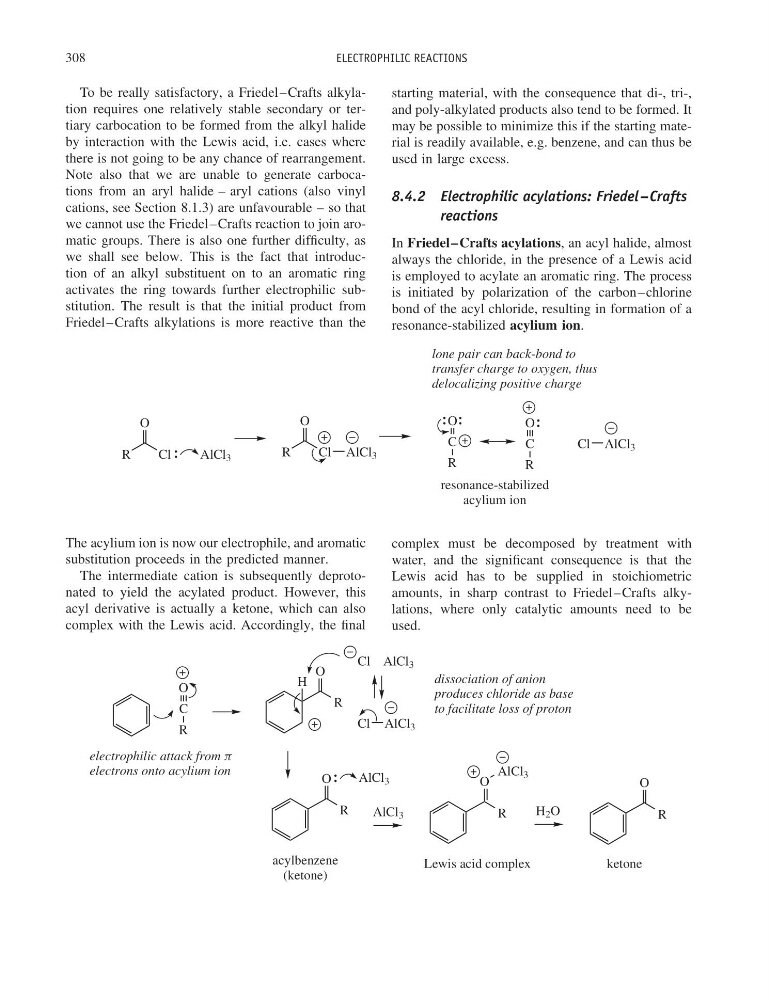
In Friedel–Crafts acylations, an acyl halide, almost
always the chloride, in the presence of a Lewis acid
is employed to acylate an aromatic ring. The process
is initiated by polarization of the carbon–chlorine
bond of the acyl chloride, resulting in formation of a
resonance-stabilized acylium ion.
O
R
Cl
AlCl 3
O
R
Cl AlCl 3
O
C
R
O
C
R
resonance-stabilized
acylium ion
Cl AlCl 3
lone pair can back-bond to
transfer charge to oxygen, thus
delocalizing positive charge
The acylium ion is now our electrophile, and aromatic
substitution proceeds in the predicted manner.
The intermediate cation is subsequently deprotonated to yield the acylated product. However, this
acyl derivative is actually a ketone, which can also
complex with the Lewis acid. Accordingly, the final
complex must be decomposed by treatment with
water, and the significant consequence is that the
Lewis acid has to be supplied in stoichiometric
amounts, in sharp contrast to Friedel–Crafts alkylations, where only catalytic amounts need to be
used.
H
Cl AlCl 3
Cl AlCl 3
electrophilic attack from p
electrons onto acylium ion
dissociation of anion
produces chloride as base
to facilitate loss of proton
acylbenzene
(ketone)
O
C
R
R
O
R
O
AlCl 3
R
O
AlCl 3
Lewis acid complex
R
O
H 2 O
AlCl 3
ketone
ELECTROPHILIC REACTIONS
To be really satisfactory, a Friedel–Crafts alkylation requires one relatively stable secondary or tertiary carbocation to be formed from the alkyl halide
by interaction with the Lewis acid, i.e. cases where
there is not going to be any chance of rearrangement.
Note also that we are unable to generate carbocations from an aryl halide – aryl cations (also vinyl
cations, see Section 8.1.3) are unfavourable – so that
we cannot use the Friedel–Crafts reaction to join aromatic groups. There is also one further difficulty, as
we shall see below. This is the fact that introduction of an alkyl substituent on to an aromatic ring
activates the ring towards further electrophilic substitution. The result is that the initial product from
Friedel–Crafts alkylations is more reactive than the
starting material, with the consequence that di-, tri-,
and poly-alkylated products also tend to be formed. It
may be possible to minimize this if the starting material is readily available, e.g. benzene, and can thus be
used in large excess.
8.4.2 Electrophilic acylations: Friedel–Crafts
reactions
In Friedel–Crafts acylations, an acyl halide, almost
always the chloride, in the presence of a Lewis acid
is employed to acylate an aromatic ring. The process
is initiated by polarization of the carbon–chlorine
bond of the acyl chloride, resulting in formation of a
resonance-stabilized acylium ion.
O
R
Cl
AlCl 3
O
R
Cl AlCl 3
O
C
R
O
C
R
resonance-stabilized
acylium ion
Cl AlCl 3
lone pair can back-bond to
transfer charge to oxygen, thus
delocalizing positive charge
The acylium ion is now our electrophile, and aromatic
substitution proceeds in the predicted manner.
The intermediate cation is subsequently deprotonated to yield the acylated product. However, this
acyl derivative is actually a ketone, which can also
complex with the Lewis acid. Accordingly, the final
complex must be decomposed by treatment with
water, and the significant consequence is that the
Lewis acid has to be supplied in stoichiometric
amounts, in sharp contrast to Friedel–Crafts alkylations, where only catalytic amounts need to be
used.
H
Cl AlCl 3
Cl AlCl 3
electrophilic attack from p
electrons onto acylium ion
dissociation of anion
produces chloride as base
to facilitate loss of proton
acylbenzene
(ketone)
O
C
R
R
O
R
O
AlCl 3
R
O
AlCl 3
Lewis acid complex
R
O
H 2 O
AlCl 3
ketone