

ELECTROPHILIC AROMATIC SUBSTITUTION
307
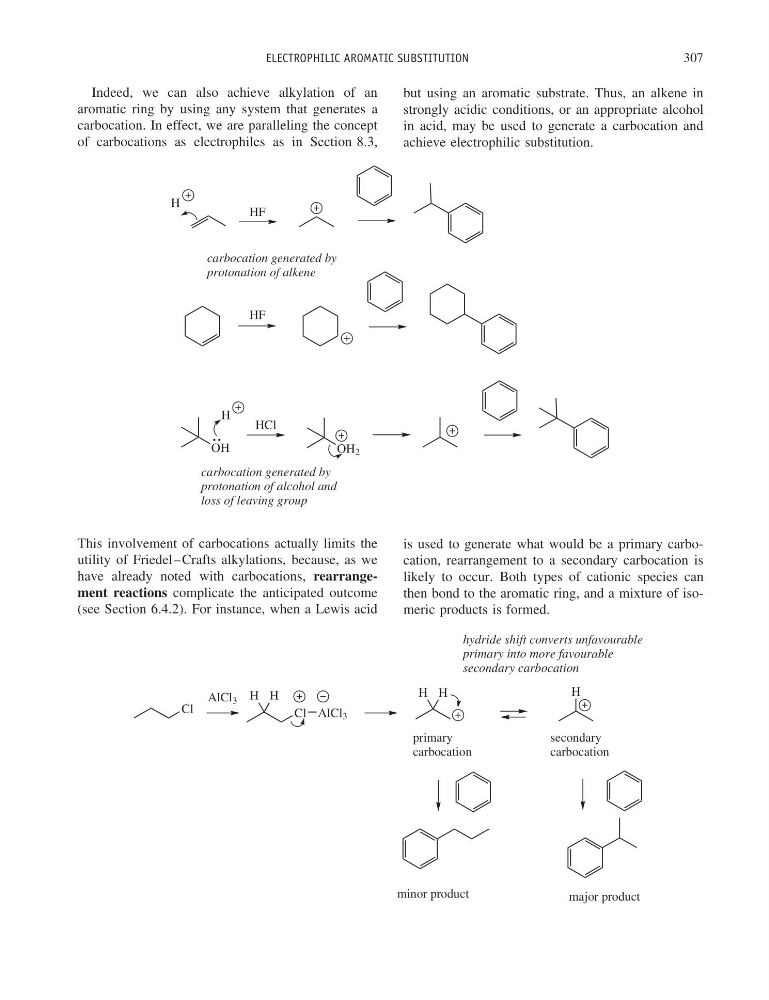
Indeed, we can also achieve alkylation of an
aromatic ring by using any system that generates a
carbocation. In effect, we are paralleling the concept
of carbocations as electrophiles as in Section 8.3,
but using an aromatic substrate. Thus, an alkene in
strongly acidic conditions, or an appropriate alcohol
in acid, may be used to generate a carbocation and
achieve electrophilic substitution.
HF
carbocation generated by
protonation of alkene
OH
HCl
carbocation generated by
protonation of alcohol and
loss of leaving group
H
OH 2
H
HF
This involvement of carbocations actually limits the
utility of Friedel–Crafts alkylations, because, as we
have already noted with carbocations, rearrangement reactions complicate the anticipated outcome
(see Section 6.4.2). For instance, when a Lewis acid
is used to generate what would be a primary carbocation, rearrangement to a secondary carbocation is
likely to occur. Both types of cationic species can
then bond to the aromatic ring, and a mixture of isomeric products is formed.
Cl
H
H
AlCl 3
Cl
AlCl 3
H
H
H
primary
carbocation
secondary
carbocation
hydride shift converts unfavourable
primary into more favourable
secondary carbocation
minor product
major product
307
Indeed, we can also achieve alkylation of an
aromatic ring by using any system that generates a
carbocation. In effect, we are paralleling the concept
of carbocations as electrophiles as in Section 8.3,
but using an aromatic substrate. Thus, an alkene in
strongly acidic conditions, or an appropriate alcohol
in acid, may be used to generate a carbocation and
achieve electrophilic substitution.
HF
carbocation generated by
protonation of alkene
OH
HCl
carbocation generated by
protonation of alcohol and
loss of leaving group
H
OH 2
H
HF
This involvement of carbocations actually limits the
utility of Friedel–Crafts alkylations, because, as we
have already noted with carbocations, rearrangement reactions complicate the anticipated outcome
(see Section 6.4.2). For instance, when a Lewis acid
is used to generate what would be a primary carbocation, rearrangement to a secondary carbocation is
likely to occur. Both types of cationic species can
then bond to the aromatic ring, and a mixture of isomeric products is formed.
Cl
H
H
AlCl 3
Cl
AlCl 3
H
H
H
primary
carbocation
secondary
carbocation
hydride shift converts unfavourable
primary into more favourable
secondary carbocation
minor product
major product