

306
ELECTROPHILIC REACTIONS
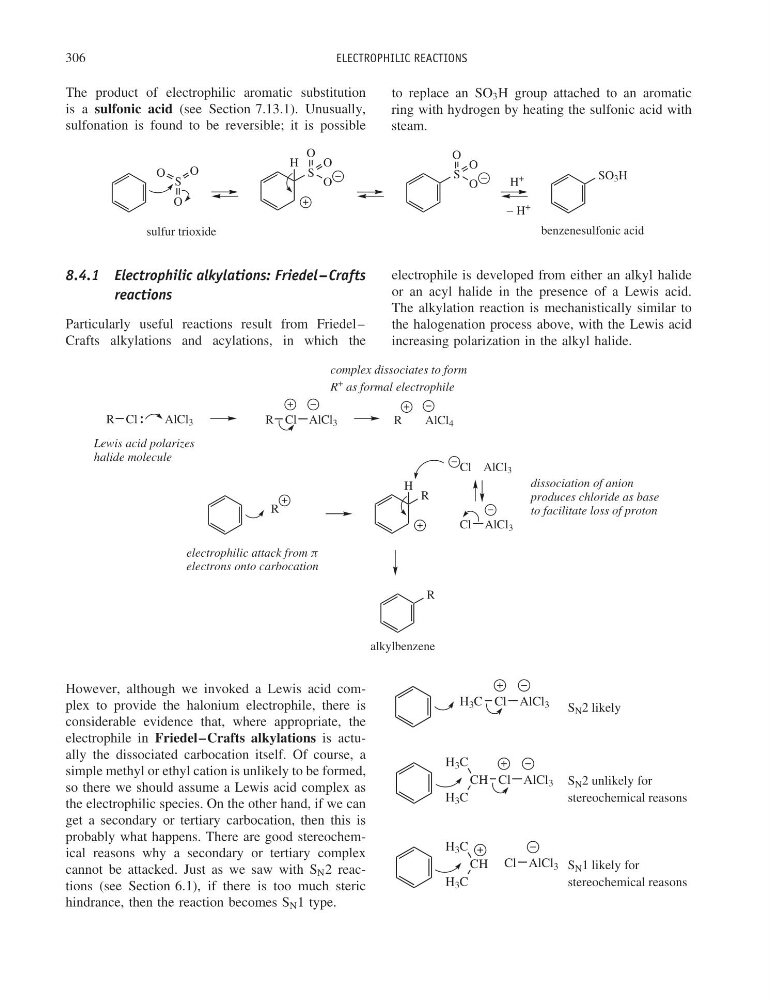
The product of electrophilic aromatic substitution
is a sulfonic acid (see Section 7.13.1). Unusually,
sulfonation is found to be reversible; it is possible
to replace an SO 3 H group attached to an aromatic
ring with hydrogen by heating the sulfonic acid with
steam.
O
S
O
O
S
H
O
O
O
S
O
O
O
SO 3 H
benzenesulfonic acid
sulfur trioxide
H
+
− H
+
8.4.1 Electrophilic alkylations: Friedel–Crafts
reactions
Particularly useful reactions result from Friedel–
Crafts alkylations and acylations, in which the
electrophile is developed from either an alkyl halide
or an acyl halide in the presence of a Lewis acid.
The alkylation reaction is mechanistically similar to
the halogenation process above, with the Lewis acid
increasing polarization in the alkyl halide.
R Cl
AlCl 3
R Cl AlCl 3
AlCl 4
R
H
Cl AlCl 3
Cl AlCl 3
R
Lewis acid polarizes
halide molecule
complex dissociates to form
R
+ as formal electrophile
electrophilic attack from p
electrons onto carbocation
dissociation of anion
produces chloride as base
to facilitate loss of proton
alkylbenzene
R
R
However, although we invoked a Lewis acid complex to provide the halonium electrophile, there is
considerable evidence that, where appropriate, the
electrophile in Friedel–Crafts alkylations is actually the dissociated carbocation itself. Of course, a
simple methyl or ethyl cation is unlikely to be formed,
so there we should assume a Lewis acid complex as
the electrophilic species. On the other hand, if we can
get a secondary or tertiary carbocation, then this is
probably what happens. There are good stereochemical reasons why a secondary or tertiary complex
cannot be attacked. Just as we saw with S N 2 reactions (see Section 6.1), if there is too much steric
hindrance, then the reaction becomes S N 1 type.
H 3 C Cl AlCl 3 S N 2 likely
CH Cl AlCl 3
H 3 C
H 3 C
S N 2 unlikely for
stereochemical reasons
CH Cl AlCl 3
H 3 C
H 3 C
S N 1 likely for
stereochemical reasons
ELECTROPHILIC REACTIONS
The product of electrophilic aromatic substitution
is a sulfonic acid (see Section 7.13.1). Unusually,
sulfonation is found to be reversible; it is possible
to replace an SO 3 H group attached to an aromatic
ring with hydrogen by heating the sulfonic acid with
steam.
O
S
O
O
S
H
O
O
O
S
O
O
O
SO 3 H
benzenesulfonic acid
sulfur trioxide
H
+
− H
+
8.4.1 Electrophilic alkylations: Friedel–Crafts
reactions
Particularly useful reactions result from Friedel–
Crafts alkylations and acylations, in which the
electrophile is developed from either an alkyl halide
or an acyl halide in the presence of a Lewis acid.
The alkylation reaction is mechanistically similar to
the halogenation process above, with the Lewis acid
increasing polarization in the alkyl halide.
R Cl
AlCl 3
R Cl AlCl 3
AlCl 4
R
H
Cl AlCl 3
Cl AlCl 3
R
Lewis acid polarizes
halide molecule
complex dissociates to form
R
+ as formal electrophile
electrophilic attack from p
electrons onto carbocation
dissociation of anion
produces chloride as base
to facilitate loss of proton
alkylbenzene
R
R
However, although we invoked a Lewis acid complex to provide the halonium electrophile, there is
considerable evidence that, where appropriate, the
electrophile in Friedel–Crafts alkylations is actually the dissociated carbocation itself. Of course, a
simple methyl or ethyl cation is unlikely to be formed,
so there we should assume a Lewis acid complex as
the electrophilic species. On the other hand, if we can
get a secondary or tertiary carbocation, then this is
probably what happens. There are good stereochemical reasons why a secondary or tertiary complex
cannot be attacked. Just as we saw with S N 2 reactions (see Section 6.1), if there is too much steric
hindrance, then the reaction becomes S N 1 type.
H 3 C Cl AlCl 3 S N 2 likely
CH Cl AlCl 3
H 3 C
H 3 C
S N 2 unlikely for
stereochemical reasons
CH Cl AlCl 3
H 3 C
H 3 C
S N 1 likely for
stereochemical reasons