

ELECTROPHILIC AROMATIC SUBSTITUTION
305
bromination generally occurs only in the presence of
a Lewis acid, which allows a greater fraction of the
positive charge to develop on the electrophilic atom.
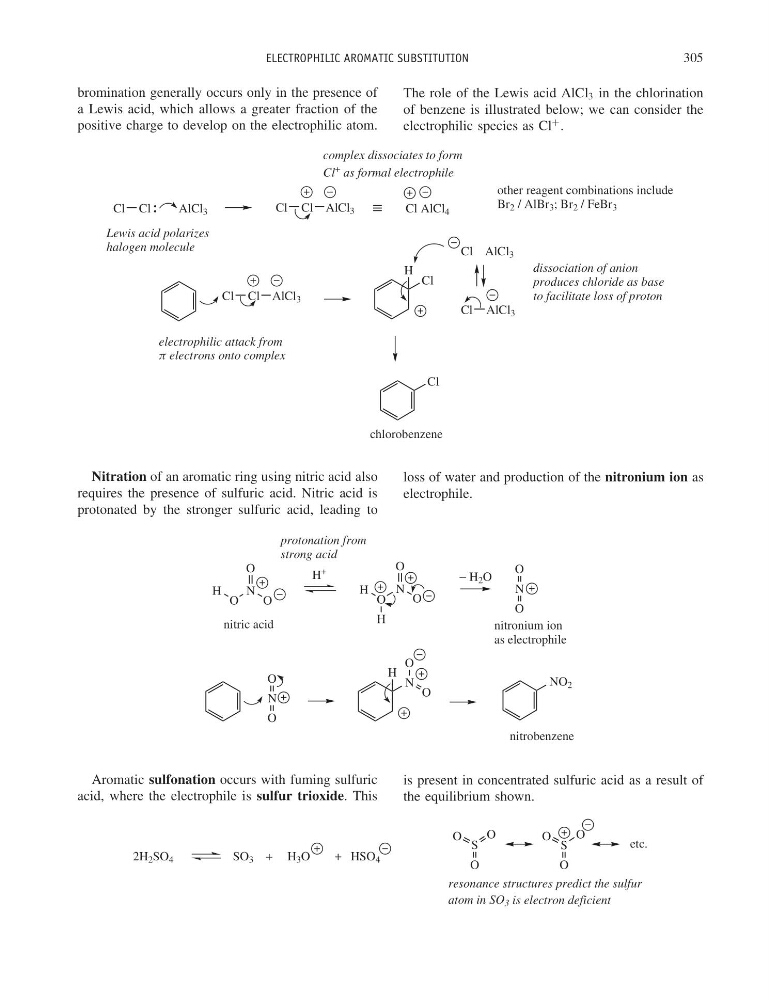
The role of the Lewis acid AlCl 3 in the chlorination
of benzene is illustrated below; we can consider the
electrophilic species as Cl
+ .
Cl Cl
AlCl 3
Cl Cl AlCl 3
Cl AlCl 4
≡
Cl Cl AlCl 3
Cl
H
Cl AlCl 3
Cl AlCl 3
Cl
Lewis acid polarizes
halogen molecule
complex dissociates to form
Cl
+ as formal electrophile
electrophilic attack from
p electrons onto complex
dissociation of anion
produces chloride as base
to facilitate loss of proton
other reagent combinations include
Br 2 / AlBr 3 ; Br 2 / FeBr 3
chlorobenzene
Nitration of an aromatic ring using nitric acid also
requires the presence of sulfuric acid. Nitric acid is
protonated by the stronger sulfuric acid, leading to
loss of water and production of the nitronium ion as
electrophile.
O
N
O
O
H
H +
protonation from
strong acid
O
N
O
O
H
H
O
N
O
− H 2 O
nitronium ion
as electrophile
O
N
O
N
H
NO 2
O
O
nitrobenzene
nitric acid
Aromatic sulfonation occurs with fuming sulfuric
acid, where the electrophile is sulfur trioxide. This
is present in concentrated sulfuric acid as a result of
the equilibrium shown.
SO 3
H 3 O
HSO 4
+
+
O
S
O
O
O
S
O
O
etc.
resonance structures predict the sulfur
atom in SO 3 is electron deficient
2H 2 SO 4
305
bromination generally occurs only in the presence of
a Lewis acid, which allows a greater fraction of the
positive charge to develop on the electrophilic atom.
The role of the Lewis acid AlCl 3 in the chlorination
of benzene is illustrated below; we can consider the
electrophilic species as Cl
+ .
Cl Cl
AlCl 3
Cl Cl AlCl 3
Cl AlCl 4
≡
Cl Cl AlCl 3
Cl
H
Cl AlCl 3
Cl AlCl 3
Cl
Lewis acid polarizes
halogen molecule
complex dissociates to form
Cl
+ as formal electrophile
electrophilic attack from
p electrons onto complex
dissociation of anion
produces chloride as base
to facilitate loss of proton
other reagent combinations include
Br 2 / AlBr 3 ; Br 2 / FeBr 3
chlorobenzene
Nitration of an aromatic ring using nitric acid also
requires the presence of sulfuric acid. Nitric acid is
protonated by the stronger sulfuric acid, leading to
loss of water and production of the nitronium ion as
electrophile.
O
N
O
O
H
H +
protonation from
strong acid
O
N
O
O
H
H
O
N
O
− H 2 O
nitronium ion
as electrophile
O
N
O
N
H
NO 2
O
O
nitrobenzene
nitric acid
Aromatic sulfonation occurs with fuming sulfuric
acid, where the electrophile is sulfur trioxide. This
is present in concentrated sulfuric acid as a result of
the equilibrium shown.
SO 3
H 3 O
HSO 4
+
+
O
S
O
O
O
S
O
O
etc.
resonance structures predict the sulfur
atom in SO 3 is electron deficient
2H 2 SO 4