

304
ELECTROPHILIC REACTIONS
Box 8.3(continued)
With squalene oxide suitably positioned and folded onto the enzyme surface, a series of electrophilic cyclizations
can be used to rationalize formation of the polycyclic structure. The cyclizations are carbocation-mediated and
proceed in a stepwise sequence. Thus, protonation of the epoxide group will allow opening of this ring and
generation of the preferred tertiary carbocation (see Box 6.12). This is suitably placed to allow electrophilic
addition to a double bond, formation of a six-membered ring and production of a new tertiary carbocation. This
process continues twice more, generating a new carbocation, until the protosteryl cation is formed. This is then
followed by a sequence of concerted Wagner–Meerwein migrations of methyls and hydrides leading to lanosterol.
It is not appropriate to discuss these migrations in this chapter, but this aspect is studied further in Box 6.12.
Note that the preferred tertiary carbocation (Markovnikov addition) is produced in all of the cyclizations, except
in one case, the third ring, which appears to be formed in an anti-Markovnikov sense. The latest studies now show
that the reaction as illustrated above is not quite correct. The third ring is first produced as a five-membered one,
reassuringly by Markovnikov addition via the predicted tertiary carbocation, and it is subsequently expanded to a
six-membered ring through a Wagner–Meerwein 1,2-alkyl shift. This should not be thought of as a complication;
simply note the formation of a biochemically important polycyclic ring system through a series of electrophilic
additions.
8.4 Electrophilic aromatic substitution
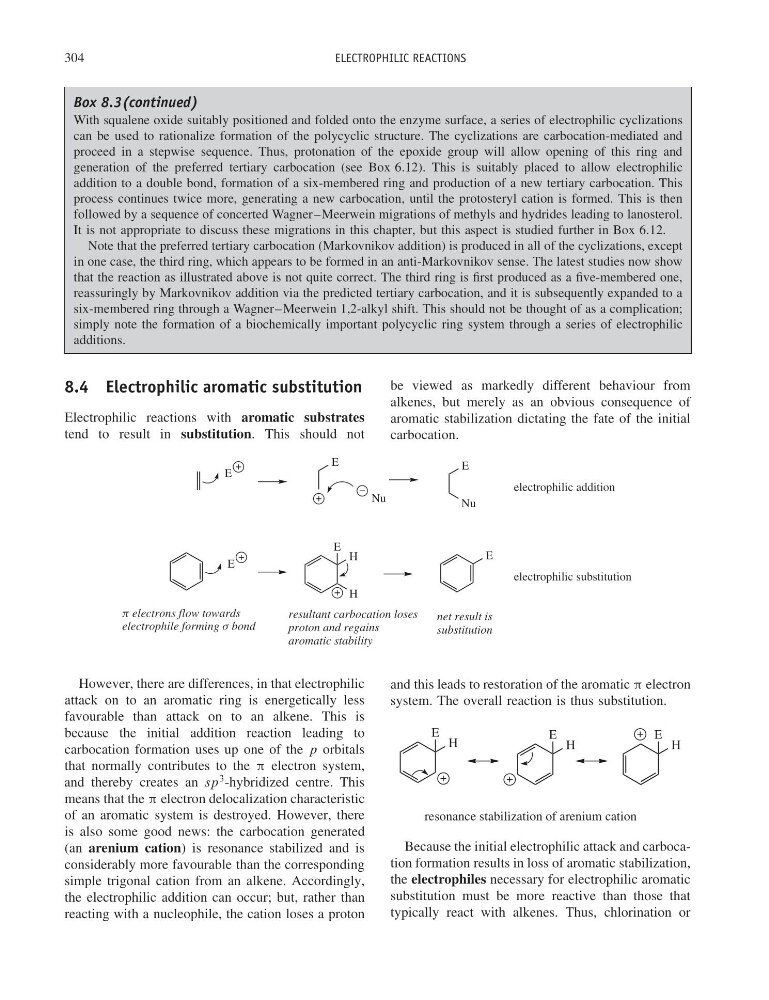
Electrophilic reactions with aromatic substrates
tend to result in substitution. This should not
be viewed as markedly different behaviour from
alkenes, but merely as an obvious consequence of
aromatic stabilization dictating the fate of the initial
carbocation.
E
H
E
H
p electrons flow towards
electrophile forming s bond
resultant carbocation loses
proton and regains
aromatic stability
E
net result is
substitution
E
E
Nu
E
Nu
electrophilic addition
electrophilic substitution
However, there are differences, in that electrophilic
attack on to an aromatic ring is energetically less
favourable than attack on to an alkene. This is
because the initial addition reaction leading to
carbocation formation uses up one of the p orbitals
that normally contributes to the π electron system,
and thereby creates an sp
3 -hybridized centre. This
means that the π electron delocalization characteristic
of an aromatic system is destroyed. However, there
is also some good news: the carbocation generated
(an arenium cation) is resonance stabilized and is
considerably more favourable than the corresponding
simple trigonal cation from an alkene. Accordingly,
the electrophilic addition can occur; but, rather than
reacting with a nucleophile, the cation loses a proton
and this leads to restoration of the aromatic π electron
system. The overall reaction is thus substitution.
H
E
H
E
H
E
resonance stabilization of arenium cation
Because the initial electrophilic attack and carbocation formation results in loss of aromatic stabilization,
the electrophiles necessary for electrophilic aromatic
substitution must be more reactive than those that
typically react with alkenes. Thus, chlorination or
ELECTROPHILIC REACTIONS
Box 8.3(continued)
With squalene oxide suitably positioned and folded onto the enzyme surface, a series of electrophilic cyclizations
can be used to rationalize formation of the polycyclic structure. The cyclizations are carbocation-mediated and
proceed in a stepwise sequence. Thus, protonation of the epoxide group will allow opening of this ring and
generation of the preferred tertiary carbocation (see Box 6.12). This is suitably placed to allow electrophilic
addition to a double bond, formation of a six-membered ring and production of a new tertiary carbocation. This
process continues twice more, generating a new carbocation, until the protosteryl cation is formed. This is then
followed by a sequence of concerted Wagner–Meerwein migrations of methyls and hydrides leading to lanosterol.
It is not appropriate to discuss these migrations in this chapter, but this aspect is studied further in Box 6.12.
Note that the preferred tertiary carbocation (Markovnikov addition) is produced in all of the cyclizations, except
in one case, the third ring, which appears to be formed in an anti-Markovnikov sense. The latest studies now show
that the reaction as illustrated above is not quite correct. The third ring is first produced as a five-membered one,
reassuringly by Markovnikov addition via the predicted tertiary carbocation, and it is subsequently expanded to a
six-membered ring through a Wagner–Meerwein 1,2-alkyl shift. This should not be thought of as a complication;
simply note the formation of a biochemically important polycyclic ring system through a series of electrophilic
additions.
8.4 Electrophilic aromatic substitution
Electrophilic reactions with aromatic substrates
tend to result in substitution. This should not
be viewed as markedly different behaviour from
alkenes, but merely as an obvious consequence of
aromatic stabilization dictating the fate of the initial
carbocation.
E
H
E
H
p electrons flow towards
electrophile forming s bond
resultant carbocation loses
proton and regains
aromatic stability
E
net result is
substitution
E
E
Nu
E
Nu
electrophilic addition
electrophilic substitution
However, there are differences, in that electrophilic
attack on to an aromatic ring is energetically less
favourable than attack on to an alkene. This is
because the initial addition reaction leading to
carbocation formation uses up one of the p orbitals
that normally contributes to the π electron system,
and thereby creates an sp
3 -hybridized centre. This
means that the π electron delocalization characteristic
of an aromatic system is destroyed. However, there
is also some good news: the carbocation generated
(an arenium cation) is resonance stabilized and is
considerably more favourable than the corresponding
simple trigonal cation from an alkene. Accordingly,
the electrophilic addition can occur; but, rather than
reacting with a nucleophile, the cation loses a proton
and this leads to restoration of the aromatic π electron
system. The overall reaction is thus substitution.
H
E
H
E
H
E
resonance stabilization of arenium cation
Because the initial electrophilic attack and carbocation formation results in loss of aromatic stabilization,
the electrophiles necessary for electrophilic aromatic
substitution must be more reactive than those that
typically react with alkenes. Thus, chlorination or