

CARBOCATIONS AS ELECTROPHILES
303
Cyclization involves the neryl cation with electrophilic attack from the double bond giving the favoured
tertiary carbocation and a favourable six-membered ring. Loss of a proton from this cation results in formation of
limonene, actually the less-substituted alkene, so this where enzyme control takes over. Alternatively, discharge
of the cation by addition of water as a nucleophile leads to α-terpineol. By a similar sequence, α-terpineol may be
transformed into cineole. This requires generation of a carbocation by protonation of the double bond; the proton
is added so that the favoured tertiary cation is formed. Cineole formation then involves nucleophilic attack from
the alcohol group with generation of a further ring system, this time a heterocyclic ring. Limonene is a major
constituent of lemon oil, α-terpineol is found in pine oil, and cineole is the principal component of eucalyptus oil.
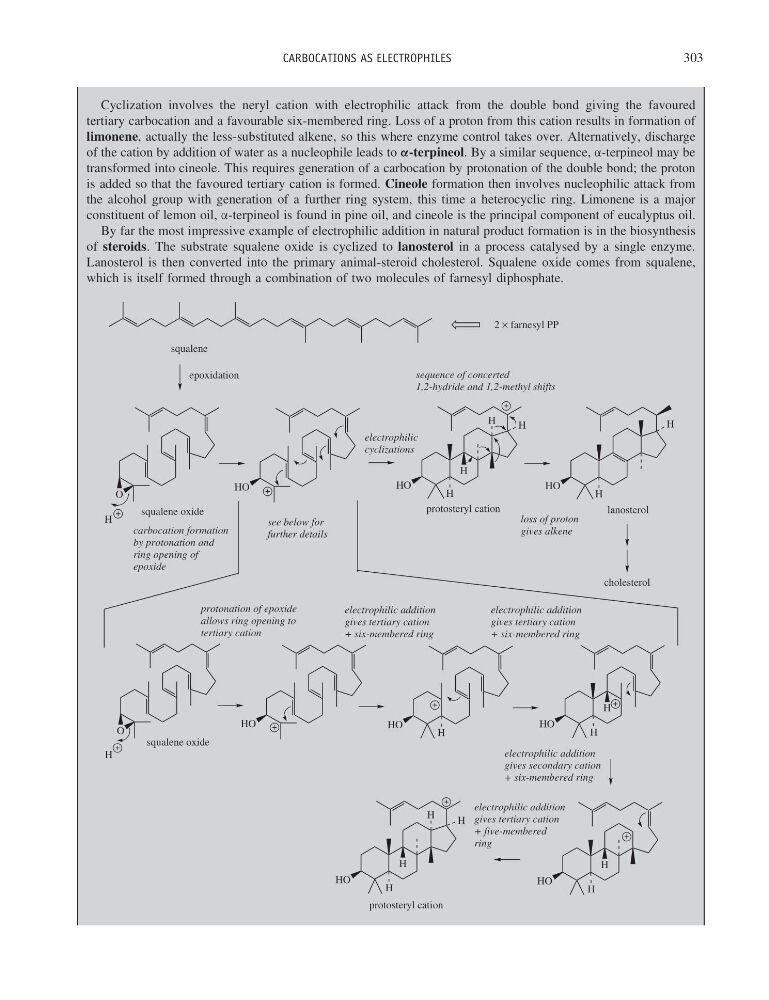
By far the most impressive example of electrophilic addition in natural product formation is in the biosynthesis
of steroids. The substrate squalene oxide is cyclized to lanosterol in a process catalysed by a single enzyme.
Lanosterol is then converted into the primary animal-steroid cholesterol. Squalene oxide comes from squalene,
which is itself formed through a combination of two molecules of farnesyl diphosphate.
O
H
H
H
H
HO
H
H
HO
squalene oxide
squalene
protosteryl cation
lanosterol
sequence of concerted
1,2-hydride and 1,2-methyl shifts
loss of proton
gives alkene
electrophilic
cyclizations
H
HO
carbocation formation
by protonation and
ring opening of
epoxide
cholesterol
O
HO
HO
HO
H
H
HO
H
H
H
HO
H
H
H
H
squalene oxide
protonation of epoxide
allows ring opening to
tertiary cation
protosteryl cation
electrophilic addition
gives tertiary cation
+ six-membered ring
electrophilic addition
gives tertiary cation
+ five-membered
ring
electrophilic addition
gives secondary cation
+ six-membered ring
electrophilic addition
gives tertiary cation
+ six-membered ring
2 × farnesyl PP
epoxidation
see below for
further details
H
303
Cyclization involves the neryl cation with electrophilic attack from the double bond giving the favoured
tertiary carbocation and a favourable six-membered ring. Loss of a proton from this cation results in formation of
limonene, actually the less-substituted alkene, so this where enzyme control takes over. Alternatively, discharge
of the cation by addition of water as a nucleophile leads to α-terpineol. By a similar sequence, α-terpineol may be
transformed into cineole. This requires generation of a carbocation by protonation of the double bond; the proton
is added so that the favoured tertiary cation is formed. Cineole formation then involves nucleophilic attack from
the alcohol group with generation of a further ring system, this time a heterocyclic ring. Limonene is a major
constituent of lemon oil, α-terpineol is found in pine oil, and cineole is the principal component of eucalyptus oil.
By far the most impressive example of electrophilic addition in natural product formation is in the biosynthesis
of steroids. The substrate squalene oxide is cyclized to lanosterol in a process catalysed by a single enzyme.
Lanosterol is then converted into the primary animal-steroid cholesterol. Squalene oxide comes from squalene,
which is itself formed through a combination of two molecules of farnesyl diphosphate.
O
H
H
H
H
HO
H
H
HO
squalene oxide
squalene
protosteryl cation
lanosterol
sequence of concerted
1,2-hydride and 1,2-methyl shifts
loss of proton
gives alkene
electrophilic
cyclizations
H
HO
carbocation formation
by protonation and
ring opening of
epoxide
cholesterol
O
HO
HO
HO
H
H
HO
H
H
H
HO
H
H
H
H
squalene oxide
protonation of epoxide
allows ring opening to
tertiary cation
protosteryl cation
electrophilic addition
gives tertiary cation
+ six-membered ring
electrophilic addition
gives tertiary cation
+ five-membered
ring
electrophilic addition
gives secondary cation
+ six-membered ring
electrophilic addition
gives tertiary cation
+ six-membered ring
2 × farnesyl PP
epoxidation
see below for
further details
H