

302
ELECTROPHILIC REACTIONS
Box 8.3(continued)
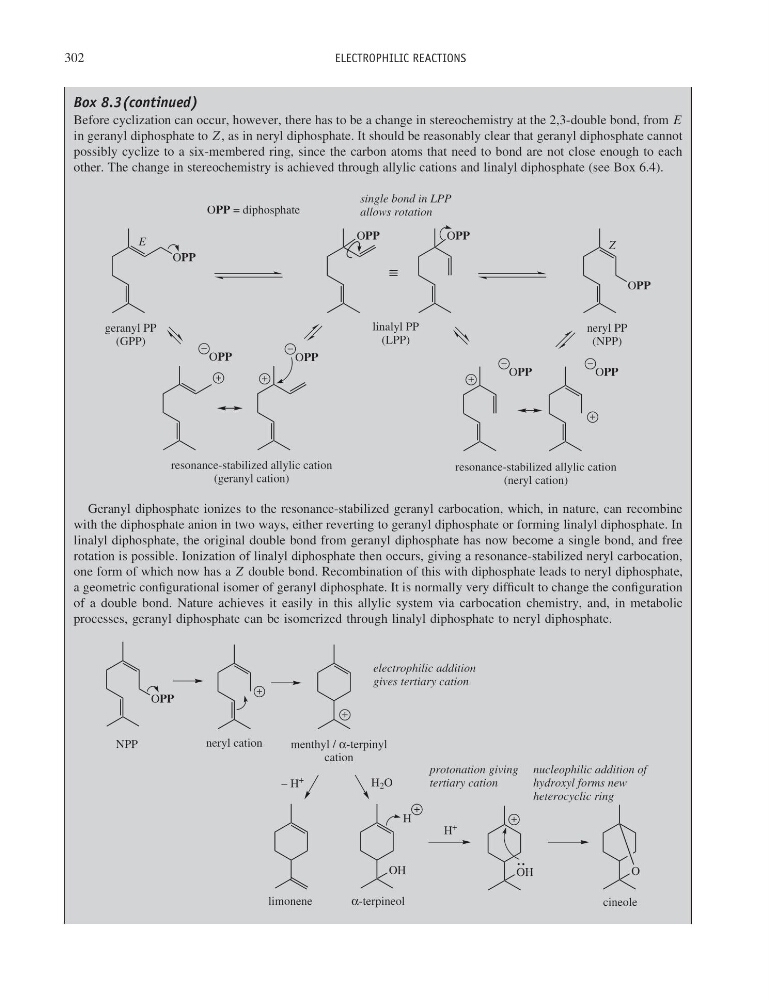
Before cyclization can occur, however, there has to be a change in stereochemistry at the 2,3-double bond, from E
in geranyl diphosphate to Z, as in neryl diphosphate. It should be reasonably clear that geranyl diphosphate cannot
possibly cyclize to a six-membered ring, since the carbon atoms that need to bond are not close enough to each
other. The change in stereochemistry is achieved through allylic cations and linalyl diphosphate (see Box 6.4).
OPP
OPP
Z
E
geranyl PP
(GPP)
neryl PP
(NPP)
resonance-stabilized allylic cation
(geranyl cation)
resonance-stabilized allylic cation
(neryl cation)
OPP
OPP
OPP
OPP
OPP = diphosphate
OPP
OPP
≡
linalyl PP
(LPP)
single bond in LPP
allows rotation
Geranyl diphosphate ionizes to the resonance-stabilized geranyl carbocation, which, in nature, can recombine
with the diphosphate anion in two ways, either reverting to geranyl diphosphate or forming linalyl diphosphate. In
linalyl diphosphate, the original double bond from geranyl diphosphate has now become a single bond, and free
rotation is possible. Ionization of linalyl diphosphate then occurs, giving a resonance-stabilized neryl carbocation,
one form of which now has a Z double bond. Recombination of this with diphosphate leads to neryl diphosphate,
a geometric configurational isomer of geranyl diphosphate. It is normally very difficult to change the configuration
of a double bond. Nature achieves it easily in this allylic system via carbocation chemistry, and, in metabolic
processes, geranyl diphosphate can be isomerized through linalyl diphosphate to neryl diphosphate.
OH
O
α-terpineol
cineole
limonene
nucleophilic addition of
hydroxyl forms new
heterocyclic ring
– H
+
OPP
neryl cation
menthyl / α-terpinyl
cation
OH
H +
H
protonation giving
tertiary cation
electrophilic addition
gives tertiary cation
H 2 O
NPP
ELECTROPHILIC REACTIONS
Box 8.3(continued)
Before cyclization can occur, however, there has to be a change in stereochemistry at the 2,3-double bond, from E
in geranyl diphosphate to Z, as in neryl diphosphate. It should be reasonably clear that geranyl diphosphate cannot
possibly cyclize to a six-membered ring, since the carbon atoms that need to bond are not close enough to each
other. The change in stereochemistry is achieved through allylic cations and linalyl diphosphate (see Box 6.4).
OPP
OPP
Z
E
geranyl PP
(GPP)
neryl PP
(NPP)
resonance-stabilized allylic cation
(geranyl cation)
resonance-stabilized allylic cation
(neryl cation)
OPP
OPP
OPP
OPP
OPP = diphosphate
OPP
OPP
≡
linalyl PP
(LPP)
single bond in LPP
allows rotation
Geranyl diphosphate ionizes to the resonance-stabilized geranyl carbocation, which, in nature, can recombine
with the diphosphate anion in two ways, either reverting to geranyl diphosphate or forming linalyl diphosphate. In
linalyl diphosphate, the original double bond from geranyl diphosphate has now become a single bond, and free
rotation is possible. Ionization of linalyl diphosphate then occurs, giving a resonance-stabilized neryl carbocation,
one form of which now has a Z double bond. Recombination of this with diphosphate leads to neryl diphosphate,
a geometric configurational isomer of geranyl diphosphate. It is normally very difficult to change the configuration
of a double bond. Nature achieves it easily in this allylic system via carbocation chemistry, and, in metabolic
processes, geranyl diphosphate can be isomerized through linalyl diphosphate to neryl diphosphate.
OH
O
α-terpineol
cineole
limonene
nucleophilic addition of
hydroxyl forms new
heterocyclic ring
– H
+
OPP
neryl cation
menthyl / α-terpinyl
cation
OH
H +
H
protonation giving
tertiary cation
electrophilic addition
gives tertiary cation
H 2 O
NPP