

CARBOCATIONS AS ELECTROPHILES
301
– H +
isopentenyl
diphosphate (IPP)
OPP
OPP
OPP
OPP
geranyl diphosphate
(GPP)
electrophilic addition
giving tertiary cation
resonance-stabilized
allylic cation
cation formation via
loss of leaving group
dimethylallyl diphosphate
DMAPP
H
monoterpenes
(C 10 )
OPP
OPP = diphosphate
O
P
O
O
P O
O
O
O
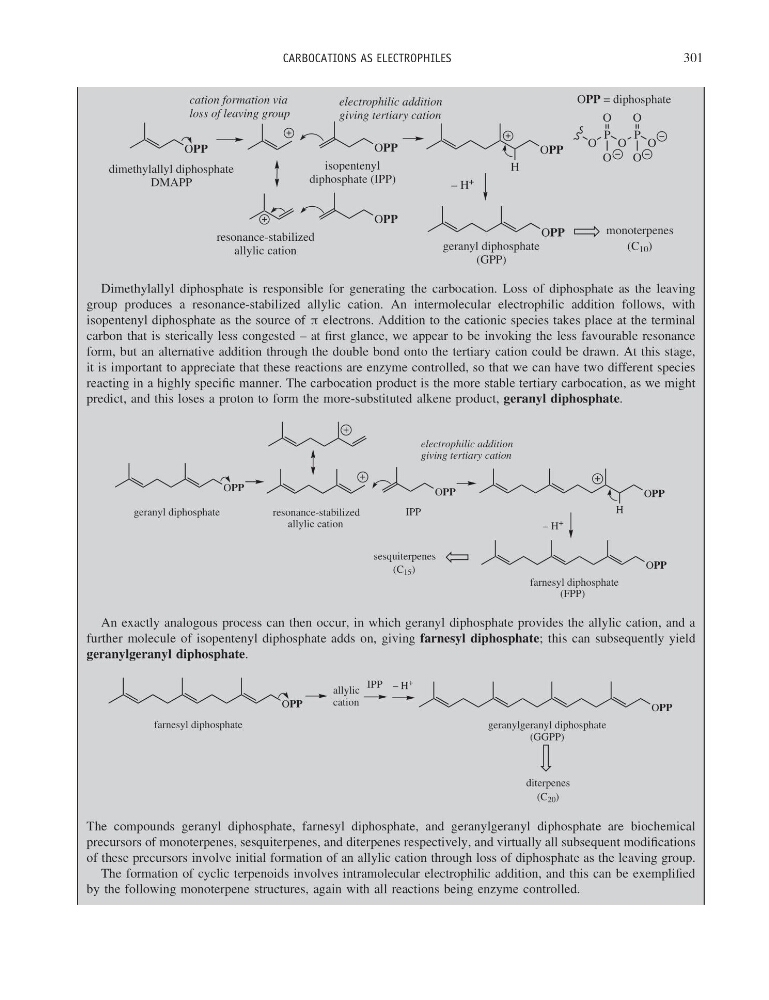
Dimethylallyl diphosphate is responsible for generating the carbocation. Loss of diphosphate as the leaving
group produces a resonance-stabilized allylic cation. An intermolecular electrophilic addition follows, with
isopentenyl diphosphate as the source of π electrons. Addition to the cationic species takes place at the terminal
carbon that is sterically less congested – at first glance, we appear to be invoking the less favourable resonance
form, but an alternative addition through the double bond onto the tertiary cation could be drawn. At this stage,
it is important to appreciate that these reactions are enzyme controlled, so that we can have two different species
reacting in a highly specific manner. The carbocation product is the more stable tertiary carbocation, as we might
predict, and this loses a proton to form the more-substituted alkene product, geranyl diphosphate.
OPP
OPP
OPP
farnesyl diphosphate
(FPP)
geranyl diphosphate
electrophilic addition
giving tertiary cation
resonance-stabilized
allylic cation
– H +
OPP
H
sesquiterpenes
(C 15 )
IPP
An exactly analogous process can then occur, in which geranyl diphosphate provides the allylic cation, and a
further molecule of isopentenyl diphosphate adds on, giving farnesyl diphosphate; this can subsequently yield
geranylgeranyl diphosphate.
OPP
OPP
farnesyl diphosphate
geranylgeranyl diphosphate
(GGPP)
allylic
cation
– H
+
diterpenes
(C 20 )
IPP
The compounds geranyl diphosphate, farnesyl diphosphate, and geranylgeranyl diphosphate are biochemical
precursors of monoterpenes, sesquiterpenes, and diterpenes respectively, and virtually all subsequent modifications
of these precursors involve initial formation of an allylic cation through loss of diphosphate as the leaving group.
The formation of cyclic terpenoids involves intramolecular electrophilic addition, and this can be exemplified
by the following monoterpene structures, again with all reactions being enzyme controlled.
301
– H +
isopentenyl
diphosphate (IPP)
OPP
OPP
OPP
OPP
geranyl diphosphate
(GPP)
electrophilic addition
giving tertiary cation
resonance-stabilized
allylic cation
cation formation via
loss of leaving group
dimethylallyl diphosphate
DMAPP
H
monoterpenes
(C 10 )
OPP
OPP = diphosphate
O
P
O
O
P O
O
O
O
Dimethylallyl diphosphate is responsible for generating the carbocation. Loss of diphosphate as the leaving
group produces a resonance-stabilized allylic cation. An intermolecular electrophilic addition follows, with
isopentenyl diphosphate as the source of π electrons. Addition to the cationic species takes place at the terminal
carbon that is sterically less congested – at first glance, we appear to be invoking the less favourable resonance
form, but an alternative addition through the double bond onto the tertiary cation could be drawn. At this stage,
it is important to appreciate that these reactions are enzyme controlled, so that we can have two different species
reacting in a highly specific manner. The carbocation product is the more stable tertiary carbocation, as we might
predict, and this loses a proton to form the more-substituted alkene product, geranyl diphosphate.
OPP
OPP
OPP
farnesyl diphosphate
(FPP)
geranyl diphosphate
electrophilic addition
giving tertiary cation
resonance-stabilized
allylic cation
– H +
OPP
H
sesquiterpenes
(C 15 )
IPP
An exactly analogous process can then occur, in which geranyl diphosphate provides the allylic cation, and a
further molecule of isopentenyl diphosphate adds on, giving farnesyl diphosphate; this can subsequently yield
geranylgeranyl diphosphate.
OPP
OPP
farnesyl diphosphate
geranylgeranyl diphosphate
(GGPP)
allylic
cation
– H
+
diterpenes
(C 20 )
IPP
The compounds geranyl diphosphate, farnesyl diphosphate, and geranylgeranyl diphosphate are biochemical
precursors of monoterpenes, sesquiterpenes, and diterpenes respectively, and virtually all subsequent modifications
of these precursors involve initial formation of an allylic cation through loss of diphosphate as the leaving group.
The formation of cyclic terpenoids involves intramolecular electrophilic addition, and this can be exemplified
by the following monoterpene structures, again with all reactions being enzyme controlled.