

300
ELECTROPHILIC REACTIONS
i.e. giving the secondary benzylic carbocation. Now
this carbocation may suffer several fates. It may
be attacked by a nucleophilic species or, more
likely, it may lose a proton to yield an alkene.
Alternatively, it may act as the electrophile for
reaction with a further styrene molecule, generating
yet another carbocation. It can be seen that this
type of process may then continue, giving polymeric
products: polystyrene. The final carbocation will
be discharged most probably by loss of a proton.
The process is termed cationic polymerization. In
practice, the process is more useful for generating
dimers and trimers than polymers, and industrial
polymers are usually produced by radical processes
(see Section 9.4.2).
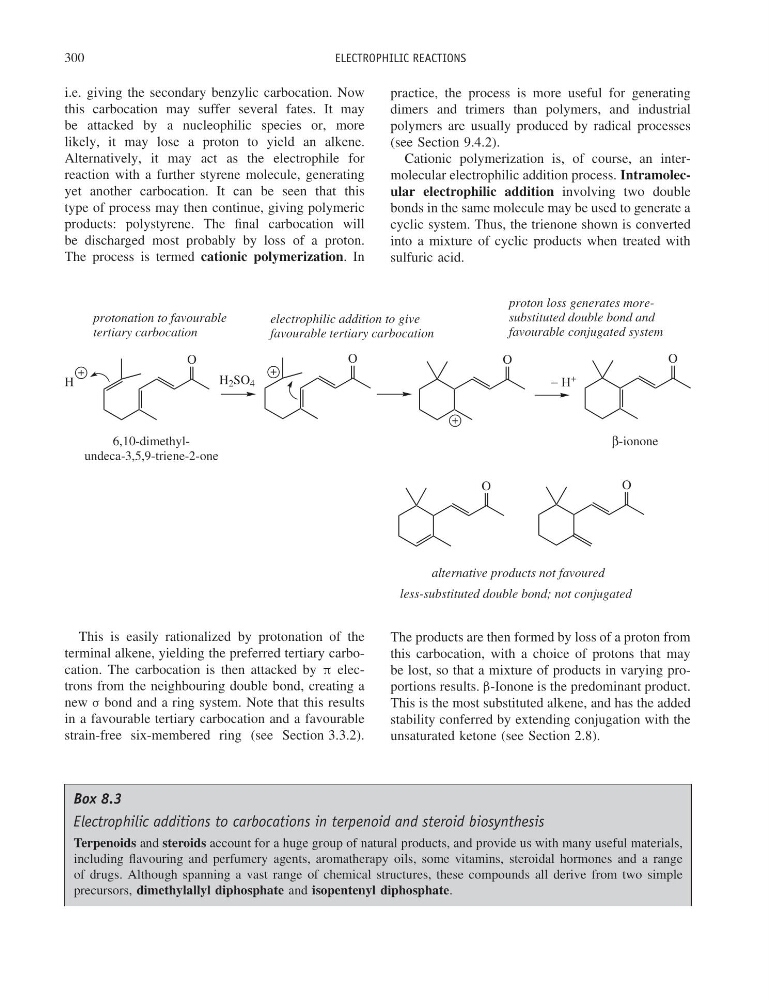
Cationic polymerization is, of course, an intermolecular electrophilic addition process. Intramolecular electrophilic addition involving two double
bonds in the same molecule may be used to generate a
cyclic system. Thus, the trienone shown is converted
into a mixture of cyclic products when treated with
sulfuric acid.
O
O
O
O
H
H 2 SO 4
− H
+
β-ionone
6,10-dimethylundeca-3,5,9-triene-2-one
protonation to favourable
tertiary carbocation
electrophilic addition to give
favourable tertiary carbocation
proton loss generates moresubstituted double bond and
favourable conjugated system
O
O
alternative products not favoured
less-substituted double bond; not conjugated
This is easily rationalized by protonation of the
terminal alkene, yielding the preferred tertiary carbocation. The carbocation is then attacked by π electrons from the neighbouring double bond, creating a
new σ bond and a ring system. Note that this results
in a favourable tertiary carbocation and a favourable
strain-free six-membered ring (see Section 3.3.2).
The products are then formed by loss of a proton from
this carbocation, with a choice of protons that may
be lost, so that a mixture of products in varying proportions results. β-Ionone is the predominant product.
This is the most substituted alkene, and has the added
stability conferred by extending conjugation with the
unsaturated ketone (see Section 2.8).
Box 8.3
Electrophilic additions to carbocations in terpenoid and steroid biosynthesis
Terpenoids and steroids account for a huge group of natural products, and provide us with many useful materials,
including flavouring and perfumery agents, aromatherapy oils, some vitamins, steroidal hormones and a range
of drugs. Although spanning a vast range of chemical structures, these compounds all derive from two simple
precursors, dimethylallyl diphosphate and isopentenyl diphosphate.
ELECTROPHILIC REACTIONS
i.e. giving the secondary benzylic carbocation. Now
this carbocation may suffer several fates. It may
be attacked by a nucleophilic species or, more
likely, it may lose a proton to yield an alkene.
Alternatively, it may act as the electrophile for
reaction with a further styrene molecule, generating
yet another carbocation. It can be seen that this
type of process may then continue, giving polymeric
products: polystyrene. The final carbocation will
be discharged most probably by loss of a proton.
The process is termed cationic polymerization. In
practice, the process is more useful for generating
dimers and trimers than polymers, and industrial
polymers are usually produced by radical processes
(see Section 9.4.2).
Cationic polymerization is, of course, an intermolecular electrophilic addition process. Intramolecular electrophilic addition involving two double
bonds in the same molecule may be used to generate a
cyclic system. Thus, the trienone shown is converted
into a mixture of cyclic products when treated with
sulfuric acid.
O
O
O
O
H
H 2 SO 4
− H
+
β-ionone
6,10-dimethylundeca-3,5,9-triene-2-one
protonation to favourable
tertiary carbocation
electrophilic addition to give
favourable tertiary carbocation
proton loss generates moresubstituted double bond and
favourable conjugated system
O
O
alternative products not favoured
less-substituted double bond; not conjugated
This is easily rationalized by protonation of the
terminal alkene, yielding the preferred tertiary carbocation. The carbocation is then attacked by π electrons from the neighbouring double bond, creating a
new σ bond and a ring system. Note that this results
in a favourable tertiary carbocation and a favourable
strain-free six-membered ring (see Section 3.3.2).
The products are then formed by loss of a proton from
this carbocation, with a choice of protons that may
be lost, so that a mixture of products in varying proportions results. β-Ionone is the predominant product.
This is the most substituted alkene, and has the added
stability conferred by extending conjugation with the
unsaturated ketone (see Section 2.8).
Box 8.3
Electrophilic additions to carbocations in terpenoid and steroid biosynthesis
Terpenoids and steroids account for a huge group of natural products, and provide us with many useful materials,
including flavouring and perfumery agents, aromatherapy oils, some vitamins, steroidal hormones and a range
of drugs. Although spanning a vast range of chemical structures, these compounds all derive from two simple
precursors, dimethylallyl diphosphate and isopentenyl diphosphate.