

CARBOCATIONS AS ELECTROPHILES
299
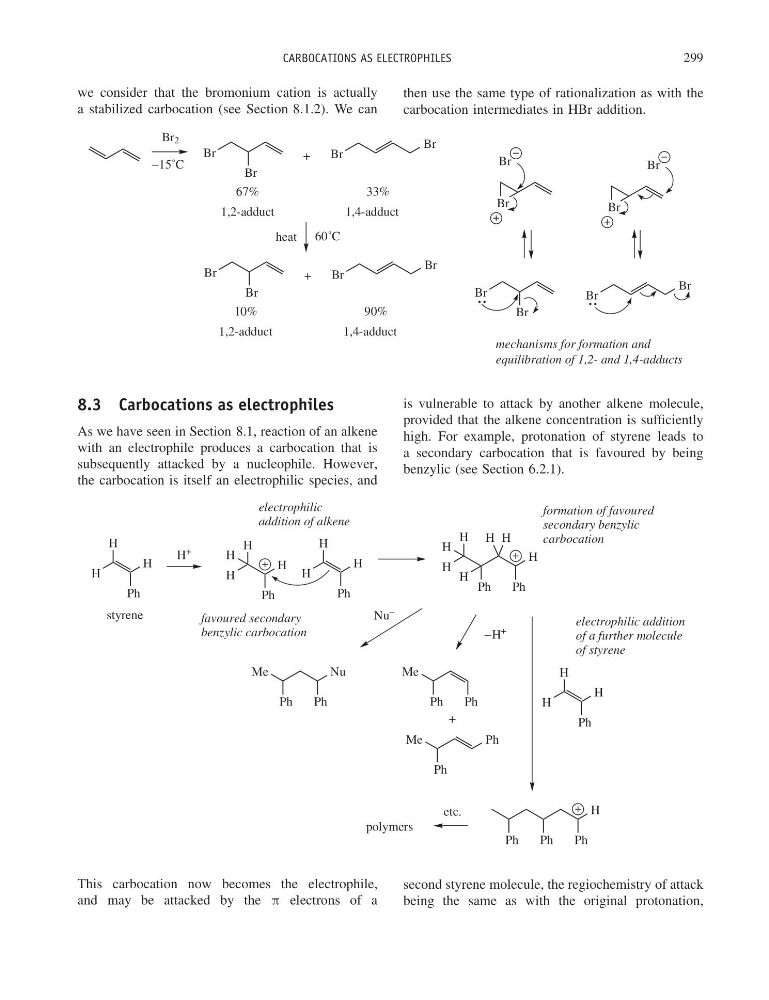
we consider that the bromonium cation is actually
a stabilized carbocation (see Section 8.1.2). We can
then use the same type of rationalization as with the
carbocation intermediates in HBr addition.
Br 2
Br
+
−15˚C
Br
heat
Br
67%
33%
1,2-adduct
1,4-adduct
10%
90%
1,2-adduct
1,4-adduct
Br
+
Br
Br
60˚C
Br
Br
Br
Br
Br
Br
Br
Br
Br
Br
mechanisms for formation and
equilibration of 1,2- and 1,4-adducts
8.3 Carbocations as electrophiles
As we have seen in Section 8.1, reaction of an alkene
with an electrophile produces a carbocation that is
subsequently attacked by a nucleophile. However,
the carbocation is itself an electrophilic species, and
is vulnerable to attack by another alkene molecule,
provided that the alkene concentration is sufficiently
high. For example, protonation of styrene leads to
a secondary carbocation that is favoured by being
benzylic (see Section 6.2.1).
H
H
H
Ph
styrene
H +
H
H
H
Ph
H
favoured secondary
benzylic carbocation
H
H
H
Ph
electrophilic
addition of alkene
H
H
H
H
H
Ph
H
Ph
formation of favoured
secondary benzylic
carbocation
Me
Nu
Ph
Ph
Me
Ph
Ph
Nu −
H
−H +
H
H
H
Ph
electrophilic addition
of a further molecule
of styrene
H
Ph
Ph
Ph
Me
Ph
Ph
+
etc.
polymers
This carbocation now becomes the electrophile,
and may be attacked by the π electrons of a
second styrene molecule, the regiochemistry of attack
being the same as with the original protonation,
299
we consider that the bromonium cation is actually
a stabilized carbocation (see Section 8.1.2). We can
then use the same type of rationalization as with the
carbocation intermediates in HBr addition.
Br 2
Br
+
−15˚C
Br
heat
Br
67%
33%
1,2-adduct
1,4-adduct
10%
90%
1,2-adduct
1,4-adduct
Br
+
Br
Br
60˚C
Br
Br
Br
Br
Br
Br
Br
Br
Br
Br
mechanisms for formation and
equilibration of 1,2- and 1,4-adducts
8.3 Carbocations as electrophiles
As we have seen in Section 8.1, reaction of an alkene
with an electrophile produces a carbocation that is
subsequently attacked by a nucleophile. However,
the carbocation is itself an electrophilic species, and
is vulnerable to attack by another alkene molecule,
provided that the alkene concentration is sufficiently
high. For example, protonation of styrene leads to
a secondary carbocation that is favoured by being
benzylic (see Section 6.2.1).
H
H
H
Ph
styrene
H +
H
H
H
Ph
H
favoured secondary
benzylic carbocation
H
H
H
Ph
electrophilic
addition of alkene
H
H
H
H
H
Ph
H
Ph
formation of favoured
secondary benzylic
carbocation
Me
Nu
Ph
Ph
Me
Ph
Ph
Nu −
H
−H +
H
H
H
Ph
electrophilic addition
of a further molecule
of styrene
H
Ph
Ph
Ph
Me
Ph
Ph
+
etc.
polymers
This carbocation now becomes the electrophile,
and may be attacked by the π electrons of a
second styrene molecule, the regiochemistry of attack
being the same as with the original protonation,