

298
ELECTROPHILIC REACTIONS
product, with the more stable one predominating.
These products are, of course, the result of addition
of just 1 mol of HX to the conjugated system. The
second double bond could also react if further HX
were available, with regiochemistry now following
the principles already established in Section 8.1.
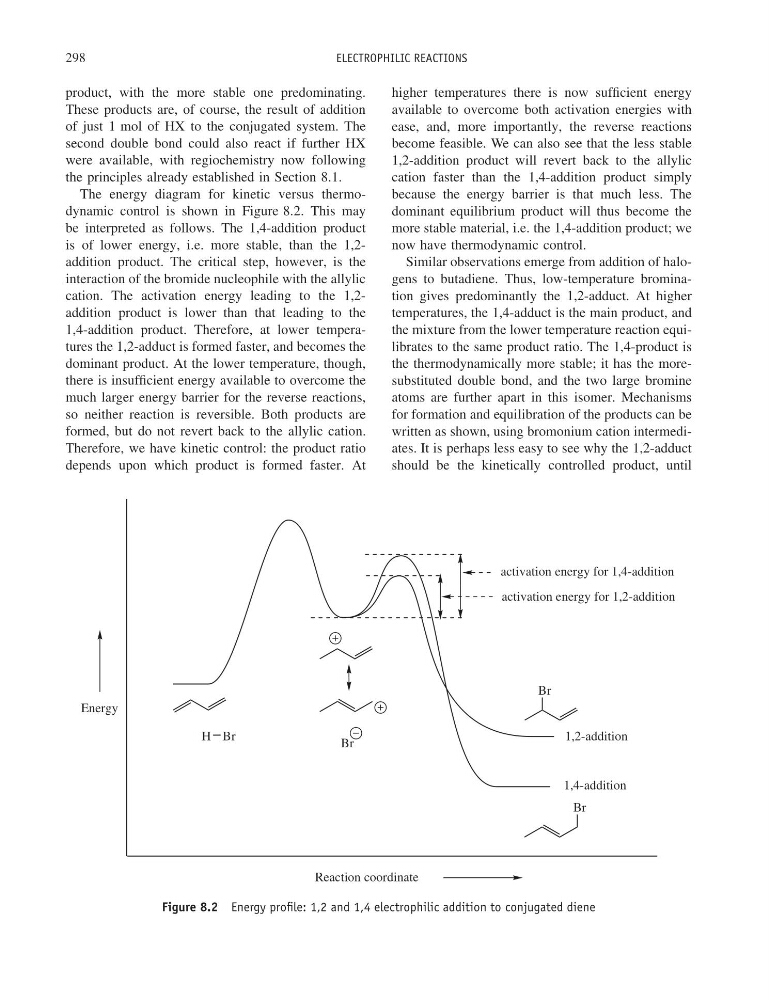
The energy diagram for kinetic versus thermodynamic control is shown in Figure 8.2. This may
be interpreted as follows. The 1,4-addition product
is of lower energy, i.e. more stable, than the 1,2addition product. The critical step, however, is the
interaction of the bromide nucleophile with the allylic
cation. The activation energy leading to the 1,2addition product is lower than that leading to the
1,4-addition product. Therefore, at lower temperatures the 1,2-adduct is formed faster, and becomes the
dominant product. At the lower temperature, though,
there is insufficient energy available to overcome the
much larger energy barrier for the reverse reactions,
so neither reaction is reversible. Both products are
formed, but do not revert back to the allylic cation.
Therefore, we have kinetic control: the product ratio
depends upon which product is formed faster. At
higher temperatures there is now sufficient energy
available to overcome both activation energies with
ease, and, more importantly, the reverse reactions
become feasible. We can also see that the less stable
1,2-addition product will revert back to the allylic
cation faster than the 1,4-addition product simply
because the energy barrier is that much less. The
dominant equilibrium product will thus become the
more stable material, i.e. the 1,4-addition product; we
now have thermodynamic control.
Similar observations emerge from addition of halogens to butadiene. Thus, low-temperature bromination gives predominantly the 1,2-adduct. At higher
temperatures, the 1,4-adduct is the main product, and
the mixture from the lower temperature reaction equilibrates to the same product ratio. The 1,4-product is
the thermodynamically more stable; it has the moresubstituted double bond, and the two large bromine
atoms are further apart in this isomer. Mechanisms
for formation and equilibration of the products can be
written as shown, using bromonium cation intermediates. It is perhaps less easy to see why the 1,2-adduct
should be the kinetically controlled product, until
Energy
Reaction coordinate
H Br
Br
Br
Br
1,2-addition
1,4-addition
activation energy for 1,2-addition
activation energy for 1,4-addition
Figure 8.2 Energy profile: 1,2 and 1,4 electrophilic addition to conjugated diene
ELECTROPHILIC REACTIONS
product, with the more stable one predominating.
These products are, of course, the result of addition
of just 1 mol of HX to the conjugated system. The
second double bond could also react if further HX
were available, with regiochemistry now following
the principles already established in Section 8.1.
The energy diagram for kinetic versus thermodynamic control is shown in Figure 8.2. This may
be interpreted as follows. The 1,4-addition product
is of lower energy, i.e. more stable, than the 1,2addition product. The critical step, however, is the
interaction of the bromide nucleophile with the allylic
cation. The activation energy leading to the 1,2addition product is lower than that leading to the
1,4-addition product. Therefore, at lower temperatures the 1,2-adduct is formed faster, and becomes the
dominant product. At the lower temperature, though,
there is insufficient energy available to overcome the
much larger energy barrier for the reverse reactions,
so neither reaction is reversible. Both products are
formed, but do not revert back to the allylic cation.
Therefore, we have kinetic control: the product ratio
depends upon which product is formed faster. At
higher temperatures there is now sufficient energy
available to overcome both activation energies with
ease, and, more importantly, the reverse reactions
become feasible. We can also see that the less stable
1,2-addition product will revert back to the allylic
cation faster than the 1,4-addition product simply
because the energy barrier is that much less. The
dominant equilibrium product will thus become the
more stable material, i.e. the 1,4-addition product; we
now have thermodynamic control.
Similar observations emerge from addition of halogens to butadiene. Thus, low-temperature bromination gives predominantly the 1,2-adduct. At higher
temperatures, the 1,4-adduct is the main product, and
the mixture from the lower temperature reaction equilibrates to the same product ratio. The 1,4-product is
the thermodynamically more stable; it has the moresubstituted double bond, and the two large bromine
atoms are further apart in this isomer. Mechanisms
for formation and equilibration of the products can be
written as shown, using bromonium cation intermediates. It is perhaps less easy to see why the 1,2-adduct
should be the kinetically controlled product, until
Energy
Reaction coordinate
H Br
Br
Br
Br
1,2-addition
1,4-addition
activation energy for 1,2-addition
activation energy for 1,4-addition
Figure 8.2 Energy profile: 1,2 and 1,4 electrophilic addition to conjugated diene