

ELECTROPHILIC ADDITION TO CONJUGATED SYSTEMS
297
At first glance, this appears to be a secondary
carbocation, but on further examination one can see
that it is also an allylic cation. Allylic carbocations
are stabilized by resonance, resulting in dispersal
of the positive charge (see Section 6.2.1). From
these two resonance forms, we can predict that both
carbons 2 and 4 will be electron deficient. Now
this has particular consequences when we consider
subsequent attack of the nucleophile X
− on to the
carbocation. There are two possible centres that
may be attacked, resulting in two different products.
The products are the result of either 1,2-addition
or 1,4-addition. The addition across the four-carbon
system as in the 1,4-adduct is termed conjugate
addition.
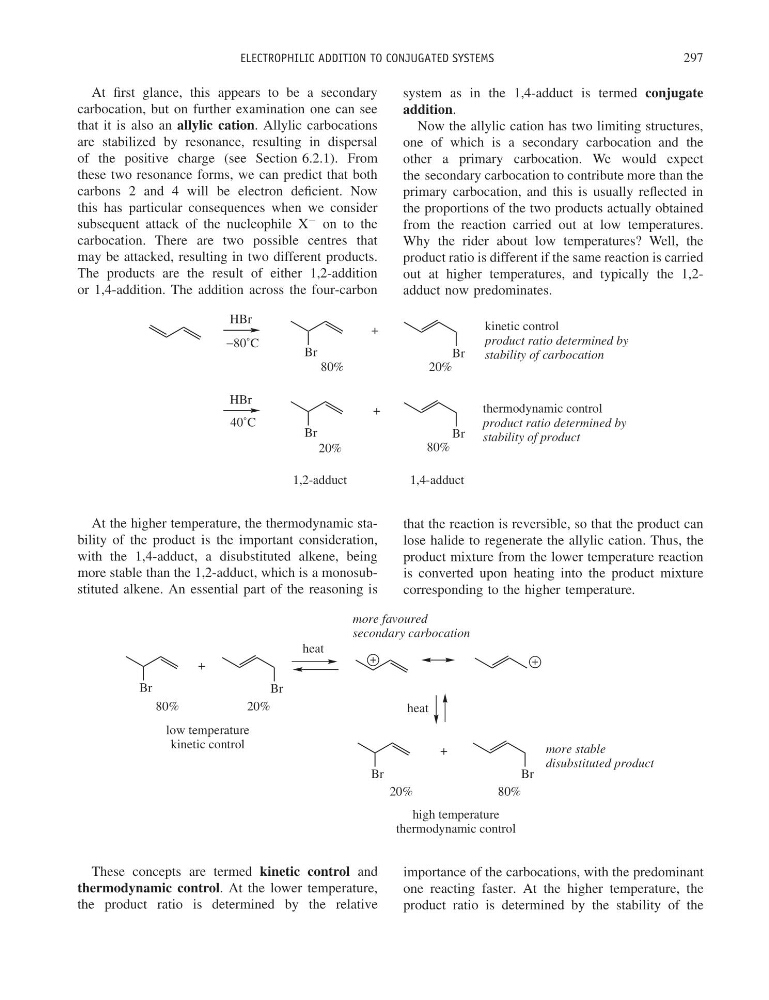
Now the allylic cation has two limiting structures,
one of which is a secondary carbocation and the
other a primary carbocation. We would expect
the secondary carbocation to contribute more than the
primary carbocation, and this is usually reflected in
the proportions of the two products actually obtained
from the reaction carried out at low temperatures.
Why the rider about low temperatures? Well, the
product ratio is different if the same reaction is carried
out at higher temperatures, and typically the 1,2adduct now predominates.
HBr
Br
Br
+
−80˚C
80%
20%
HBr
Br
Br
+
40˚C
20%
80%
kinetic control
product ratio determined by
stability of carbocation
thermodynamic control
product ratio determined by
stability of product
1,2-adduct
1,4-adduct
At the higher temperature, the thermodynamic stability of the product is the important consideration,
with the 1,4-adduct, a disubstituted alkene, being
more stable than the 1,2-adduct, which is a monosubstituted alkene. An essential part of the reasoning is
that the reaction is reversible, so that the product can
lose halide to regenerate the allylic cation. Thus, the
product mixture from the lower temperature reaction
is converted upon heating into the product mixture
corresponding to the higher temperature.
Br
Br
+
80%
20%
Br
Br
+
20%
80%
low temperature
kinetic control
high temperature
thermodynamic control
more favoured
secondary carbocation
more stable
disubstituted product
heat
heat
These concepts are termed kinetic control and
thermodynamic control. At the lower temperature,
the product ratio is determined by the relative
importance of the carbocations, with the predominant
one reacting faster. At the higher temperature, the
product ratio is determined by the stability of the
297
At first glance, this appears to be a secondary
carbocation, but on further examination one can see
that it is also an allylic cation. Allylic carbocations
are stabilized by resonance, resulting in dispersal
of the positive charge (see Section 6.2.1). From
these two resonance forms, we can predict that both
carbons 2 and 4 will be electron deficient. Now
this has particular consequences when we consider
subsequent attack of the nucleophile X
− on to the
carbocation. There are two possible centres that
may be attacked, resulting in two different products.
The products are the result of either 1,2-addition
or 1,4-addition. The addition across the four-carbon
system as in the 1,4-adduct is termed conjugate
addition.
Now the allylic cation has two limiting structures,
one of which is a secondary carbocation and the
other a primary carbocation. We would expect
the secondary carbocation to contribute more than the
primary carbocation, and this is usually reflected in
the proportions of the two products actually obtained
from the reaction carried out at low temperatures.
Why the rider about low temperatures? Well, the
product ratio is different if the same reaction is carried
out at higher temperatures, and typically the 1,2adduct now predominates.
HBr
Br
Br
+
−80˚C
80%
20%
HBr
Br
Br
+
40˚C
20%
80%
kinetic control
product ratio determined by
stability of carbocation
thermodynamic control
product ratio determined by
stability of product
1,2-adduct
1,4-adduct
At the higher temperature, the thermodynamic stability of the product is the important consideration,
with the 1,4-adduct, a disubstituted alkene, being
more stable than the 1,2-adduct, which is a monosubstituted alkene. An essential part of the reasoning is
that the reaction is reversible, so that the product can
lose halide to regenerate the allylic cation. Thus, the
product mixture from the lower temperature reaction
is converted upon heating into the product mixture
corresponding to the higher temperature.
Br
Br
+
80%
20%
Br
Br
+
20%
80%
low temperature
kinetic control
high temperature
thermodynamic control
more favoured
secondary carbocation
more stable
disubstituted product
heat
heat
These concepts are termed kinetic control and
thermodynamic control. At the lower temperature,
the product ratio is determined by the relative
importance of the carbocations, with the predominant
one reacting faster. At the higher temperature, the
product ratio is determined by the stability of the