

16
MOLECULAR REPRESENTATIONS AND NOMENCLATURE
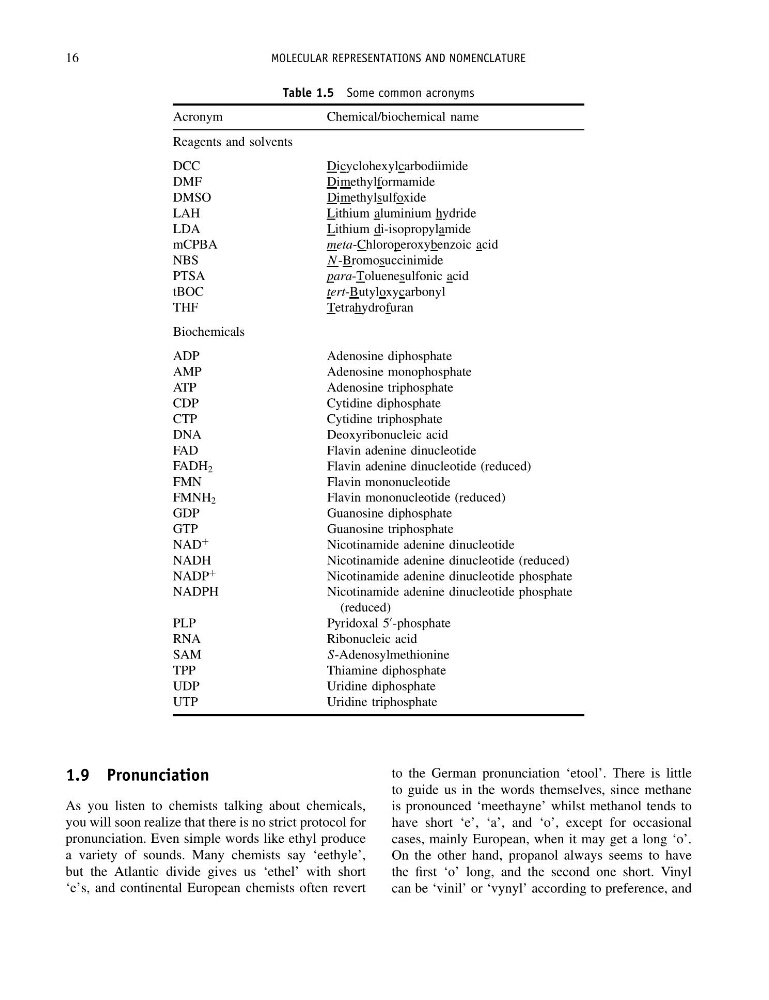
Table 1.5 Some common acronyms
Acronym
Chemical/biochemical name
Reagents and solvents
DCC
Dicyclohexylcarbodiimide
DMF
Dimethylformamide
DMSO
Dimethylsulfoxide
LAH
Lithium aluminium hydride
LDA
Lithium di-isopropylamide
mCPBA
meta-Chloroperoxybenzoic acid
NBS
N-Bromosuccinimide
PTSA
para-Toluenesulfonic acid
tBOC
tert-Butyloxycarbonyl
THF
Tetrahydrofuran
Biochemicals
ADP
Adenosine diphosphate
AMP
Adenosine monophosphate
ATP
Adenosine triphosphate
CDP
Cytidine diphosphate
CTP
Cytidine triphosphate
DNA
Deoxyribonucleic acid
FAD
Flavin adenine dinucleotide
FADH 2
Flavin adenine dinucleotide (reduced)
FMN
Flavin mononucleotide
FMNH 2
Flavin mononucleotide (reduced)
GDP
Guanosine diphosphate
GTP
Guanosine triphosphate
NAD
+
Nicotinamide adenine dinucleotide
NADH
Nicotinamide adenine dinucleotide (reduced)
NADP
+
Nicotinamide adenine dinucleotide phosphate
NADPH
Nicotinamide adenine dinucleotide phosphate
(reduced)
PLP
Pyridoxal 5
-phosphate
RNA
Ribonucleic acid
SAM
S-Adenosylmethionine
TPP
Thiamine diphosphate
UDP
Uridine diphosphate
UTP
Uridine triphosphate
1.9 Pronunciation
As you listen to chemists talking about chemicals,
you will soon realize that there is no strict protocol for
pronunciation. Even simple words like ethyl produce
a variety of sounds. Many chemists say ‘eethyle’,
but the Atlantic divide gives us ‘ethel’ with short
‘e’s, and continental European chemists often revert
to the German pronunciation ‘etool’. There is little
to guide us in the words themselves, since methane
is pronounced ‘meethayne’ whilst methanol tends to
have short ‘e’, ‘a’, and ‘o’, except for occasional
cases, mainly European, when it may get a long ‘o’.
On the other hand, propanol always seems to have
the first ‘o’ long, and the second one short. Vinyl
can be ‘vinil’ or ‘vynyl’ according to preference, and
MOLECULAR REPRESENTATIONS AND NOMENCLATURE
Table 1.5 Some common acronyms
Acronym
Chemical/biochemical name
Reagents and solvents
DCC
Dicyclohexylcarbodiimide
DMF
Dimethylformamide
DMSO
Dimethylsulfoxide
LAH
Lithium aluminium hydride
LDA
Lithium di-isopropylamide
mCPBA
meta-Chloroperoxybenzoic acid
NBS
N-Bromosuccinimide
PTSA
para-Toluenesulfonic acid
tBOC
tert-Butyloxycarbonyl
THF
Tetrahydrofuran
Biochemicals
ADP
Adenosine diphosphate
AMP
Adenosine monophosphate
ATP
Adenosine triphosphate
CDP
Cytidine diphosphate
CTP
Cytidine triphosphate
DNA
Deoxyribonucleic acid
FAD
Flavin adenine dinucleotide
FADH 2
Flavin adenine dinucleotide (reduced)
FMN
Flavin mononucleotide
FMNH 2
Flavin mononucleotide (reduced)
GDP
Guanosine diphosphate
GTP
Guanosine triphosphate
NAD
+
Nicotinamide adenine dinucleotide
NADH
Nicotinamide adenine dinucleotide (reduced)
NADP
+
Nicotinamide adenine dinucleotide phosphate
NADPH
Nicotinamide adenine dinucleotide phosphate
(reduced)
PLP
Pyridoxal 5
-phosphate
RNA
Ribonucleic acid
SAM
S-Adenosylmethionine
TPP
Thiamine diphosphate
UDP
Uridine diphosphate
UTP
Uridine triphosphate
1.9 Pronunciation
As you listen to chemists talking about chemicals,
you will soon realize that there is no strict protocol for
pronunciation. Even simple words like ethyl produce
a variety of sounds. Many chemists say ‘eethyle’,
but the Atlantic divide gives us ‘ethel’ with short
‘e’s, and continental European chemists often revert
to the German pronunciation ‘etool’. There is little
to guide us in the words themselves, since methane
is pronounced ‘meethayne’ whilst methanol tends to
have short ‘e’, ‘a’, and ‘o’, except for occasional
cases, mainly European, when it may get a long ‘o’.
On the other hand, propanol always seems to have
the first ‘o’ long, and the second one short. Vinyl
can be ‘vinil’ or ‘vynyl’ according to preference, and