

ACRONYMS
15
1.6 Common, non-systematic names
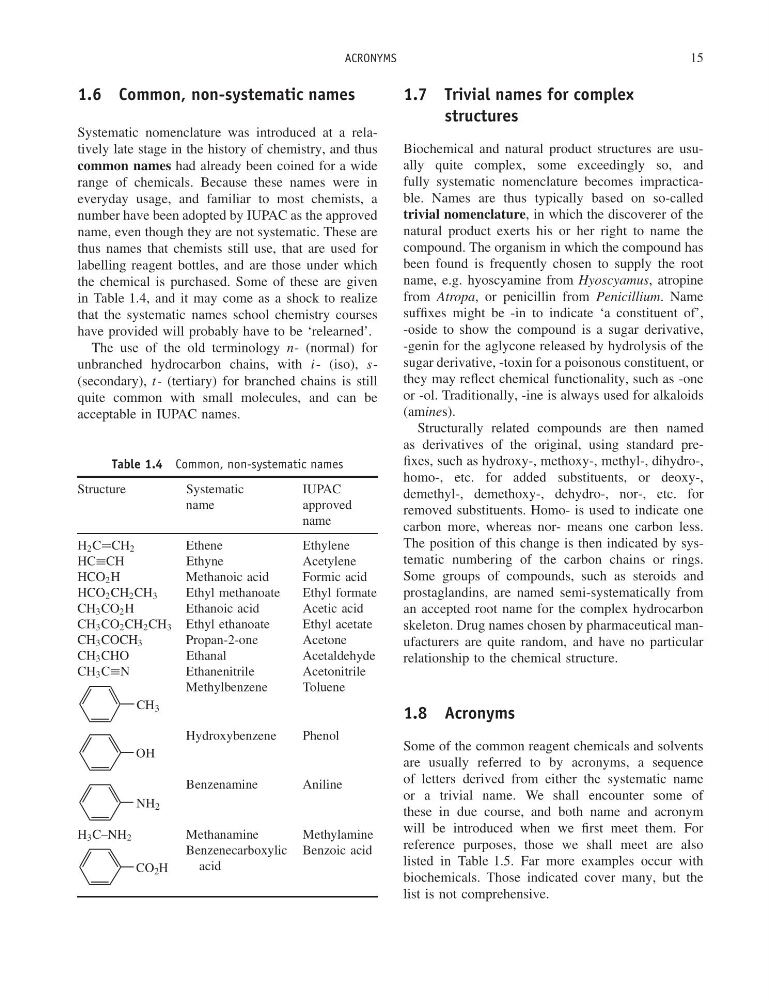
Systematic nomenclature was introduced at a relatively late stage in the history of chemistry, and thus
common names had already been coined for a wide
range of chemicals. Because these names were in
everyday usage, and familiar to most chemists, a
number have been adopted by IUPAC as the approved
name, even though they are not systematic. These are
thus names that chemists still use, that are used for
labelling reagent bottles, and are those under which
the chemical is purchased. Some of these are given
in Table 1.4, and it may come as a shock to realize
that the systematic names school chemistry courses
have provided will probably have to be ‘relearned’.
The use of the old terminology n- (normal) for
unbranched hydrocarbon chains, with i- (iso), s(secondary), t- (tertiary) for branched chains is still
quite common with small molecules, and can be
acceptable in IUPAC names.
Table 1.4 Common, non-systematic names
Structure
Systematic
name
IUPAC
approved
name
H 2 C=CH 2
Ethene
Ethylene
HC≡CH
Ethyne
Acetylene
HCO 2 H
Methanoic acid
Formic acid
HCO 2 CH 2 CH 3
Ethyl methanoate
Ethyl formate
CH 3 CO 2 H
Ethanoic acid
Acetic acid
CH 3 CO 2 CH 2 CH 3 Ethyl ethanoate
Ethyl acetate
CH 3 COCH 3
Propan-2-one
Acetone
CH 3 CHO
Ethanal
Acetaldehyde
CH 3 C≡N
Ethanenitrile
Acetonitrile
CH 3
Methylbenzene
Toluene
OH
Hydroxybenzene
Phenol
NH 2
Benzenamine
Aniline
H 3 C–NH 2
Methanamine
Methylamine
CO 2 H
Benzenecarboxylic
acid
Benzoic acid
1.7 Trivial names for complex
structures
Biochemical and natural product structures are usually quite complex, some exceedingly so, and
fully systematic nomenclature becomes impracticable. Names are thus typically based on so-called
trivial nomenclature, in which the discoverer of the
natural product exerts his or her right to name the
compound. The organism in which the compound has
been found is frequently chosen to supply the root
name, e.g. hyoscyamine from Hyoscyamus, atropine
from Atropa, or penicillin from Penicillium. Name
suffixes might be -in to indicate ‘a constituent of’,
-oside to show the compound is a sugar derivative,
-genin for the aglycone released by hydrolysis of the
sugar derivative, -toxin for a poisonous constituent, or
they may reflect chemical functionality, such as -one
or -ol. Traditionally, -ine is always used for alkaloids
(amines).
Structurally related compounds are then named
as derivatives of the original, using standard prefixes, such as hydroxy-, methoxy-, methyl-, dihydro-,
homo-, etc. for added substituents, or deoxy-,
demethyl-, demethoxy-, dehydro-, nor-, etc. for
removed substituents. Homo- is used to indicate one
carbon more, whereas nor- means one carbon less.
The position of this change is then indicated by systematic numbering of the carbon chains or rings.
Some groups of compounds, such as steroids and
prostaglandins, are named semi-systematically from
an accepted root name for the complex hydrocarbon
skeleton. Drug names chosen by pharmaceutical manufacturers are quite random, and have no particular
relationship to the chemical structure.
1.8 Acronyms
Some of the common reagent chemicals and solvents
are usually referred to by acronyms, a sequence
of letters derived from either the systematic name
or a trivial name. We shall encounter some of
these in due course, and both name and acronym
will be introduced when we first meet them. For
reference purposes, those we shall meet are also
listed in Table 1.5. Far more examples occur with
biochemicals. Those indicated cover many, but the
list is not comprehensive.
15
1.6 Common, non-systematic names
Systematic nomenclature was introduced at a relatively late stage in the history of chemistry, and thus
common names had already been coined for a wide
range of chemicals. Because these names were in
everyday usage, and familiar to most chemists, a
number have been adopted by IUPAC as the approved
name, even though they are not systematic. These are
thus names that chemists still use, that are used for
labelling reagent bottles, and are those under which
the chemical is purchased. Some of these are given
in Table 1.4, and it may come as a shock to realize
that the systematic names school chemistry courses
have provided will probably have to be ‘relearned’.
The use of the old terminology n- (normal) for
unbranched hydrocarbon chains, with i- (iso), s(secondary), t- (tertiary) for branched chains is still
quite common with small molecules, and can be
acceptable in IUPAC names.
Table 1.4 Common, non-systematic names
Structure
Systematic
name
IUPAC
approved
name
H 2 C=CH 2
Ethene
Ethylene
HC≡CH
Ethyne
Acetylene
HCO 2 H
Methanoic acid
Formic acid
HCO 2 CH 2 CH 3
Ethyl methanoate
Ethyl formate
CH 3 CO 2 H
Ethanoic acid
Acetic acid
CH 3 CO 2 CH 2 CH 3 Ethyl ethanoate
Ethyl acetate
CH 3 COCH 3
Propan-2-one
Acetone
CH 3 CHO
Ethanal
Acetaldehyde
CH 3 C≡N
Ethanenitrile
Acetonitrile
CH 3
Methylbenzene
Toluene
OH
Hydroxybenzene
Phenol
NH 2
Benzenamine
Aniline
H 3 C–NH 2
Methanamine
Methylamine
CO 2 H
Benzenecarboxylic
acid
Benzoic acid
1.7 Trivial names for complex
structures
Biochemical and natural product structures are usually quite complex, some exceedingly so, and
fully systematic nomenclature becomes impracticable. Names are thus typically based on so-called
trivial nomenclature, in which the discoverer of the
natural product exerts his or her right to name the
compound. The organism in which the compound has
been found is frequently chosen to supply the root
name, e.g. hyoscyamine from Hyoscyamus, atropine
from Atropa, or penicillin from Penicillium. Name
suffixes might be -in to indicate ‘a constituent of’,
-oside to show the compound is a sugar derivative,
-genin for the aglycone released by hydrolysis of the
sugar derivative, -toxin for a poisonous constituent, or
they may reflect chemical functionality, such as -one
or -ol. Traditionally, -ine is always used for alkaloids
(amines).
Structurally related compounds are then named
as derivatives of the original, using standard prefixes, such as hydroxy-, methoxy-, methyl-, dihydro-,
homo-, etc. for added substituents, or deoxy-,
demethyl-, demethoxy-, dehydro-, nor-, etc. for
removed substituents. Homo- is used to indicate one
carbon more, whereas nor- means one carbon less.
The position of this change is then indicated by systematic numbering of the carbon chains or rings.
Some groups of compounds, such as steroids and
prostaglandins, are named semi-systematically from
an accepted root name for the complex hydrocarbon
skeleton. Drug names chosen by pharmaceutical manufacturers are quite random, and have no particular
relationship to the chemical structure.
1.8 Acronyms
Some of the common reagent chemicals and solvents
are usually referred to by acronyms, a sequence
of letters derived from either the systematic name
or a trivial name. We shall encounter some of
these in due course, and both name and acronym
will be introduced when we first meet them. For
reference purposes, those we shall meet are also
listed in Table 1.5. Far more examples occur with
biochemicals. Those indicated cover many, but the
list is not comprehensive.