

14
MOLECULAR REPRESENTATIONS AND NOMENCLATURE
H
N
O
N
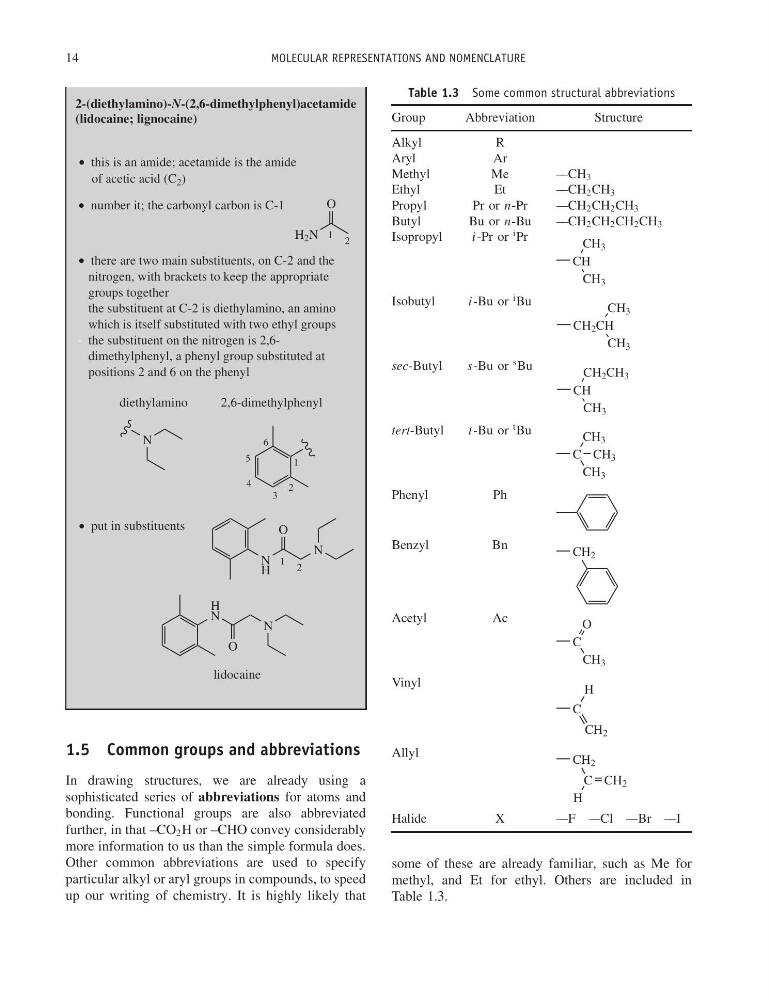
2-(diethylamino)-N-(2,6-dimethylphenyl)acetamide
(lidocaine; lignocaine)
• number it; the carbonyl carbon is C-1
• this is an amide; acetamide is the amide
of acetic acid (C 2 )
1 2
H 2 N
O
• there are two main substituents, on C-2 and the
nitrogen, with brackets to keep the appropriate
groups together
the substituent at C-2 is diethylamino, an amino
which is itself substituted with two ethyl groups
· the substituent on the nitrogen is 2,6dimethylphenyl, a phenyl group substituted at
positions 2 and 6 on the phenyl
N
diethylamino
2,6-dimethylphenyl
1
2
3
4
5
6
• put in substituents
1 2
O
N
H
N
lidocaine
1.5 Common groups and abbreviations
In drawing structures, we are already using a
sophisticated series of abbreviations for atoms and
bonding. Functional groups are also abbreviated
further, in that –CO 2 H or –CHO convey considerably
more information to us than the simple formula does.
Other common abbreviations are used to specify
particular alkyl or aryl groups in compounds, to speed
up our writing of chemistry. It is highly likely that
Table 1.3 Some common structural abbreviations
Group
Abbreviation
Structure
Alkyl
R
Aryl
Ar
Methyl
Me
––CH 3
Ethyl
Et
––CH 2 CH 3
Propyl
Pr or n-Pr
––CH 2 CH 2 CH 3
Butyl
Bu or n-Bu
––CH 2 CH 2 CH 2 CH 3
Isopropyl
i-Pr or
i Pr
CH
CH 3
CH 3
Isobutyl
i-Bu or
i Bu
CH 2 CH
CH 3
CH 3
sec-Butyl
s-Bu or
s Bu
CH
CH 3
CH 2 CH 3
tert-Butyl
t-Bu or
t Bu
C
CH 3
CH 3
CH 3
Phenyl
Ph
Benzyl
Bn
CH 2
Acetyl
Ac
C
CH 3
O
Vinyl
C
CH 2
H
Allyl
CH 2
C CH 2
H
Halide
X
––F ––Cl ––Br ––I
some of these are already familiar, such as Me for
methyl, and Et for ethyl. Others are included in
Table 1.3.
MOLECULAR REPRESENTATIONS AND NOMENCLATURE
H
N
O
N
2-(diethylamino)-N-(2,6-dimethylphenyl)acetamide
(lidocaine; lignocaine)
• number it; the carbonyl carbon is C-1
• this is an amide; acetamide is the amide
of acetic acid (C 2 )
1 2
H 2 N
O
• there are two main substituents, on C-2 and the
nitrogen, with brackets to keep the appropriate
groups together
the substituent at C-2 is diethylamino, an amino
which is itself substituted with two ethyl groups
· the substituent on the nitrogen is 2,6dimethylphenyl, a phenyl group substituted at
positions 2 and 6 on the phenyl
N
diethylamino
2,6-dimethylphenyl
1
2
3
4
5
6
• put in substituents
1 2
O
N
H
N
lidocaine
1.5 Common groups and abbreviations
In drawing structures, we are already using a
sophisticated series of abbreviations for atoms and
bonding. Functional groups are also abbreviated
further, in that –CO 2 H or –CHO convey considerably
more information to us than the simple formula does.
Other common abbreviations are used to specify
particular alkyl or aryl groups in compounds, to speed
up our writing of chemistry. It is highly likely that
Table 1.3 Some common structural abbreviations
Group
Abbreviation
Structure
Alkyl
R
Aryl
Ar
Methyl
Me
––CH 3
Ethyl
Et
––CH 2 CH 3
Propyl
Pr or n-Pr
––CH 2 CH 2 CH 3
Butyl
Bu or n-Bu
––CH 2 CH 2 CH 2 CH 3
Isopropyl
i-Pr or
i Pr
CH
CH 3
CH 3
Isobutyl
i-Bu or
i Bu
CH 2 CH
CH 3
CH 3
sec-Butyl
s-Bu or
s Bu
CH
CH 3
CH 2 CH 3
tert-Butyl
t-Bu or
t Bu
C
CH 3
CH 3
CH 3
Phenyl
Ph
Benzyl
Bn
CH 2
Acetyl
Ac
C
CH 3
O
Vinyl
C
CH 2
H
Allyl
CH 2
C CH 2
H
Halide
X
––F ––Cl ––Br ––I
some of these are already familiar, such as Me for
methyl, and Et for ethyl. Others are included in
Table 1.3.