

290
ELECTROPHILIC REACTIONS
In the synthesis of cyclohexene oxide from cyclohexene shown, this does implicate the less favourable
diaxial conformer in the epoxide-forming step. Cyclohexene oxide contains a cis-fused ring system, the
only arrangement possible, since the three-membered
ring is necessarily planar (see Section 3.5.2).
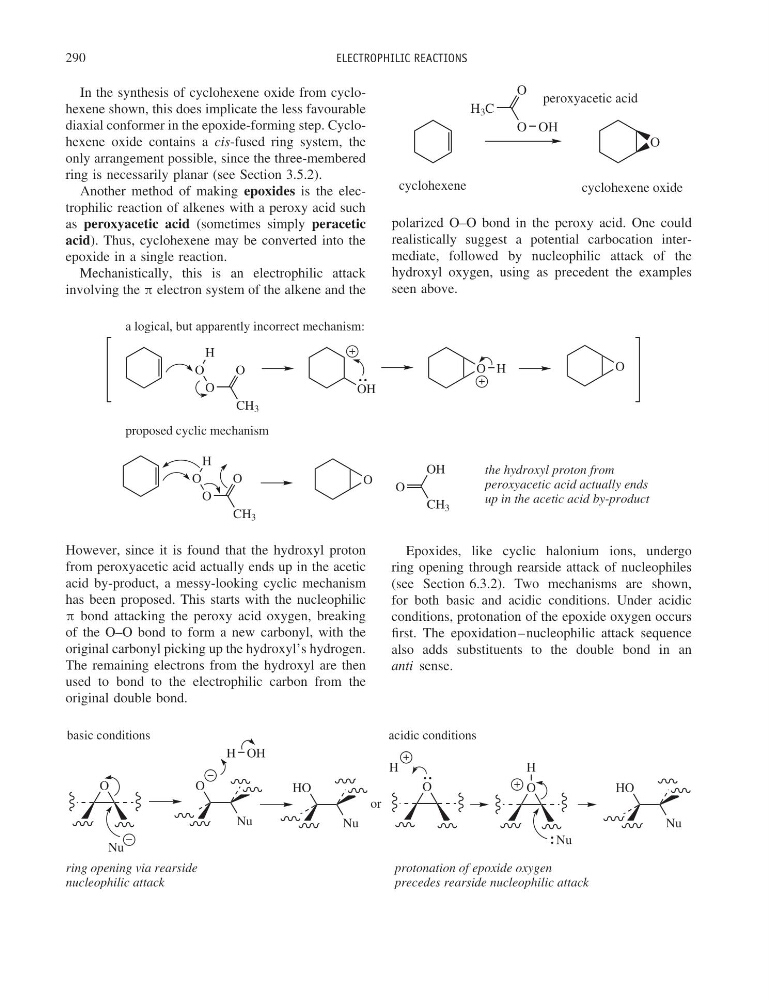
Another method of making epoxides is the electrophilic reaction of alkenes with a peroxy acid such
as peroxyacetic acid (sometimes simply peracetic
acid). Thus, cyclohexene may be converted into the
epoxide in a single reaction.
Mechanistically, this is an electrophilic attack
involving the π electron system of the alkene and the
cyclohexene
H 3 C
O
O
OH
peroxyacetic acid
O
cyclohexene oxide
polarized O–O bond in the peroxy acid. One could
realistically suggest a potential carbocation intermediate, followed by nucleophilic attack of the
hydroxyl oxygen, using as precedent the examples
seen above.
CH 3
O
O
O
H
O
O
CH 3
OH
CH 3
O
O
O
H
OH
O
O
a logical, but apparently incorrect mechanism:
proposed cyclic mechanism
the hydroxyl proton from
peroxyacetic acid actually ends
up in the acetic acid by-product
H
However, since it is found that the hydroxyl proton
from peroxyacetic acid actually ends up in the acetic
acid by-product, a messy-looking cyclic mechanism
has been proposed. This starts with the nucleophilic
π bond attacking the peroxy acid oxygen, breaking
of the O–O bond to form a new carbonyl, with the
original carbonyl picking up the hydroxyl’s hydrogen.
The remaining electrons from the hydroxyl are then
used to bond to the electrophilic carbon from the
original double bond.
Epoxides, like cyclic halonium ions, undergo
ring opening through rearside attack of nucleophiles
(see Section 6.3.2). Two mechanisms are shown,
for both basic and acidic conditions. Under acidic
conditions, protonation of the epoxide oxygen occurs
first. The epoxidation–nucleophilic attack sequence
also adds substituents to the double bond in an
anti sense.
O
Nu
O
Nu
or
O
Nu
HO
Nu
H
ring opening via rearside
nucleophilic attack
protonation of epoxide oxygen
precedes rearside nucleophilic attack
basic conditions
acidic conditions
O
H
HO
Nu
H OH
ELECTROPHILIC REACTIONS
In the synthesis of cyclohexene oxide from cyclohexene shown, this does implicate the less favourable
diaxial conformer in the epoxide-forming step. Cyclohexene oxide contains a cis-fused ring system, the
only arrangement possible, since the three-membered
ring is necessarily planar (see Section 3.5.2).
Another method of making epoxides is the electrophilic reaction of alkenes with a peroxy acid such
as peroxyacetic acid (sometimes simply peracetic
acid). Thus, cyclohexene may be converted into the
epoxide in a single reaction.
Mechanistically, this is an electrophilic attack
involving the π electron system of the alkene and the
cyclohexene
H 3 C
O
O
OH
peroxyacetic acid
O
cyclohexene oxide
polarized O–O bond in the peroxy acid. One could
realistically suggest a potential carbocation intermediate, followed by nucleophilic attack of the
hydroxyl oxygen, using as precedent the examples
seen above.
CH 3
O
O
O
H
O
O
CH 3
OH
CH 3
O
O
O
H
OH
O
O
a logical, but apparently incorrect mechanism:
proposed cyclic mechanism
the hydroxyl proton from
peroxyacetic acid actually ends
up in the acetic acid by-product
H
However, since it is found that the hydroxyl proton
from peroxyacetic acid actually ends up in the acetic
acid by-product, a messy-looking cyclic mechanism
has been proposed. This starts with the nucleophilic
π bond attacking the peroxy acid oxygen, breaking
of the O–O bond to form a new carbonyl, with the
original carbonyl picking up the hydroxyl’s hydrogen.
The remaining electrons from the hydroxyl are then
used to bond to the electrophilic carbon from the
original double bond.
Epoxides, like cyclic halonium ions, undergo
ring opening through rearside attack of nucleophiles
(see Section 6.3.2). Two mechanisms are shown,
for both basic and acidic conditions. Under acidic
conditions, protonation of the epoxide oxygen occurs
first. The epoxidation–nucleophilic attack sequence
also adds substituents to the double bond in an
anti sense.
O
Nu
O
Nu
or
O
Nu
HO
Nu
H
ring opening via rearside
nucleophilic attack
protonation of epoxide oxygen
precedes rearside nucleophilic attack
basic conditions
acidic conditions
O
H
HO
Nu
H OH